
There are moments in history when the official map of reality no longer matches the sky.
For centuries, the geocentric universe survived not because it best explained the evidence, but because authority, habit, doctrine, and institutional power had organized themselves around it. The old model had defenders. It had textbooks. It had gatekeepers. It had social consequences for those who challenged it. But the planets still moved the way they moved. The telescope did not ask permission from the institutions of the day.
That is where we are now with wireless radiation.
The current safety paradigm says radiofrequency radiation is safe so long as it does not heat tissue beyond a short-term thermal threshold. It is the Ptolemaic model of wireless safety: elaborate, entrenched, legally enforced, and increasingly unable to explain the biological observations accumulating around it.
The science is pointing in one direction. The regulatory bodies are pointing in another.
RF Safe’s position is simple: truth does not come from governments, captured committees, industry roadmaps, or de facto standards. Truth comes from biological reality. And biological reality is telling us that the thermal-only model is incomplete.
The thermal-only model is the geocentric universe of wireless safety
The status quo says that the only substantiated adverse effect of radiofrequency electromagnetic fields is heating. ICNIRP states that “the only substantiated effect” relevant to human health and safety from RF exposure is heating of exposed tissue, and that exposure below the thermal threshold is unlikely to be associated with adverse health effects.
That sentence is the center of the old universe.
Everything else is forced to orbit around it. Oxidative stress? Not substantiated enough. DNA damage? Not consistent enough. Gene-expression changes? Not clearly adverse enough. Neurological effects? Not proven enough. Reproductive effects? Not decisive enough. Low-intensity effects? Too complicated. Chronic exposures? Too heterogeneous. Modulation effects? Too hard to standardize. Children? Too little certainty. Pregnancy? More research needed.
This is how a paradigm protects itself. It does not need to disprove every finding. It only needs to control what counts as “established.”
ICNIRP’s 2020 guidelines explicitly define their own evidentiary gate: reported RF health effects generally need to be independently verified, sufficiently high-quality, and consistent with current scientific understanding before ICNIRP treats them as “evidence” for exposure restrictions. That sounds reasonable until one sees the circularity. If “current scientific understanding” is already filtered through the thermal-only framework, then non-thermal evidence is forced to prove itself inside a courtroom whose judge is the old model.
This is not neutral science. It is paradigm defense.
And it is not conspiracy thinking to say so. It is institutional analysis.
A review by Nordhagen and Flydal examined the authorship network behind ICNIRP 2020 and concluded that ICNIRP’s supporting literature came from a small co-author network, with just 17 researchers at its core, many affiliated with ICNIRP and/or IEEE; the authors argued that ICNIRP’s “thermal-only” view contrasts with the majority of research findings and is not suited as a basis for good governance.
Whether one accepts every criticism of ICNIRP or not, the deeper problem remains: the body that authored and defends the thermal framework also functions as a gatekeeper over the evidence that would require abandoning it.
That is not how public health should work.
The evidence is not a collection of anomalies. It is a convergence.
Dr. Henry Lai’s compilations are so important because they take the discussion out of the realm of isolated studies and put it where it belongs: the pattern of the literature.
The pattern is not subtle.
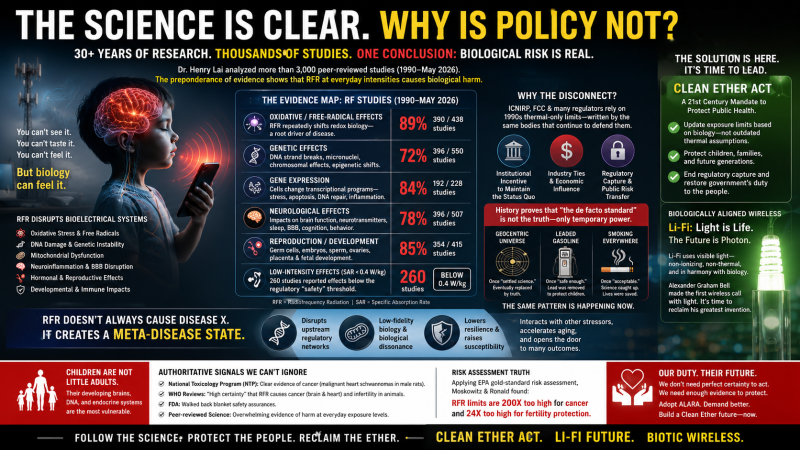
In Lai’s RFR oxidative-effects file, 390 of 438 studies — 89% — reported significant oxidative or free-radical effects from radiofrequency radiation. Lai’s summary states that change in cellular free-radical status is a consistent effect of RFR; 110 of 114 low-intensity oxidative studies found effects.
In Lai’s RFR genetic-effects file, 396 of 550 studies — 72% — reported genetic effects, while the gene-expression subset showed 192 of 228 studies — 84% — reporting effects.
In Lai’s RFR neurological file, 396 of 507 studies — 78% — reported neurological effects.
In Lai’s RFR reproduction and development file, 354 of 415 studies — 85% — reported effects. That file also identifies 73 low-SAR reproduction/development effect studies below 0.4 W/kg, with a mean SAR of 0.069 W/kg and a median of 0.027 W/kg.
And the low-intensity RFR file is the direct blow to the thermal paradigm. Lai identifies 260 studies reporting biological effects below SAR 0.4 W/kg, most of them in vivo, most of them chronic or repeated exposure. He reports a mean SAR of 0.072 W/kg and median of 0.028 W/kg for those 260 studies, and explicitly states that current RFR exposure guidelines are not valid for protecting against health-detrimental effects of RFR.
That should be the end of the old debate.
Not the end of research. Not the end of uncertainty. Not the end of refinement. But the end of pretending that “below thermal limits” means biologically inert.
The ELF and static-field literature points in the same direction. Lai’s static/ELF oxidative file reports 319 of 353 studies — 90% — finding oxidative effects. His static/ELF genetic file reports 363 of 434 studies — 84% — finding genetic effects, and 232 of 252 gene-expression studies — 92% — finding effects. His static/ELF neurological file reports 364 of 397 studies — 92% — finding neurological effects. His static/ELF reproduction file reports 82 of 105 studies — 78% — finding effects. And his low-flux-density static/ELF file lists effects below 0.01 mT / 10 μT across genetic, oxidative, neurological, physiological, cellular, human, in vivo, and in vitro categories.
This is the convergence map:
RF and ELF are not producing one isolated signal. They are repeatedly touching the same biological control systems: redox balance, DNA integrity, gene expression, calcium signaling, mitochondrial function, neural excitability, endocrine rhythm, reproductive function, development, and cellular repair.
That is not random noise.
That is biology responding.
Why RF may never map cleanly to “Disease X”
The central mistake in the public debate is the assumption that a harmful exposure must map neatly to one disease.
Critics want a simple equation:
RF exposure → Disease X
But that is not how upstream biological stressors work.
Sleep disruption does not cause only “sleep disease.” Air pollution does not cause only one diagnosis. Lead did not harm children through one tidy endpoint. Endocrine disruptors do not politely confine themselves to one organ system. Chronic stress does not appear as one clean pathology. These exposures shift the biological terrain. They degrade regulatory systems. They lower resilience. They make many downstream disorders more likely, more severe, or harder to recover from.
Wireless radiation belongs in that category.
The correct model is not:
RFR → one disease
The correct model is:
RFR / ELF / IF exposure → upstream regulatory disturbance → reduced biological fidelity → increased susceptibility → disease expression shaped by genetics, age, sex, pregnancy, sleep, nutrition, stress, chemical exposures, infection, and baseline vulnerability
That is why the evidence appears across so many domains. Oxidative stress is not “about” one disease. DNA repair is not “about” one disease. Mitochondrial dysfunction is not “about” one disease. Calcium signaling is not “about” one disease. Circadian disruption is not “about” one disease. Gene-expression drift is not “about” one disease.
These are upstream governors of health.
When those governors are disturbed, the organism does not always announce the problem with a single diagnosis. It becomes less coherent. Less resilient. Less precise. Less able to repair, regulate, develop, reproduce, sleep, detoxify, and defend.
RF Safe calls this biological dissonance.
Over time, biological dissonance becomes low-fidelity biology.
Low-fidelity biology is not a disease label. It is the biological condition in which disease pathways become easier to enter.
This is why the “prove it causes one disease” demand is the wrong evidentiary standard. It is like demanding that a corrupted operating system produce only one software error. A degraded operating system can produce many failures depending on which programs are running, which hardware is stressed, and which vulnerabilities already exist.
The living body is a bioelectric operating system. Wireless radiation may not be the whole disease. It may be the corruption of signal fidelity that makes the disease state more likely.
“Non-ionizing” does not mean “non-biological”
The phrase “non-ionizing radiation” has been used to lull the public into a false sense of safety.
Yes, RF radiation does not carry enough photon energy to directly ionize atoms the way X-rays or gamma rays can. But direct ionization is not the only pathway to biological harm.
Biology is not merely chemistry. Biology is electrochemistry. It is membrane voltage. It is calcium signaling. It is electron transport. It is mitochondrial potential. It is cryptochrome biology. It is radical-pair chemistry. It is circadian timing. It is neural oscillation. It is developmental bioelectric patterning.
A living organism is not a bag of water waiting to be heated. It is an electrical coherence system.
This is why the RF Safe message must be clear:
Invisible does not mean irrelevant.
Non-ionizing does not mean non-biological.
Legal does not mean safe.
A heating standard cannot protect biological fidelity.
The court has already exposed the regulatory failure
In 2021, the U.S. Court of Appeals for the D.C. Circuit ruled against the FCC in Environmental Health Trust v. FCC. The court held that the FCC failed to provide a reasoned explanation for its determination that its RF guidelines adequately protect against harmful effects unrelated to cancer. It also found the FCC arbitrary and capricious in failing to address evidence and comments involving children, long-term exposure, RF pulsation and modulation, technological changes since 1996, and environmental harm.
That ruling should have been a public-health earthquake.
The court did not say the public was safe. It did not say the science was settled. It did not say the FCC’s 1996-era limits had been vindicated. It said the FCC failed to reason adequately through the evidence.
That matters because the entire wireless siting system depends on those limits.
If the limit is outdated, the legal shield built around that limit becomes a mechanism for imposing risk.
Section 704: the law that silenced communities
Section 704 of the Telecommunications Act of 1996 is one of the most important and least understood public-health provisions in modern American law.
On paper, it preserves some local zoning authority. In practice, it removes the most important question from local democratic debate: is this RF exposure safe for the people who live here?
The statute says that no state or local government may regulate the placement, construction, or modification of personal wireless service facilities on the basis of the environmental effects of RF emissions, so long as the facilities comply with FCC regulations.
That means a parent can stand up at a local hearing and explain that a proposed tower is near a school, nursery, bedroom window, or playground. A doctor can cite biological concerns. A scientist can discuss low-intensity effects. A resident can raise worries about sleep, fertility, neurological symptoms, or children’s development. But if the tower is deemed compliant with FCC limits, local government is federally preempted from regulating siting on that basis.
This is why RF Safe views Section 704 as an assault on constitutional values.
It functions as a gag rule against meaningful local health objections. It strips communities of practical self-government. It places property, bodily integrity, and local police-power concerns under a federal standard that the D.C. Circuit has already found inadequately explained. As RF Safe sees it, Section 704 collides with First Amendment values of petition and speech, Fifth Amendment values of due process and property protection, and Tenth Amendment values of local authority — not necessarily because courts have framed it that way, but because in practice it forces communities to accept exposure decisions without being allowed to challenge the biological premise beneath them.
A republic should not tell parents: “You may speak, but your health concerns cannot count.”
That is not democracy.
That is preemption in service of deployment.
Public Law 90-602: the law already knew radiation-emitting products needed oversight
The United States does not lack a legal foundation for action.
Public Law 90-602, the Radiation Control for Health and Safety Act of 1968, created the framework now reflected in FDA’s electronic product radiation control provisions. FDA’s own summary states that “electronic product radiation” includes both ionizing and non-ionizing electromagnetic radiation emitted from electronic products, and FDA lists cordless and cellular telephones among examples of non-medical electronic products.
That is crucial.
The law already recognizes that non-ionizing emissions from electronic products belong in a health-protection framework. The problem is not that government lacks authority. The problem is that government has failed to apply that authority with biological seriousness.
The same FDA summary describes reporting, product reports, annual reports, accidental radiation occurrences, defect determinations, notice of defects or noncompliance, corrective actions, labeling, and compliance tools for radiation-emitting electronic products.
So the question becomes unavoidable:
If cellular phones and wireless devices are radiation-emitting electronic products, and if thousands of studies now point to oxidative, genetic, neurological, reproductive, developmental, and low-intensity effects, why has the federal government not required a modern biological safety regime?
Why are we still relying on a heating model from another technological era?
Why are children carrying, wearing, and sleeping near transmitters whose safety framework was never built around chronic developmental biology?
Public Law 90-602 was not a decorative statute. It was a public-health promise.
That promise has not been honored.
NTP: clear evidence, then retreat
The National Toxicology Program’s cell-phone radiation studies should have triggered a new era of federal research.
NTP found clear evidence of malignant schwannomas of the heart in male rats exposed to 900 MHz RFR, some evidence of malignant gliomas in male rat brains, and some evidence of adrenal-gland tumors. NTP also reported significant increases in DNA damage in the frontal cortex of male mice, blood cells of female mice, and hippocampus of male rats.
That is not a trivial signal.
That is the kind of signal toxicology programs exist to detect before human harm becomes undeniable.
But instead of expanding into a modern research program for 4G, 5G, Wi-Fi, Bluetooth, wearables, beamforming, mixed RF/ELF exposures, and chronic child-development scenarios, NIEHS states that no further work with that RFR exposure system will be conducted and that it has no further plans to conduct additional RFR exposure studies at this time. The agency cites technical difficulty, resource intensity, and the fact that the system was designed around 2G/3G rather than newer technologies.
In a sane public-health system, “the old system cannot test modern exposures” would be the reason to build a better system.
Instead, it became the reason to stop.
That is exactly backwards.
The lesson of NTP should not be that RFR is safe. The lesson is that when the federal government finally looked carefully, it found cancer signals and DNA damage — and then failed to build the next-generation research infrastructure the public deserves.
The cancer and fertility risk-assessment problem
The old system asks whether RF exposure exceeds a thermal threshold. A modern public-health system asks what exposure levels would protect against cancer, reproductive toxicity, developmental harm, neurological disruption, oxidative stress, and long-term biological dissonance.
Melnick and Moskowitz have now applied health-protective risk-assessment logic to RF-EMF exposure limits. They explain that current FCC and ICNIRP limits derive from old behavioral studies in small numbers of food-deprived rats and monkeys, where the key endpoint was short-term behavioral disruption linked to heating. Based on that, 4 W/kg became the presumed adverse-effect threshold, and 0.08 W/kg became the whole-body public limit after safety factors.
But when Melnick and Moskowitz used benchmark-dose and uncertainty-factor methods more consistent with how public-health agencies assess hazardous environmental agents, they concluded that current public RF limits are 15- to 900-fold higher than exposure levels associated with a cancer risk of 1 in 100,000, depending on exposure duration, and 8- to 24-fold higher than levels protective of male reproductive health.
That is the regulatory crisis in one sentence:
The limits were built to prevent heating. They were not built to prevent cancer risk or reproductive toxicity.
Melnick and colleagues have also criticized several WHO-commissioned RF reviews for methodological decisions they argue create a false sense of safety, including the oxidative-stress review’s exclusion and subdivision of evidence and the improper use of low-certainty evidence to infer no risk. They specifically state that there is a clear need to reduce exposures and strengthen safety limits, especially for pregnant women, children, and people with chronic health conditions.
The public-health burden should not fall on families while institutions debate endlessly.
When the evidence points upstream, precaution must move upstream too.
IARC already placed RF and ELF on the carcinogenicity map
The International Agency for Research on Cancer classified radiofrequency electromagnetic fields as possibly carcinogenic to humans, Group 2B, in 2011. ELF magnetic fields were also evaluated as possibly carcinogenic to humans, Group 2B, in IARC’s earlier monograph on static and extremely low-frequency fields.
The public has often been told that Group 2B is weak or meaningless. That is wrong. Group 2B is not a declaration of safety. It is an official carcinogenicity warning category used when the evidence is limited, incomplete, or mechanistically concerning enough that the possibility cannot be dismissed.
And since 2011, the RF evidence has not vanished. It has expanded: NTP, Ramazzini, oxidative stress, DNA damage, gene expression, reproductive toxicity, neurological endpoints, low-intensity effects, and the accumulating evidence mapped by Lai.
The responsible response to IARC 2B is not complacency.
It is ALARA.
ALARA is not fear. It is civilization.
ALARA means As Low As Reasonably Achievable.
It is not panic. It is not anti-technology. It is not retreat. It is the oldest and most basic principle of responsible exposure management: when a plausible risk exists, especially for children and developing life, unnecessary exposure should be reduced when reasonable alternatives exist.
Children do not get a second developmental window.
Pregnancy does not get a reset.
Sperm DNA, oocyte quality, fetal brain development, synaptic pruning, endocrine rhythm, immune calibration, sleep architecture, and mitochondrial programming are not abstractions. They are the biological foundations of a life.
Lai’s reproduction and development files show that reproductive and developmental systems are among the most consistently affected domains in both RFR and ELF/static EMF literature.
So the standard for schools, nurseries, bedrooms, pediatric clinics, maternity wards, and fertility settings should not be “prove harm beyond all doubt.” The standard should be:
Can we provide the same connectivity with less biological burden?
If the answer is yes, then we are morally obligated to do it.
Parents do not need permission from ICNIRP, the FCC, FDA, WHO, telecom lawyers, or school IT vendors to turn off Wi-Fi at night, keep devices away from the body, use Ethernet, avoid phones in pockets, avoid tablets on laps, and demand wired or light-based infrastructure in children’s spaces.
The right question is not, “Has every institution admitted the old model failed?”
The right question is, “Why would we keep exposing children unnecessarily when safer architectures already exist?”
The photon is the way out
The future does not require us to abandon communication.
It requires us to choose the right physical layer.
All electromagnetic communication uses photons in the broad physical sense. RF communication uses long-wavelength photons. Light communication uses optical photons. The issue is not whether photons are good or bad. The issue is which wavelengths, modulations, power levels, penetration properties, containment characteristics, and biological interactions we choose as the default architecture for human environments.
The photon is the workhorse of the universe. But we must harness it intelligently.
Fiber-optic communication already proves the principle: immense bandwidth, low leakage, physical containment, and no need to fill occupied rooms with pulsed microwave carriers. Li-Fi extends that logic into indoor wireless mobility.
The answer is not wireless at any cost.
The answer is biologically aligned wireless.
Alexander Graham Bell already showed us the path
The first wireless telephone message was not a radio call.
It was light.
On June 3, 1880, Alexander Graham Bell transmitted the first wireless telephone message on his newly invented photophone from the top of the Franklin School in Washington, D.C. The Library of Congress notes that Bell believed the photophone was his most important invention and that it transmitted sound on a beam of light.
Bell later regarded the photophone as “the greatest invention I have ever made; greater than the telephone,” and the Library of Congress states that the photophone revealed the principle on which modern laser and fiber-optic communication systems are founded.
That history matters.
The future of wireless does not have to be microwave saturation. It can be the return of Bell’s greatest idea, finally matured.
Li-Fi is not fantasy. IEEE 802.11bb-2023 provides a standard for enhanced light communications for wireless LAN operation, including optical bands in the 400–600 nm and 1200–1600 nm ranges.
This is the bridge to a better future:
Fiber for the backbone.
Ethernet for fixed devices.
Li-Fi for indoor wireless.
Low-power RF only where RF is truly necessary.
That is not regression. That is design intelligence.
The Clean Ether Act
We cleaned the air by removing lead from gasoline.
EPA began phasing out lead in gasoline in the 1970s; leaded gasoline was fully prohibited after 1995, and lead levels in air declined 94% between 1980 and 1999.
That was not anti-transportation. It was pro-life, pro-child, pro-civilization technology reform.
Now we must clean the ether.
By “ether,” RF Safe means the shared electromagnetic environment: the invisible commons through which modern communication travels and through which living bodies must maintain their own bioelectric coherence.
A Clean Ether Act would not ban communication. It would end the reckless assumption that pulsed microwave radiation should be the default indoor data layer for every home, classroom, hospital, nursery, library, office, and bedroom.
It would begin with a simple principle:
Use the lowest-risk physical layer capable of doing the job.
That means fiber wherever possible. Ethernet for fixed devices. Li-Fi for indoor mobility. RF for outdoor mobility, emergency communication, aviation, maritime systems, rural access, and cases where wired or optical communication is genuinely impractical.
The Clean Ether Act would recognize that indoor wireless is not the same problem as outdoor wireless. A phone moving through a city needs mobile RF. A child’s tablet in a classroom does not. A hospital bed does not. A nursery monitor does not. A school laptop sitting on a desk does not. A smart TV six feet from a router does not. A desktop computer does not. A home at night does not.
The microwave default is not destiny.
It is a design choice.
And it is time to choose differently.
What a Clean Ether Act must do
A Clean Ether Act must first repeal or fundamentally reform Section 704 so that local communities can once again raise health and environmental concerns in wireless siting decisions. A federal law that blocks local governments from considering RF health concerns while forcing them to rely on outdated FCC limits is not public-health policy. It is deployment policy.
Second, it must require biologically based exposure standards. The new standard must include oxidative stress, DNA damage, gene expression, mitochondrial function, calcium signaling, immune modulation, endocrine and circadian disruption, neurodevelopment, fertility, pregnancy, childhood exposure, chronic low-intensity exposure, pulse modulation, and mixed RF/ELF/IF environments.
Third, it must enforce ALARA in children’s spaces. Schools, nurseries, pediatric wards, maternity wards, fertility clinics, libraries, and bedrooms should become wired-first and Li-Fi-first environments. Always-on RF should be treated as a last resort, not a convenience default.
Fourth, it must create a right to wired access. No child, worker, patient, tenant, or student should be forced into unnecessary RF exposure when a wired connection is feasible. Wired infrastructure should be treated as a public-health accommodation, not an obsolete luxury.
Fifth, it must require transparent device labeling. Every wireless device should disclose transmit power, duty cycle, antenna activity, body-contact warnings, cumulative transmit time, proximity guidance, sleep-mode behavior, and safer operating modes. A phone should tell the user when it is transmitting near the body. A router should make RF scheduling obvious. A laptop should not hide active antennas beneath a child’s hands and lap.
Sixth, it must require independent biological testing before mass deployment. No major wireless technology should be deployed at national scale without testing real-world signals, modulation patterns, chronic exposures, pregnancy models, juvenile models, reproductive endpoints, oxidative stress, gene expression, neurodevelopment, and ecological effects.
Seventh, it must create an electromagnetic exposure map of the nation. We monitor air pollution, water pollution, noise, and chemical contamination. We should monitor RF, ELF, IF, tower density, indoor wireless exposure, school exposure, hospital exposure, and environmental effects on wildlife.
Eighth, it must accelerate Li-Fi, fiber, and Ethernet deployment through procurement policy, tax incentives, school infrastructure grants, hospital standards, public-building requirements, and device-manufacturer mandates.
The Clean Ether Act is not a symbolic slogan.
It is the policy architecture for ending the thermal-only era.
This is not anti-technology. It is pro-biocompatible technology.
The wireless industry wants the public to believe there are only two choices: accept microwave saturation or reject modern life.
That is false.
The real choice is between crude wireless and intelligent wireless.
Crude wireless fills space with pulsed RF because it is convenient for deployment.
Intelligent wireless asks what the biological environment requires.
Crude wireless treats the human body as an obstacle between antennas.
Intelligent wireless treats the body as a bioelectric system worthy of protection.
Crude wireless uses legal compliance as a substitute for safety.
Intelligent wireless designs for ALARA.
Crude wireless defends the 1990s.
Intelligent wireless builds the future.
RF Safe does not reject connectivity. RF Safe rejects the lazy assumption that pulsed microwave exposure should be the default price of connectivity.
The status quo will not reform itself
Every entrenched model has defenders.
The geocentric universe had defenders.
Leaded gasoline had defenders.
Tobacco had defenders.
Asbestos had defenders.
PFAS had defenders.
The pattern is familiar: industry normalizes the exposure, institutions narrow the definition of proof, regulators defer to established committees, dissenting scientists are marginalized, uncertainty is weaponized, and the public is told to wait.
Then decades later, society asks why action took so long.
We should not repeat that cycle with wireless radiation.
The evidence is already strong enough to act. Not to panic. Not to abandon technology. But to redesign.
Dr. Lai’s compilations show a preponderance of evidence across oxidative, genetic, neurological, reproductive, developmental, gene-expression, and low-intensity domains. NTP found clear evidence of cancer in male rats and DNA damage in specific tissues. IARC classified RF and ELF magnetic fields as possibly carcinogenic. The D.C. Circuit found the FCC’s explanation inadequate. Public Law 90-602 already recognizes non-ionizing electronic product radiation as a matter of federal health oversight. Modern risk-assessment work suggests current limits are dramatically too high for cancer and fertility protection. The technology to reduce exposure already exists.
The only missing ingredient is political courage.
The final message
The science is not telling us that every person exposed to wireless radiation will get the same disease.
The science is telling us something more fundamental.
It is telling us that RF, ELF, static, and intermediate-frequency exposures can disturb the upstream regulatory systems of life: redox balance, DNA repair, gene expression, mitochondrial function, neural signaling, endocrine rhythm, reproduction, development, immune function, and bioelectric coherence.
That is biological dissonance.
That is low-fidelity biology.
That is the meta-disease state.
And because the exposure acts upstream, the health effects will often be difficult to map downstream. That difficulty is not evidence of safety. It is exactly what one should expect from a chronic biological-fidelity stressor.
RF Safe’s endgame is therefore clear:
Replace the thermal-only paradigm with a biological-fidelity paradigm.
Replace microwave-default infrastructure with fiber, Ethernet, and Li-Fi.
Replace Section 704’s gag rule with local democratic health authority.
Replace regulatory complacency with ALARA for children.
Replace outdated exposure limits with biologically based standards.
Replace the dirty ether with a Clean Ether Act.
The photophone was Bell’s greatest invention because it pointed toward a future that was not yet ready for it.
Now we are ready.
The next wireless revolution should not be more pulsed microwave radiation in every classroom, nursery, hospital, and bedroom.
The next wireless revolution should be light.
Clean the ether. Protect the children. Follow the biology. Build the future.