
We spend ~87% of our time indoors. Every home, office, school, and hospital is bathed in pulsed radiofrequency (RF) electromagnetic fields from Wi-Fi routers, IoT devices, smart appliances, and Bluetooth. This is chronic, cumulative exposure—yet our regulatory framework still treats it as safe because it does not cause measurable tissue heating. That assumption is outdated, contradicted by animal, mechanistic, and now population-level human data.
This article makes the case for a Clean Ether Act—a policy modeled directly on the 1970 Clean Air Act’s successful phase-out of leaded gasoline. Just as unleaded fuel and catalytic converters did not bankrupt Detroit but drove innovation and delivered massive public health gains, shifting indoor wireless data transmission to Li-Fi (Light Fidelity / Visible Light Communication) will protect biology, deliver superior performance, and open new markets for Silicon Valley. It is not anti-technology. It is pro-future.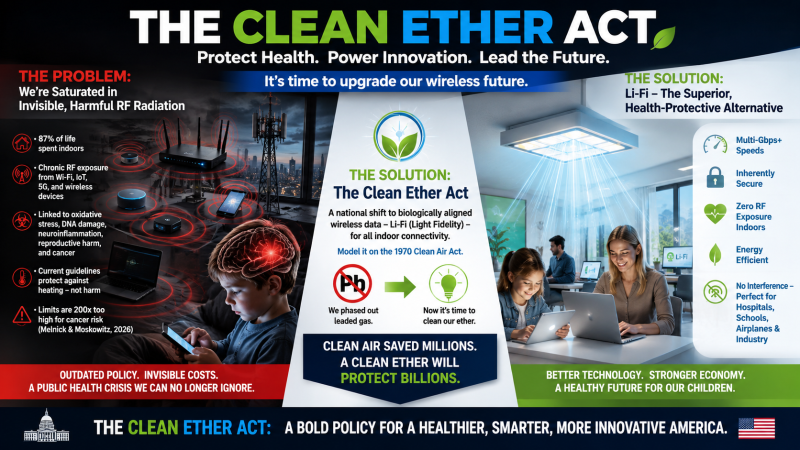
1. The Science of Harm: Non-Thermal Effects Are Real and Well-Documented
Radiofrequency radiation was classified by the IARC as a Group 2B possible carcinogen in 2011. The evidence has only grown stronger.
Recent population-level data from Joel Moskowitz (UC Berkeley): In a May 18, 2026 analysis of National Cancer Institute SEER 21 Registry data (covering 48% of the U.S. population), Moskowitz documents significant age-adjusted increases since 2000 in several head-and-neck tumor categories relevant to wireless device exposure (cell phones and cordless phones held close to the head). These rises cannot be dismissed as artifacts of better diagnosis or an aging population—the data are age-adjusted and show clear upward trends in the exact anatomic sites where exposure is highest.
This SEER analysis directly addresses—and refutes—the common claim that brain tumor rates have remained stable. They have not.
Complementing this are earlier case-control meta-analyses by Moskowitz and colleagues showing that heavy, long-term use (~1,000 lifetime hours, or roughly 17 minutes per day over 10 years) is associated with a statistically significant 60% increase in brain cancer risk (glioma and acoustic neuroma), with stronger associations in higher-quality studies free of industry funding.
Supporting animal evidence:
- NTP and Ramazzini Institute studies: Clear evidence of malignant heart schwannomas and some brain gliomas in male rats exposed to cellphone-level RF at non-thermal levels. DNA damage was also observed.
Mechanisms: The common pathway is oxidative stress. RF triggers reactive oxygen species (ROS) via voltage-gated ion channel dysfunction, leading to DNA strand breaks, lipid peroxidation, sperm damage, blood-brain barrier leakage, and neuroinflammation. Over 90% of experimental studies confirm this pattern.
Children and reproductive tissues are especially vulnerable. Modern biology is “low-fidelity” in the face of this novel pulsed microwave noise—our cells evolved for natural electromagnetic signals (light, Earth’s fields), not the coherent, high-duty-cycle RF we now flood them with.
2. Current Exposure Limits Are Extremely Too High
FCC and ICNIRP guidelines were set decades ago based on short-term animal studies focused solely on thermal effects. They assume a 4 W/kg SAR threshold below which nothing harmful occurs.
A March 2026 peer-reviewed paper by Ronald Melnick and Joel Moskowitz (ICBE-EMF, published in Environmental Health) applied standard EPA risk-assessment methods to the NTP cancer data. Their conclusion: Current limits are at least 200 times too high to protect against cancer risk at the EPA’s acceptable level of 1 in 100,000. They are also 8–24 times too high to protect male fertility. Recent WHO-commissioned systematic reviews reached “high certainty” that RF causes cancer and reproductive toxicity in animals—yet regulators still rely on the old thermal-only model.
This is the regulatory equivalent of ignoring lead’s neurodevelopmental effects and only regulating engine knock.
3. The Superior Alternative: Li-Fi (Light Fidelity)
Li-Fi uses visible or infrared light from ordinary LEDs to transmit data at extremely high speeds. A photodetector on the receiving device decodes the imperceptible flickering. It is commercial reality today, with the IEEE 802.11bb standard (2023) ensuring seamless interoperability with existing Wi-Fi networks.
Li-Fi vs. Wi-Fi: A Clear Win
| Feature | Traditional Wi-Fi (RF) | Li-Fi (Light) |
|---|---|---|
| Speed | Practical: a few Gbps | Commercial: multi-Gbps (10 Gbps+ products in 2026); Lab: 100+ Gbps |
| Available Spectrum | Crowded RF bands | Visible light spectrum: 10,000× larger |
| Security | Signals penetrate walls | Inherent physical security—light blocked by walls |
| Health Impact | Chronic RF-EMF exposure | Zero RF indoors—biologically aligned |
| Interference | High (other devices, microwaves, etc.) | None—works perfectly in hospitals, aircraft, factories |
| Energy Efficiency | Dedicated hardware | Dual-use with existing LED lighting infrastructure |
| Latency | Good | Excellent (ideal for VR/AR/8K) |
Companies like pureLiFi are shipping commercial modules (Light Antenna ONE, Kitefin gateways, Bridge XC for hybrid outdoor-to-indoor). Hospitals use it for EMI-free medical device communication. Schools and offices are piloting it. The market is exploding with CAGRs above 40% and projections exceeding $45 billion by 2034.
Li-Fi targets the indoor environment where the vast majority of data traffic and chronic exposure occurs. A hybrid approach—Li-Fi primary indoors, RF for outdoor/mobile—gives us the best of both worlds.
4. The Clean Ether Act: Policy That Mirrors a Proven Success Story
In the 1970s, the auto industry fought the Clean Air Act’s mandate to slash emissions by 90% and phase out leaded gasoline. Detroit warned of factory closures and job losses. Instead, innovation flourished: catalytic converters, unleaded engines, and cleaner fuels created new markets and jobs while delivering enormous public health benefits. Blood lead levels plummeted. Billions in healthcare and productivity costs were saved.
The Clean Ether Act does the same for wireless:
- Phased indoor RF exposure limits for new construction and public buildings (schools, hospitals, government facilities first).
- Incentives, tax credits, and procurement preferences for Li-Fi-enabled lighting and devices.
- R&D funding for photonics integration and IEEE-standard compliance.
- Outdoor/mobile RF remains available where needed.
This is not a ban on Silicon Valley. It is a strategic pivot that positions U.S. companies to lead the next generation of optical wireless technology—just as the auto industry led in emissions controls.
5. The Broader Benefits
- Public Health: Dramatically reduced chronic RF exposure where it matters most.
- Cybersecurity: Physical containment of data signals.
- Performance: Faster, lower-latency, interference-free networks ready for the metaverse, 8K streaming, and dense IoT.
- Sustainability: Repurposes existing LED infrastructure → lower energy use and spectrum congestion.
- Economic Opportunity: New jobs in optical components, smart lighting, secure enterprise networks. Silicon Valley’s semiconductor and LED expertise becomes a competitive advantage.
Call to Action
The science is clear. The technology is ready. The precedent exists. We do not need to choose between connectivity and health—we can have both, at higher performance.
Policymakers: Introduce and pass the Clean Ether Act. Prioritize indoor environments and vulnerable populations.
Industry leaders: Accelerate Li-Fi integration. The companies that move first will own the future.
Consumers and parents: Demand Li-Fi-enabled routers, lighting, and devices. Start with pilot installations in schools and homes.
RF Safe has been championing the Clean Ether framework for years. The moment is now.
Share this article. Tag your representatives. Support research and pilots. The ether can be cleaned—just as we cleaned the air.
The future is light. Let’s build it.
Key Sources (May 2026 updates included):
- Joel Moskowitz SEER 21 analysis (saferemr.com, May 18, 2026)
- Melnick & Moskowitz/ICBE-EMF 2026 paper in Environmental Health
- NTP reports
- IEEE 802.11bb standard
- pureLiFi and market reports
This is not speculation. It is evidence-based policy for a healthier, faster, more secure digital world. The Clean Ether Act is the logical next step. Let’s make it happen.