- Biology functions as high-fidelity timing machine via bioelectric signals; persistent pulsed EMF noise degrades membrane and mitochondrial precision.
- S4 voltage sensors and CYB5B experience forced oscillations and redox disruption, producing calcium timing errors and loss of self-tolerance.
- This creates meta-disease state favoring autoimmunity, genomic instability, and metabolic drift through informational oxidation.
- Chemistry is necessary but insufficient; timing fidelity must be protected as core longevity variable.
When the Perfect Engine Still Fails: Bioelectric Fidelity, Autoimmune Drift, and the Missing Variable in Longevity
On July 30, 2026, Bryan Johnson posted a quiet line that cut through years of maximalist optimization: “Been thinking things over and wonder if I’ve taken this whole longevity thing too far.”
Weeks earlier the diagnosis that prompted the reflection had become public. Autoimmune gastritis. His immune system is attacking the parietal cells that produce stomach acid. The condition impairs iron and B12 absorption, elevates long-term cancer risk, and is currently considered incurable by standard care. It is tightly linked to the autoimmune hypothyroidism he has carried since age 21—a classic thyrogastric pattern. Johnson’s team discovered it only because they refused to accept years of unexplained low ferritin as “normal.” Biopsies and antibody titers confirmed early-stage disease that had been progressing silently.
Johnson has done almost everything the dominant chemical model of health demands. He has spent millions on continuous biomarker tracking, extreme dietary control, plasma experiments, sauna protocols that reduced microplastics in his semen from 165 to 20 particles per millilitre, and the broader Blueprint regimen that produced measurements associated with a far younger body. The residual failure is therefore instructive. Chemistry was optimized to an extraordinary degree. Something else still drifted.
The Engine That Destroys Itself
Imagine constructing a brand-new high-performance engine. Every tolerance is perfect. Materials are flawless. Fuel is pure. Lubricants are optimal. Every form of particulate contamination has been eliminated. And yet the engine still destroys itself.
You do not need sand in the motor. You only need to degrade the timing. Persistent sensor noise in the crankshaft position, a few degrees of ignition advance error, or phase drift in the camshaft is enough. The same perfect hardware will detonate, overheat, or seize because the control layer that coordinates the chemical reactions has lost fidelity.
Biology is not merely a chemical factory. It is a high-fidelity, multi-scale timing machine powered by bioelectricity. Membrane potentials, the motion of the positively charged S4 segments of voltage-gated ion channels, calcium waveforms (frequency, amplitude, duty cycle, and phase), mitochondrial redox pulses, and membrane polarization transients constitute the control system that tells the chemical machinery when, where, and how much to act. Immune cells, in particular, decode these temporal patterns to distinguish self from non-self, tolerance from activation, and controlled response from sterile inflammation.
When that control layer is subjected to chronic, non-native pulsed electromagnetic noise, chemical perfection can still drift into self-attack.
A Personal Origin for the Fidelity Hypothesis
This is not abstract for me. At eight years old I lost a kidney to cancer. Years later my newborn daughter died from a catastrophic neural-tube defect. What initially looked like isolated genetic or developmental accidents began, over decades of research into environmental exposures, to look like informational errors—failures of the precise spatial-temporal coordination that normal development and immune surveillance require. The hypothesis that emerged is that non-native electromagnetic environments inject timing noise into systems evolution calibrated under a far quieter electromagnetic background. Microplastics and chemical toxins are real forms of entropic waste. So is the continuous pulsed RF/ELF field structure that now saturates indoor life. Both can degrade the fidelity of the operating system.
The Missing Variable: Timing Fidelity
At the cellular level, information is carried not only by the presence of molecules but by their precise timing. Calcium oscillations are a canonical example: their frequency, amplitude, phase, and duty cycle determine which transcriptional programs (NFAT, NF-κB, and others) are engaged in lymphocytes. Voltage-gated ion channels use the S4 helix as a voltage sensor; its movement is exquisitely sensitive to local electric fields. Mitochondria convert calcium signals into redox and ATP pulses that further shape downstream decisions. When these temporal codes lose precision—“bioelectric dissonance”—the cell does not necessarily die. It operates in a lower-fidelity state: higher oxidative load, noisier signaling, shifted decision thresholds. Over years, that state can favor immune misclassification of self antigens, genomic instability in high-turnover or high-ROS tissues, desynchronized metabolic pulses, or delayed developmental programs.
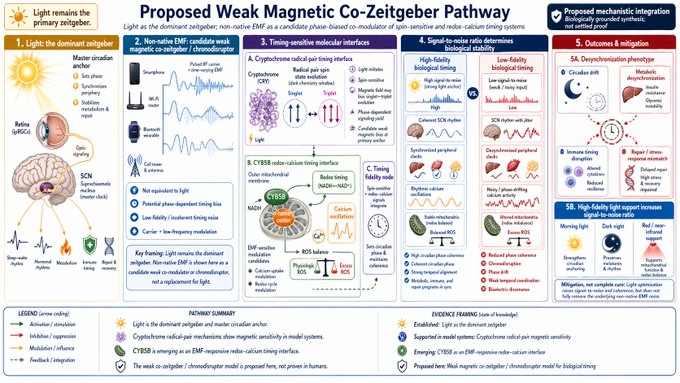
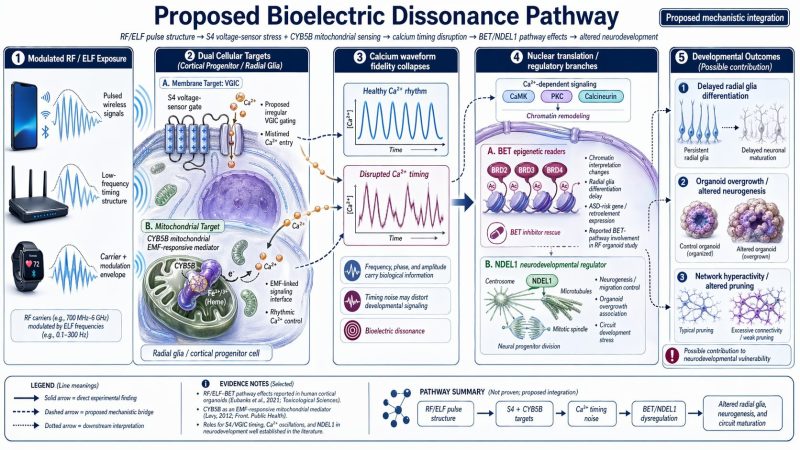
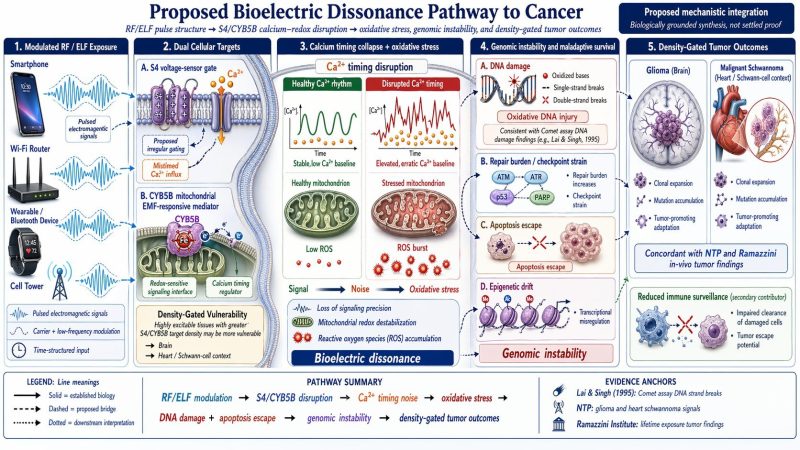
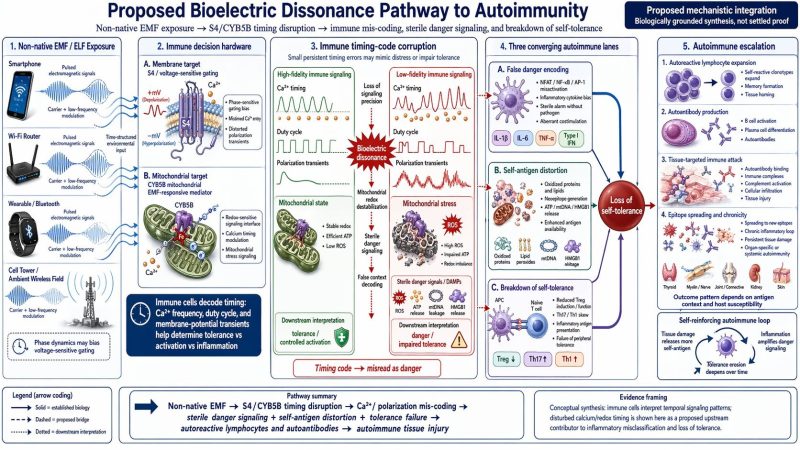
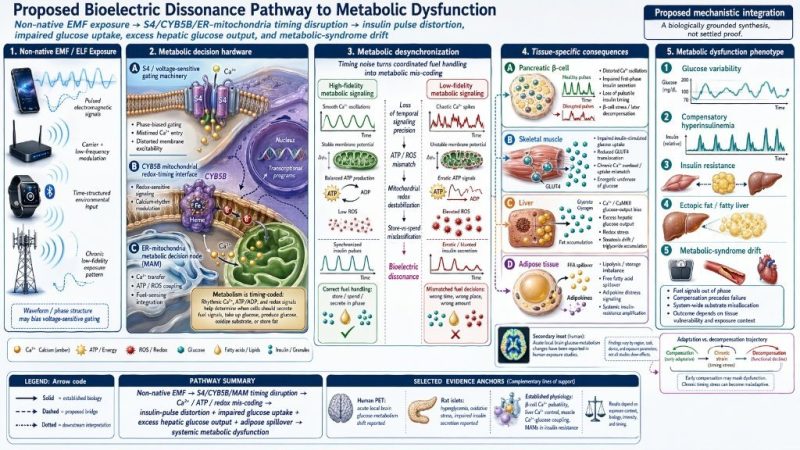
The accompanying diagrams illustrate a proposed mechanistic integration—biologically grounded synthesis, not settled proof—showing how one upstream timing disruption can branch into the major modern chronic disease clusters.
Dual Cellular Targets and the Autoimmunity Pathway
The proposed Bioelectric Dissonance Pathway to Autoimmunity centers on two primary cellular targets of pulsed RF/ELF fields in immune and other excitable cells:
A. Membrane target — S4 voltage-sensor gates. Polarized, coherent, low-frequency components of wireless signals can, via the ion forced-oscillation (IFO) mechanism developed by Panagopoulos and colleagues, exert Coulomb forces on mobile ions in the nanometre-scale aqueous layer near the membrane. Those forces nudge the positively charged S4 helices, introducing irregular gating kinetics and mistimed Ca²⁺ entry without requiring bulk tissue heating. The result is timing noise in the very sensors evolution designed for high-fidelity voltage detection.
B. Mitochondrial target — CYB5B. A May 2026 Cell paper (Kim et al.) used a CRISPR-Cas9 screen to identify cytochrome b5 type B (CYB5B) as an essential mediator of an electromagnetic-field-inducible gene switch. CYB5B, a heme-containing protein on the outer mitochondrial membrane, couples EMF input to rhythmic oscillatory calcium dynamics—not generic calcium influx—and to redox signaling. Disruption here destabilizes mitochondrial redox balance, elevating reactive oxygen species and facilitating release of damage-associated molecular patterns (mtDNA, HMGB1, oxidized lipids and proteins).
The convergence of these two targets produces bioelectric dissonance: loss of signaling precision. High-fidelity immune timing collapses into low-fidelity noise. Downstream, three converging lanes open toward loss of self-tolerance:
- False danger encoding — NFAT/NF-κB misactivation, inflammatory cytokine bias (IL-1β, IL-6, TNF-α, Type I IFN), and sterile alarm without pathogen.
- Self-antigen distortion — oxidized proteins and lipids, neoepitope generation, enhanced antigen presentation.
- Breakdown of peripheral tolerance — reduced Treg induction or function, Th17/Th1 skew, failure of controlled activation.
Over time this yields the classic autoimmune cascade: autoreactive lymphocyte expansion and memory formation, autoantibody production, tissue-targeted immune attack, epitope spreading, and a self-reinforcing inflammatory loop in which tissue damage releases more self-antigen and amplifies danger signaling. The outcome pattern depends on antigen context and host susceptibility—thyroid, stomach, myelin, joint, kidney, or skin.
The same upstream fidelity collapse—S4 + CYB5B → Ca²⁺/redox timing noise—appears, with tissue-specific density gating, in the parallel proposed pathways:
- Oxidative DNA injury, repair burden, apoptosis escape, and genomic instability (glioma, malignant schwannoma contexts consistent with NTP and Ramazzini findings; Lai & Singh 1995 Comet-assay DNA strand breaks).
- Insulin-pulse desynchronization, impaired glucose uptake, excess hepatic output, and metabolic-syndrome drift.
- Delayed radial-glia differentiation, organoid overgrowth/altered neurogenesis, and network hyperactivity via BET epigenetic readers and NDEL1 regulation (supported by RF effects on BET-mediated pathways in human cortical organoids).
One biophysical failure mode. Four modern health “horsemen.” Density of S4 channels and mitochondria/NOX systems explains why effects are graded and tissue-specific rather than all-or-nothing.
Low-Fidelity Biology and the Meta-Disease State
This is not a claim that non-native EMF is the sole or direct cause of any individual’s autoimmune gastritis. Bryan Johnson’s AIG is multifactorial—genetics, early-life exposures, and decades of thyroid autoimmunity matter. The point is subtler and more systemic: when the electromagnetic environment injects persistent timing noise into the sensors and oscillators that maintain coordination, the probability of drift rises across multiple systems. The body is forced to operate in a chronically lower-fidelity state.
Informational oxidation—the gradual corrosion of the precision of the cellular communication microenvironment—may be as consequential as chemical oxidation. Chemistry is necessary but not sufficient. Timing is the missing variable. The result is not one disease but a meta-disease state in which thresholds for tolerance, genomic stability, metabolic synchrony, and developmental precision are all shifted. Because developmental and epigenetic programs are themselves timing-dependent, the effects carry transgenerational potential.
People who report electromagnetic hypersensitivity are not necessarily “sensing the signal.” They may be sensing what it feels like when their biology is forced to operate with reduced coherence—sleep disruption, autonomic symptoms, inflammatory flares, cognitive fog—depending on individual vulnerability.
An Invitation to Measurement-Obsessed Longevity Science
Johnson and his team excel at measuring what can be measured. The next frontier is to treat bioelectric fidelity with the same seriousness currently applied to ferritin, microplastics, and epigenetic clocks. That means:
- Characterizing calcium oscillation spectra, mitochondrial ROS pulse patterns, and immune-cell membrane-potential transients under realistic pulsed versus continuous or shielded conditions.
- Testing whether controlled reduction of pulsed RF/ELF exposure (or waveform-specific filtering) alters immune decision markers, redox dynamics, or disease progression in AIG and related conditions.
- Incorporating electromagnetic environment as a controlled variable in Blueprint-style protocols, just as chemical toxins already are.
The diagrams presented here are proposed integrations. They rest on established biology (S4 voltage sensing, calcium timing codes in immunity, mitochondrial ROS as danger signals, BET and NDEL1 in neurodevelopment) plus specific bridges (IFO-VGIC mechanism, the 2026 CYB5B CRISPR findings, organoid BET studies, and the broader oxidative-stress literature). They are hypotheses that warrant rigorous testing, not settled proof. Mainstream risk assessment remains focused on thermal effects and has classified RF as a possible carcinogen (IARC 2B) largely on the basis of limited evidence for glioma and acoustic neuroma. The fidelity framework offers a coherent, testable way to understand non-thermal, timing-based contributions that current bulk-biomarker approaches can miss.
Bryan Johnson has shown what extreme chemical optimization can achieve. The residual autoimmune process suggests that the control layer itself still needs protection. Biology is an energy-and-information system. The electromagnetic environment is part of the information environment. If we want high-fidelity longevity, we cannot optimize the chemistry while allowing chronic degradation of the timing.
Protect the signal. The engine is already perfect. The question is whether we will keep sand out of the motor while allowing the timing to drift.