
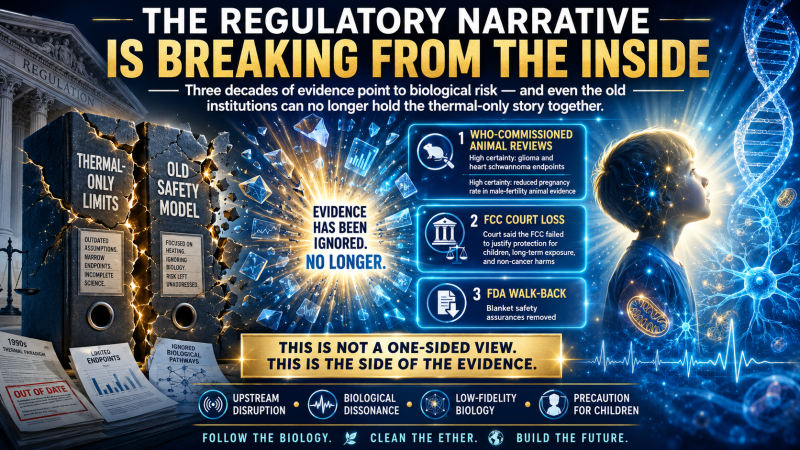
WHO-commissioned animal evidence now includes high-certainty findings for increased glioma and heart schwannoma endpoints in male rats, high-certainty evidence that RF-EMF exposure reduces pregnancy rate as a male-fertility endpoint in experimental animals, and statistically significant adverse pregnancy/birth findings including resorbed or dead fetuses, reduced fetal weight and length, fetal malformations, and neurobehavioral effects.
The Regulatory Narrative Is Breaking From the Inside
For years, the public has been told that RF radiation is not a serious biological concern unless it heats tissue. That remains the spine of the old regulatory message. WHO’s own public-facing language has long stated that heating is the main biological effect of radiofrequency fields, that heating forms the basis of current guidelines, and that adverse effects from low-level long-term RF or power-frequency exposure have not been confirmed.
But that is no longer the whole story.
The same institutional universe that has spent decades hand-waving non-thermal biological effects has now produced evidence that no honest policymaker can ignore. WHO is undertaking a new health-risk assessment of radiofrequency electromagnetic fields for an Environmental Health Criteria monograph, and WHO stated that it would commission systematic reviews to analyze and synthesize the evidence on priority health outcomes.
That matters because these reviews do not support the comforting fiction that the issue is settled.
The WHO-funded or WHO-commissioned animal-cancer review by Mevissen and colleagues evaluated cancer outcomes in experimental animals. It found high certainty of evidence for increased glioma risk in male rats and high certainty of evidence for increased heart schwannomas in male rats. The authors also noted that cancer bioassays in experimental animals are commonly used to identify potential human carcinogens, and that the two high-certainty tumor types in animals are the same tumor types identified with limited evidence in humans by IARC.
That is not a trivial footnote. That is the regulatory world’s own evidentiary machinery producing a result that cuts directly against the old public reassurance.
The reproductive evidence points in the same direction. In the WHO-commissioned male-fertility evidence base, a corrigendum elevated the certainty to high certainty of evidence that RF-EMF exposure reduces rate of pregnancy in experimental animal studies. Melnick and Moskowitz then applied health-protective risk-assessment methods and concluded that current FCC/ICNIRP-style public limits would need to be reduced by 8- to 24-fold to protect against reduced male fertility, and by 15- to more than 900-fold to bring cancer risk down to a 1-in-100,000 excess-risk level, depending on daily exposure duration.
The pregnancy and birth-outcome review is also important. It did not say every pregnancy endpoint was proven with high certainty at everyday exposure levels. But it did report statistically significant adverse findings in experimental animals: increased resorbed and dead fetuses, decreased fetal weight, decreased fetal length, increased fetal malformations, increased litters with malformed fetuses, and detrimental motor and sensory effects. Its conclusion stated that in utero RF-EMF exposure “likely affects offspring health at birth.”
That is enough to trigger precaution.
We do not wait for children to become the experiment. We use animal studies precisely because controlled toxicology exists to identify hazards before society pays the price in human bodies. WHO itself acknowledges that animal studies are essential because they are more directly relevant to establishing safe human exposure levels and can investigate dose-response relationships in ways human epidemiology often cannot. Melnick and Moskowitz make the public-health principle even plainer: well-conducted animal studies can eliminate the need to wait for sufficient human cancer data before implementing protective strategies.
This is the key moral point:
The demand for perfect human epidemiology before precaution is not scientific rigor. It is a decision to make children, pregnant women, and future generations carry the uncertainty.
NTP and Ramazzini: The Warning Was Already There
The National Toxicology Program did what toxicology programs are supposed to do. It tested long-term RF exposure in controlled animal studies. The result was not “nothing happened.” NTP found clear evidence of malignant heart schwannomas in male rats, some evidence of malignant gliomas in male rat brains, and some evidence of adrenal-gland tumors. NTP also found significant DNA damage in the frontal cortex of male mice, blood cells of female mice, and hippocampus of male rats.
Then came the Ramazzini Institute.
The Ramazzini study was not a duplicate of the NTP design. It used far-field, base-station-like exposure, exposed Sprague-Dawley rats from prenatal life until natural death, and included 2,448 animals. It found a statistically significant increase in heart schwannomas in male rats at the highest exposure level, and the authors concluded that the findings were consistent with and reinforced the NTP results because both studies reported increased tumors of the brain and heart in RFR-exposed Sprague-Dawley rats. The paper also noted that these tumors were of the same histotype as tumors observed in some epidemiological studies of cellphone users.
This is not “one odd study.” This is coherence across independent animal programs using different exposure scenarios: near-field cellphone-like exposure in NTP, far-field base-station-like exposure in Ramazzini, and convergent tumor biology in Schwann-cell and glial-cell lineages.
And after all that, NTP did not build the next-generation national research program the evidence demanded. NIEHS states that no further work with that RFR exposure system will be conducted and that it has no further plans to conduct additional RFR exposure studies at this time, citing technical difficulty, resource intensity, and the fact that the system was designed for 2G/3G rather than newer technologies.
That is backwards.
If the old exposure system cannot evaluate modern 4G, 5G, Wi-Fi, Bluetooth, wearables, beamforming, and mixed RF/ELF environments, the answer is not to stop. The answer is to build the system that can.
This Is Not a One-Sided View. This Is the Side of the Evidence.
A one-sided view would ignore the regulatory position. RF Safe does not ignore it. We put it on the table.
The old regulatory position says: current limits are protective because the only established harms are heating and acute stimulation.
The evidence says: biological systems repeatedly respond below those limits.
Dr. Henry Lai’s compilations show that the majority of studies across the major RFR domains report effects: 390 of 438 oxidative/free-radical papers, 396 of 550 genetic-effects papers, 192 of 228 gene-expression papers, 396 of 507 neurological papers, and 354 of 415 reproduction/development papers reported effects. His low-intensity RFR file identifies 260 studies reporting biological effects below SAR 0.4 W/kg, most of them in vivo and most involving repeated or chronic exposure.
The ELF/static evidence mirrors the same biological architecture: 319 of 353 oxidative-effect studies, 363 of 434 genetic-effect studies, 232 of 252 gene-expression studies, 364 of 397 neurological studies, and 82 of 105 reproduction/development studies reported effects. Lai’s low-flux-density ELF/static file also lists effects below 0.01 mT / 10 μT.
So no, this is not “cherry-picking.” This is the preponderance of three decades of evidence.
And when the preponderance of evidence points to oxidative stress, DNA damage, gene-expression shifts, neurological disruption, reproductive harm, developmental vulnerability, and low-intensity effects, it is not “balanced” to pretend the old thermal-only paradigm deserves equal weight. That is not balance. That is regulatory inertia masquerading as neutrality.
The FDA and FCC Are No Longer Stable Pillars of Reassurance
The institutional story has also changed.
Reuters reported in January 2026 that HHS would launch a study on cellphone radiation and that the FDA had taken down old webpages saying cellphones are not dangerous. HHS said the FDA removed webpages with old conclusions while HHS undertakes a study on electromagnetic radiation and health-research gaps, including new technologies. Reuters also noted that some FDA and CDC pages still continued to state that there was no credible evidence pointing to health problems from cellphone radiation.
That is not a scientific confession. But it is an institutional tell.
You cannot credibly say “we need a new federal study to identify gaps in knowledge” while simultaneously telling the public the question is closed.
The FCC’s position is even weaker. In 2021, the U.S. Court of Appeals for the D.C. Circuit ruled that the FCC failed to provide a reasoned explanation for why its RF limits adequately protect against harmful non-cancer effects. The court specifically faulted the FCC for failing to address children, long-term exposure, RF pulsation and modulation, technological developments since 1996, wireless ubiquity, and environmental impacts.
The court’s official opinion goes further. It states that the FCC relied on conclusory FDA statements, that agency silence is not a reasoned explanation, and that the unanswered question remains whether low levels of RF radiation allowed by existing limits cause negative health effects. The court remanded the matter to the FCC and required the agency to address children, long-term exposure, wireless ubiquity, technological changes, and environmental impacts.
As of 2026, Environmental Health Trust has reported additional legal action and petitions pressing the FCC to comply with that court mandate.
So when critics say, “But the FCC limits still allow it,” they are not making a scientific argument. They are citing a legally wounded standard that the court already found inadequately reasoned.
Section 704 Turned an Outdated Standard Into a Democratic Gag Rule
This is why Section 704 of the Telecommunications Act matters.
Federal law says no state or local government may regulate the placement, construction, or modification of personal wireless service facilities on the basis of the environmental effects of RF emissions if those facilities comply with FCC regulations.
That means the public is trapped in a circular system.
Communities are told they cannot object on health grounds because the facility complies with FCC limits. But the FCC limits themselves were built around thermal assumptions and were later found by a federal court to lack a reasoned explanation on children, long-term exposure, modulation, ubiquity, and environmental impacts.
That is not public-health protection.
That is preemption in service of deployment.
RF Safe should say this clearly: Section 704 functions as a democratic gag rule. It does not merely streamline infrastructure. It removes the most important question — “Is this biologically safe for the people who live here?” — from local democratic decision-making.
A government that prevents communities from raising health concerns while relying on outdated exposure limits is not protecting the people. It is protecting the deployment model.
Public Law 90-602: The Law Already Knew Radiation-Emitting Products Needed Oversight
The United States already has a legal foundation for controlling radiation-emitting electronic products. FDA’s own summary states that the Radiation Control provisions were originally enacted as the Radiation Control for Health and Safety Act of 1968, that they apply to electronic products emitting electronic product radiation, and that “electronic product radiation” includes ionizing or non-ionizing electromagnetic radiation. FDA’s own examples of non-medical electronic products include cordless and cellular telephones.
That matters.
The problem is not that government lacks authority. The problem is that government has failed to use that authority with biological seriousness.
Public Law 90-602 was a promise: electronic product radiation would be studied, controlled, labeled, and minimized when necessary to protect public health.
The modern wireless era has not honored that promise.
The Real Issue Is Upstream Biology
The reason this debate remains so difficult is that RF radiation may never map cleanly to one disease.
That is exactly what we should expect from an upstream biological stressor.
RFR does not have to behave like a single pathogen. It does not have to produce one clean disease signature in every exposed person. It can act higher in the biological hierarchy, disturbing the fidelity of the systems that determine whether the organism repairs, regulates, reproduces, develops, detoxifies, sleeps, and adapts correctly.
That is why the Lai evidence map is so important. Oxidative stress, genetic effects, gene expression, neurological changes, reproductive disruption, developmental effects, and low-intensity biological responses are not unrelated endpoints. They are different windows into the same upstream disturbance.
The correct model is not:
RFR → Disease X
The correct model is:
RFR / ELF / IF exposure → upstream biological disturbance → reduced biological fidelity → increased susceptibility → disease expression shaped by genetics, age, pregnancy, sex, sleep, chemical exposures, infection, stress, nutrition, and baseline vulnerability
That is why critics who demand a perfect one-disease map are asking the wrong question.
You do not ask whether air pollution causes only one disease. You do not ask whether endocrine disruptors cause only one endpoint. You do not ask whether sleep disruption causes only one diagnosis. You ask whether the exposure degrades the regulatory systems that maintain health.
That is the RF Safe synthesis:
Biological dissonance is the process.
Low-fidelity biology is the state.
Disease susceptibility is the downstream consequence.
Why This Leads Directly to a Clean Ether Act
Once the problem is understood correctly, the solution becomes obvious.
The goal is not to abandon technology. The goal is to stop pretending that pulsed microwave radiation should be the default physical layer for every indoor data exchange.
A biologically literate society would not fill classrooms, nurseries, bedrooms, hospitals, fertility clinics, libraries, and offices with unnecessary RF when wired and optical alternatives exist.
The Clean Ether Act should be framed as the policy response to upstream biological risk.
It should say: when a technology has plausible, repeated, biologically coherent evidence of upstream disruption, and when safer architectures are available, society must transition.
Fiber for the backbone. Ethernet for fixed devices. Li-Fi for indoor wireless mobility. Low-power RF only where RF is genuinely necessary.
This is not anti-wireless. It is the next wireless revolution.
The photon is the workhorse of the universe. We do not need to saturate children’s environments with pulsed microwaves when we can move data through light. Alexander Graham Bell’s photophone was not a historical curiosity. It was the first glimpse of biologically aligned wireless communication.
The future should not be more microwave saturation.
The future should be clean light, clean design, and clean policy.
Clean the ether. Protect the children. Follow the biology. Build the future.