
The ELF evidence does not weaken the RF Safe thesis. It completes it.
Radiofrequency radiation is only one layer of the modern electromagnetic environment. Static fields, extremely low-frequency fields, intermediate-frequency fields, pulsed magnetic fields, switched power supplies, induction systems, wireless power transfer, device circuitry, and RF modulation envelopes all converge on the same biological truth: life is electrochemical, electrodynamic, rhythmic, and redox-sensitive.
The old safety model treats electromagnetic exposure as a question of acute energy deposition: does it heat tissue, shock nerves, or immediately stimulate muscle? The evidence map from Dr. Henry Lai’s RFR and ELF/static EMF compilations points to a deeper question: does chronic, low-intensity electromagnetic exposure reduce the fidelity of biological signaling, repair, development, reproduction, and neural regulation?
That is where the concept of biological dissonance becomes essential. RF and ELF do not need to map neatly to one disease in order to be biologically consequential. They can operate far upstream, altering the terrain on which many diseases become more likely.
1. The ELF evidence map
Dr. Lai’s static/ELF EMF compilations show the same kind of directional signal seen in the RFR literature: the majority of studies in several major biological domains report effects.
| Biological domain | Lai’s static / ELF EMF finding | What it means |
|---|---|---|
| Oxidative / free-radical effects | 319 / 353 studies, 90%, reported effects | Static/ELF fields repeatedly alter redox biology: ROS, lipid peroxidation, antioxidant enzymes, oxidative DNA markers, and related cellular stress pathways. |
| Genetic effects | 363 effect studies, 71 no-effect studies, summarized as 84% effects | DNA damage, micronuclei, chromosomal effects, chromatin changes, epigenetic effects, and gene-expression shifts are repeatedly reported. |
| Gene expression | 232 / 252 studies, 92%, reported effects | ELF/static fields repeatedly change transcriptional programs, including apoptosis, tumor-suppressor, inflammatory, oxidative-stress, circadian, developmental, and differentiation pathways. |
| Neurological effects | 364 / 397 studies, 92%, reported effects | The nervous system is one of the clearest convergence points: behavior, electrophysiology, neurotransmitters, oxidative stress, development, neurodegeneration, and synaptic regulation. |
| Reproduction / development | 82 / 105 studies, 78%, reported effects | Reproductive biology is field-sensitive because it depends on DNA integrity, hormonal rhythm, gamete quality, implantation, embryonic development, and mitochondrial/redox precision. |
| Low-flux-density effects | Effects reported below 0.01 mT / 10 µT | The low-intensity ELF/static evidence directly challenges assumptions that weak fields are biologically irrelevant. |
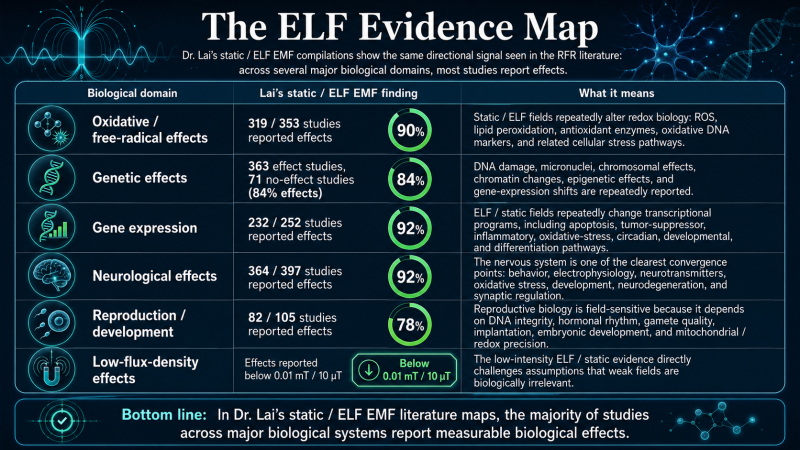 The central point is not that every ELF/static study reports harm. The central point is that the preponderance of evidence across oxidative, genetic, gene-expression, neurological, reproductive, developmental, and low-intensity studies shows biological responsiveness. Dr. Lai’s files report 319 oxidative-effect papers versus 34 no-effect papers; 363 static/ELF genetic-effect papers versus 71 no-effect papers; 232 gene-expression effect studies versus 20 no-effect studies; 364 neurological-effect papers versus 33 no-effect papers; and 82 reproduction/development effect studies versus 23 no-effect papers.
The low-flux-density file is especially important because it lists effects at and below microtesla-scale and even pico-/nano-scale magnetic field conditions, including genetic, neurological, oxidative, physiological, cellular, and human-study categories. That is the ELF counterpart to the RFR low-SAR problem: biological systems are responding below the levels the conventional safety imagination treats as meaningful.
2. ELF adds the missing half of the story
RF Safe should frame this clearly: RF and ELF should not be treated as separate silos. They are different frequency regions of the same broader environmental problem: anthropogenic electromagnetic fields interacting with bioelectric life.
RFR brings the high-frequency carrier, wireless signaling, pulsing, modulation, near-field device exposure, antenna behavior, and specific absorption patterns. ELF/static fields bring slow oscillatory magnetic exposure, power-frequency fields, device-current fields, low-frequency modulation envelopes, induced currents, weak-field biological timing effects, and interaction with magnetically sensitive chemistry. Intermediate frequencies add the bridge: induction cooking, wireless power transfer, electronic article surveillance, compact fluorescent lighting, and other power electronics.
Dr. Lai’s intermediate-frequency compilation shows why this bridge matters. Household IF exposures are often described as generally low, but certain appliances at close distance can produce relatively high exposures, and emissions may include harmonic or noisy spectra extending through the IF range. The IF review summarized in Lai’s file found 56 eligible studies but judged the evidence difficult to interpret because of heterogeneity, inconsistent findings, and methodological limitations; importantly, that is not evidence of safety, but evidence of an underdeveloped research base.
This is the correct RF Safe synthesis: modern exposure is not “RF or ELF.” It is RF plus ELF plus static fields plus IF plus modulation plus chronicity plus proximity plus biological timing.
3. The combined RF + ELF evidence map
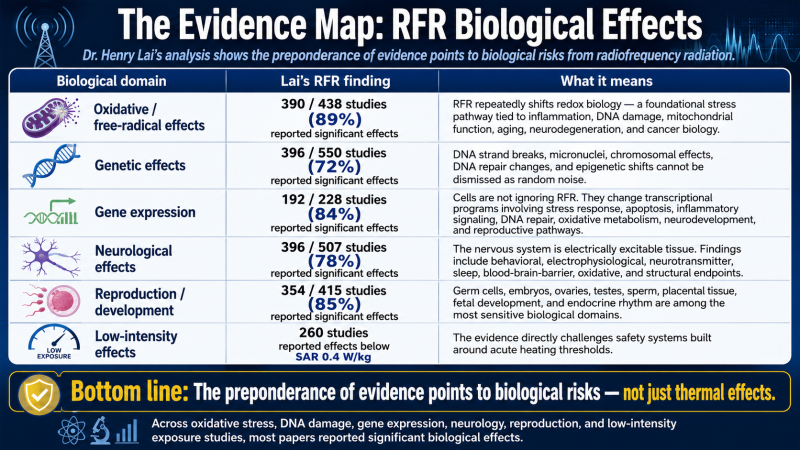
When the RFR and static/ELF files are placed side by side, the pattern is not random. It is convergent.
These are domain-specific paper counts, not necessarily unique papers, because the same study can appear in more than one biological category.
| Domain | RFR effects | Static / ELF effects | Combined direction |
|---|---|---|---|
| Oxidative / free-radical effects | 390 / 438, 89% | 319 / 353, 90% | 709 / 791, about 90% report effects |
| Genetic effects | 396 / 550, 72% | 363 effects / 71 no effects, about 84% | 759 / 984, about 77% report effects |
| Gene expression | 192 / 228, 84% | 232 / 252, 92% | 424 / 480, about 88% report effects |
| Neurological effects | 396 / 507, 78% | 364 / 397, 92% | 760 / 904, about 84% report effects |
| Reproduction / development | 354 / 415, 85% | 82 / 105, 78% | 436 / 520, about 84% report effects |
| Low-intensity effects | 260 RFR studies below SAR 0.4 W/kg reported effects | Numerous ELF/static effects reported below 0.01 mT / 10 µT | Both frequency domains show biological effects below conventional comfort-zone assumptions |
The RFR side of the map comes from Lai’s May 2026 compilations: 390 of 438 RFR oxidative studies reported effects; 396 of 550 RFR genetic studies reported effects; 192 of 228 RFR gene-expression studies reported effects; 396 of 507 RFR neurological studies reported effects; 354 of 415 RFR reproduction/development studies reported effects; and 260 low-intensity RFR studies below SAR 0.4 W/kg reported effects.
The static/ELF side shows the same biological architecture: oxidative stress, genetic disruption, altered gene expression, neurological effects, reproductive/developmental effects, and low-flux-density effects.
That is the key public-health message: RF and ELF are converging on the same biological systems.
4. The shared biological targets
The combined evidence repeatedly lands on seven biological control systems.
A. Redox control
The oxidative-stress literature is the spine of the whole EMF story. RFR: 89% effect studies. Static/ELF: 90% effect studies. That is not a peripheral finding. Redox status is upstream of inflammation, mitochondrial function, DNA repair, protein folding, cell signaling, immune response, neurodegeneration, fertility, aging, and cancer biology.
Lai’s static/ELF oxidative file explains why these endpoints matter: reactive oxygen species can damage DNA, proteins, and lipids; 8-OHdG is commonly used as a marker of oxidative DNA damage; MDA is commonly used as a lipid peroxidation marker; oxidative lipid damage affects cell membranes; protein oxidation can alter enzyme activity; and oxidative stress can alter transcription-factor regulation such as the Nrf2 antioxidant pathway.
RF Safe translation: the body does not need to be heated for the redox network to be disturbed.
B. Genome maintenance
The genetic evidence does not have to mean that every exposure directly breaks DNA like ionizing radiation. That is the wrong comparison. The more biologically plausible picture is that EMF exposure can increase oxidative stress, alter chromatin conformation, affect DNA repair, shift epigenetic regulation, and change transcriptional control. That is a genome-maintenance burden.
Dr. Lai’s static/ELF genetic file reports 363 effect papers versus 71 no-effect papers and a 92% effect rate among static/ELF gene-expression studies. The RFR genetic file reports 396 effect papers versus 154 no-effect papers and an 84% effect rate among RFR gene-expression studies.
RF Safe translation: the genome is not simply a target. It is a maintenance system. EMF appears to increase the noise and workload inside that system.
C. Gene expression and cellular decision-making
The gene-expression data are decisive for the “biological dissonance” model because gene expression is where cells reveal whether they perceive an exposure as biologically meaningful.
Static/ELF gene-expression studies include changes in p53, Bax, Bcl-2, caspase-related pathways, cryptochrome-regulated genes, inflammatory genes, antioxidant genes, stem-cell differentiation genes, and developmental genes. The first page of Lai’s static/ELF gene-expression file shows examples involving p53 and Bax upregulation with Bcl-2 downregulation, corn gene-expression changes with DNA strand breaks, Arabidopsis cryptochrome-related gene-expression changes under hypomagnetic conditions, and glioblastoma gene-expression changes involving oxidative processes.
The RF gene-expression literature similarly includes stress-response genes, ROS metabolism genes, apoptosis genes, mitochondrial transcription factors, inflammatory pathways, and developmental/neurodevelopmental gene programs.
RF Safe translation: cells are not ignoring these fields. Cells are changing their instructions.
D. Mitochondria, membranes, and ionic balance
Mitochondria are redox engines. Membranes are electrical interfaces. Ion channels, calcium fluxes, proton gradients, and membrane potentials are central to how cells decide, repair, fire, divide, migrate, die, or differentiate. A safety model that sees tissue only as a heatable mass misses the fact that biology runs on gradients and timing.
This is why the combined RF/ELF evidence is so important. Both frequency domains repeatedly implicate oxidative stress, calcium-related signaling, membrane effects, apoptosis, mitochondrial markers, and altered electrophysiology. The neurological and oxidative files repeatedly show effects involving electrical excitability, oxidative stress, neurotransmitters, cellular metabolism, and antioxidant defense.
RF Safe translation: we are not bags of water. We are membrane-bound bioelectric networks.
E. The brain, HPA axis, and neurobehavioral regulation
The nervous system is the most obvious target for field-sensitive effects because it is built from electrochemical signaling, synaptic timing, membrane excitability, neurotransmitter cycling, glial signaling, redox balance, and oscillatory networks.
The ELF neurological compilation reports 364 effect papers versus 33 no-effect papers. Its first page summarizes reported EMF-related changes in neuronal plasticity, hippocampal synapses, neurotransmitters, glial function, membrane concentration, gene expression, DNA methylation, histone modification, microRNA biogenesis, and cognitive function.
Specific ELF examples in the files include prenatal/postnatal exposure affecting behavior and synaptic proteins, and studies where ELF-EMF interacted with prenatal stress to exacerbate anxiety-like behavior, with changes in hippocampal and prefrontal-cortex markers such as BDNF, GAP-43, caspase-3, serotonin, corticosterone, NMDA receptor signaling, and 24(S)-hydroxycholesterol.
RF Safe translation: the brain is not protected by the fact that you cannot feel the field. The brain is a field-sensitive organ because it is an electrically excitable organ.
F. Reproduction and development
Reproduction is where biological fidelity becomes non-negotiable. Sperm DNA, oocyte maturation, folliculogenesis, steroidogenesis, implantation, placental signaling, embryonic development, fetal brain development, and postnatal maturation are not rough processes. They depend on timing, redox control, hormonal rhythm, and genomic accuracy.
Lai’s static/ELF reproduction file reports 82 effect papers versus 23 no-effect papers. It includes prenatal-stress/ELF interaction, ovarian follicle alterations, male sex-hormone and sperm-count effects, female hormone and ovarian-weight effects, oxidative DNA effects in testis, and other reproductive endpoints.
The RFR reproduction file reports 354 effect papers versus 61 no-effect papers and lists many low-SAR effect studies, including 73 effect studies below SAR 0.4 W/kg with a mean SAR of 0.069 W/kg and median of 0.027 W/kg, plus 52 effect studies below SAR 0.08 W/kg.
RF Safe translation: fertility and development are biological high-resolution processes. Low-fidelity signaling shows up there early.
G. Low-intensity biological effects
Low intensity is the policy fault line.
For RFR, Lai’s low-intensity compilation identifies 260 studies reporting effects below SAR 0.4 W/kg, with most being in vivo and most involving repeated or chronic exposure. He reports that for the 260 studies below SAR 0.4 W/kg, the mean SAR was 0.072 W/kg and the median was 0.028 W/kg; for the 174 studies below SAR 0.08 W/kg, the mean was 0.020 W/kg and the median was 0.014 W/kg. Lai’s summary directly states that current RFR guidelines are not valid for protection against health-detrimental RFR effects and that the data provide evidence for non-thermal effects.
For ELF/static fields, Lai’s low-flux-density file lists effects below 0.01 mT / 10 µT across genetic, oxidative, neurological, physiological, morphological, cellular, animal, human, in vitro, and in vivo categories.
RF Safe translation: the low-intensity evidence is the demolition charge under the old paradigm.
5. Why RF may never map cleanly to “Disease X”
This is the most important conceptual move.
The public is often told: “If wireless radiation were harmful, we would see one clear disease signature.” That logic is false when the exposure is upstream.
RFR and ELF/static fields are not acting like a single pathogen with a single lesion. They are not measles. They are not asbestos fibers. They are not a poison with one dominant receptor and one dominant clinical syndrome. They appear to act more like a chronic systems stressor that can disturb the fidelity of redox balance, membrane signaling, mitochondrial function, gene expression, DNA repair, hormone rhythm, neural timing, immune response, and development.
That means the expected disease pattern is not “one exposure → one disease.” It is:
field exposure → biological dissonance → reduced repair fidelity → reduced physiological resilience → increased susceptibility → disease expression shaped by genetics, age, sex, pregnancy, stress, chemical exposures, infection, sleep, nutrition, and baseline health.
That is why the effects are hard to map epidemiologically. A far-upstream stressor does not need to create a single clean clinical endpoint. It can increase biological variance, reduce resilience, accelerate vulnerability, and shift disease probability across many endpoints.
Think of it this way: chronic sleep disruption does not cause only “sleep disease.” Chronic psychological stress does not cause only “stress disease.” Air pollution does not cause only one disease. Endocrine disruptors do not cause only one endocrine endpoint. They shift systems. They degrade regulation. They alter the terrain.
RF Safe’s point should be:
RFR may not map cleanly to Disease X because RFR is not primarily a Disease X exposure. It is a biological-fidelity exposure.
6. The meta-disease state
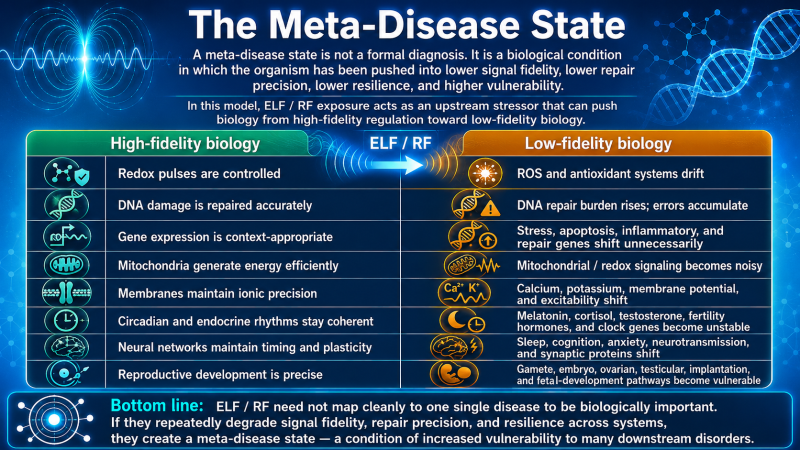
A meta-disease state is not a formal diagnosis. It is a biological condition in which the organism has been pushed into lower signal fidelity, lower repair precision, lower resilience, and higher vulnerability.
In this model, “low-fidelity biology” means:
| High-fidelity biology | Low-fidelity biology |
|---|---|
| Redox pulses are controlled | ROS and antioxidant systems drift |
| DNA damage is repaired accurately | DNA repair burden rises; errors accumulate |
| Gene expression is context-appropriate | Stress, apoptosis, inflammatory, and repair genes shift unnecessarily |
| Mitochondria generate energy efficiently | Mitochondrial/redox signaling becomes noisy |
| Membranes maintain ionic precision | Calcium, potassium, membrane potential, and excitability shift |
| Circadian and endocrine rhythms stay coherent | Melatonin, cortisol, testosterone, fertility hormones, and clock genes become unstable |
| Neural networks maintain timing and plasticity | Sleep, cognition, anxiety, neurotransmission, and synaptic proteins shift |
| Reproductive development is precise | Gamete, embryo, ovarian, testicular, implantation, and fetal-development pathways become vulnerable |
This is why RF Safe’s “biological dissonance” language is powerful. It captures what a disease-name list cannot. The issue is not merely whether RFR or ELF “causes cancer,” “causes infertility,” or “causes neurological disease” in a simplistic one-to-one way. The deeper issue is that both RF and ELF/static fields appear capable of degrading the biological conditions that protect against those outcomes.
That is low-fidelity biology.
7. The policy paradigm is collapsing
The policy story is no longer merely scientific. It is institutional.
IARC classified RF electromagnetic fields as “possibly carcinogenic to humans” in 2011, and IARC’s ELF monograph evaluated extremely low-frequency magnetic fields as “possibly carcinogenic to humans” as well.
The National Toxicology Program reported that high exposure to 900 MHz RFR used by cell phones was associated with clear evidence of malignant schwannomas of the heart in male rats, some evidence of malignant gliomas in male rat brains, and some evidence of adrenal-gland tumors.
The D.C. Circuit’s 2021 decision against the FCC is a major policy marker. The court held that the FCC failed to provide a reasoned explanation for why its guidelines adequately protect against harmful non-cancer effects of RF exposure, and specifically faulted the agency for failing to address children, long-term exposure, RF pulsation/modulation, technological developments since 1996, wireless ubiquity, and environmental impacts.
Melnick and Moskowitz’s 2026 Environmental Health paper is the next step in the collapse of the thermal-only paradigm. It states that current FCC/ICNIRP-style RF limits were based on late-1990s guidelines derived from small behavioral studies in rats and monkeys, with a 4 W/kg SAR treated as the adverse-effect threshold and a 0.08 W/kg whole-body public limit derived from safety factors. The paper concludes that current public limits are 15- to 900-fold higher than their estimates for cancer risk protection and 8- to 24-fold higher than levels protective of male reproductive health.
Reuters also reported in January 2026 that HHS would launch a cellphone-radiation study and that FDA had taken down old webpages saying cellphones are not dangerous, while some FDA/CDC pages still continued to say there was no credible evidence pointing to health problems from cellphone radiation. That matters because it shows the regulatory messaging is no longer stable, even if agencies have not yet fully changed their exposure standards.
RF Safe translation: legal compliance is not biological safety.
8. The combined-data thesis
Here is the clearest way to say it:
The combined RF and ELF literature does not describe one disease. It describes a disturbance of biological fidelity.
RFR and ELF/static EMF repeatedly converge on oxidative stress, genetic integrity, gene expression, neural function, reproduction, development, endocrine rhythm, immune signaling, membrane biology, and low-intensity effects. These are not isolated endpoints. They are the upstream control systems that determine whether an organism can maintain health under stress.
That is why the evidence must be evaluated differently. The old public-health question was:
“Can you prove that wireless radiation causes Disease X in humans at current legal exposure levels?”
The biologically correct question is:
“Does the preponderance of evidence show that RF/ELF exposure can disturb upstream biological control systems in ways that plausibly increase disease susceptibility?”
The answer to the second question is yes.
And once the second question is answered yes, the first question becomes an inadequate gatekeeper. Waiting for a perfect one-disease epidemiological signature from an upstream, multi-system, chronic exposure is not scientific rigor. It is a recipe for permanent delay.
9. The RF Safe “Bio-Fidelity Model”
A powerful public-facing framework would be:
The RF Safe Bio-Fidelity Model
Layer 1: Exposure field
RFR, ELF, static fields, intermediate frequencies, pulsing, modulation, harmonics, near-field device exposure, chronic low-intensity exposure, and mixed real-world environments.
Layer 2: Primary coupling
Radical-pair chemistry, cryptochrome-related pathways, membrane potentials, calcium signaling, mitochondrial electron transport, redox cycling, electrophysiology, and bioelectric gradients.
Layer 3: Cellular disruption
ROS shifts, antioxidant depletion or overactivation, lipid peroxidation, protein oxidation, DNA repair burden, chromatin changes, altered transcription factors, apoptosis/autophagy shifts, inflammatory signaling, and mitochondrial stress.
Layer 4: Tissue-system dissonance
Neural excitability, sleep/circadian disruption, HPA-axis alteration, fertility impairment, embryonic/developmental sensitivity, endocrine drift, immune modulation, vascular signaling, and impaired tissue repair.
Layer 5: Low-fidelity biology
The organism becomes noisier, less resilient, less precise, and more vulnerable.
Layer 6: Disease expression
Cancer, infertility, neurodevelopmental disruption, sleep disorders, anxiety, cognitive effects, immune dysregulation, endocrine dysfunction, accelerated aging, or developmental harm may emerge depending on genetic susceptibility, exposure history, life stage, co-exposures, and baseline health.
This model explains why the public keeps seeing “mixed epidemiology” while the laboratory literature keeps seeing “biological effects.” Epidemiology is often looking downstream for a clean disease flag. The mechanistic literature is showing upstream system disturbance.
10. The public message
The message should be simple, strong, and scientifically coherent:
You do not need to see it for it to affect biology.
You do not need to feel it for it to stress a cell.
It does not need to heat tissue to alter redox signaling.
It does not need to cause one disease to create a disease-prone terrain.
RF and ELF exposure should be understood as a bioelectric environmental stressor. The problem is not merely radiation energy. The problem is biological signal fidelity.
The body is an electrochemical coherence system. When external fields repeatedly disturb redox balance, gene expression, DNA repair, neural timing, endocrine rhythm, fertility signaling, and developmental processes, the result is biological dissonance. Over time, biological dissonance becomes low-fidelity biology. Low-fidelity biology is the meta-disease state.
11. The policy standard that follows
A biologically honest standard must stop asking only whether exposure causes acute heating, shock, or nerve stimulation. It must ask whether exposure preserves biological fidelity.
That requires:
- Biologically based exposure limits using oxidative stress, genotoxicity, reproduction, neurodevelopment, endocrine/circadian function, immune signaling, and mitochondrial endpoints.
- Real-world exposure testing including pulsing, modulation, mixed RF/ELF/IF fields, device proximity, chronicity, multiple frequencies, beamforming, and sleep/pregnancy/childhood exposure scenarios.
- Low-intensity research priority because both the RFR and ELF/static files show effects below conventional safety assumptions.
- Protection of vulnerable windows: pregnancy, infancy, childhood, puberty, fertility, chronic illness, neurodevelopment, sleep, and occupational exposure.
- Independent review without conflicts of interest because the biological evidence has outgrown the thermal-only paradigm.
- Exposure minimization by design, especially in schools, bedrooms, nurseries, hospitals, fertility clinics, workplaces, and public infrastructure.
This is not anti-technology. It is a demand for biocompatible technology.
12. The final RF Safe synthesis
The world has been asking the wrong question.
The question is not: “Can RF or ELF be proven to cause one named disease in every population?”
The question is: “Does the preponderance of evidence show that RF and ELF exposures can degrade the biological fidelity of living systems?”
Across Dr. Lai’s compilations, the answer is yes.
The RFR evidence shows effects in oxidative stress, genetic integrity, gene expression, neurology, reproduction/development, and low-intensity exposure. The ELF/static evidence shows the same pattern. Together, they point toward a unified biological model: electromagnetic fields can act as upstream stressors that disturb the regulatory coherence of life.
That is biological dissonance.
That is low-fidelity biology.
That is the meta-disease state.
And that is why policy must move beyond the illusion that “non-ionizing” means “non-biological,” that “legal” means “safe,” or that “no single disease signature” means “no public-health risk.”