
A New Public-Health Signal From an Old Scientific Warning
A new editorial in Frontiers in Public Health, “The 4th international expert forum on the public health and environmental impacts of cellular and wireless radiation exposure 2024,” brings together one of the most important shifts in the wireless-radiation debate: the question is no longer whether radiofrequency electromagnetic fields can interact with biology, but how society should mitigate the risks of chronic, universal exposure.
For RF Safe, this is not a new concern. RF Safe has warned for decades that the public-health discussion was trapped inside an outdated “thermal-only” model: the assumption that wireless radiation is biologically relevant only when it heats tissue. The editorial challenges that premise directly. It frames modern RF-EMF exposure as qualitatively different from natural electromagnetic background because wireless systems now combine density, polarization, pulsed modulation, carrier complexity, and continuous near-body exposure.
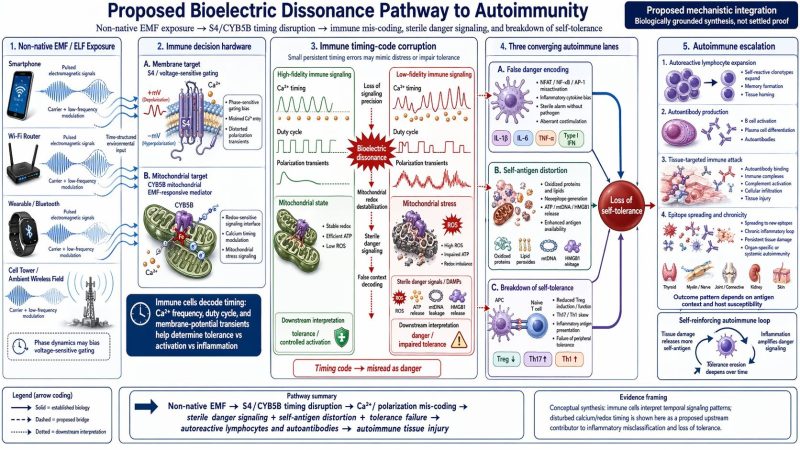
That is precisely the point RF Safe has been making: modern wireless exposure is not just “weak heat.” It is structured electromagnetic signaling imposed on living systems that depend on timing, ion gradients, calcium waves, mitochondrial redox balance, and gene-regulated repair.
What the Editorial Is Really About
The editorial is not a single laboratory experiment. It is a synthesis and framing article for a broader Research Topic developed from the 4th International Expert Forum on the Public Health and Environmental Impacts of Cellular and Wireless Radiation Exposure, held at Yale Medical School in June 2024. The Frontiers Research Topic describes the symposium as a meeting focused on wireless and cellular radiation impacts on public health and the environment, including evidence for non-thermal biological effects.
The editorial’s main argument is simple but powerful:
Current RF safety standards remain rooted in outdated assumptions from the mid-20th century, while the evidence base has moved toward biologically plausible mechanisms involving ion-channel disruption, calcium imbalance, oxidative stress, mitochondrial effects, DNA damage, developmental vulnerability, and cancer-related endpoints.
The authors explicitly point to a long-standing institutional divide: independent scientists have repeatedly reported non-thermal biological effects, while standards-setting bodies and industry-aligned interpretations have often minimized or excluded those findings. The editorial connects this problem to Nicholas Steneck’s The Microwave Debate, which documented how early microwave-risk controversies were shaped not only by data, but by institutional power, ideology, and the rejection of non-thermal mechanisms.
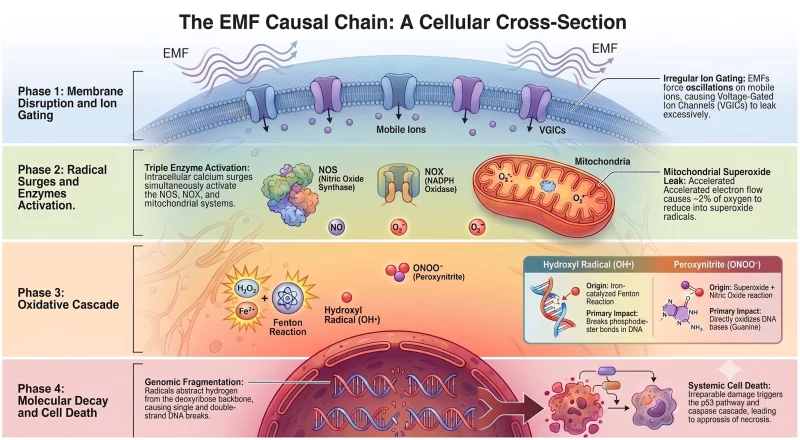
Figure 1: The EMF Causal Chain
The infographic attached to the editorial, titled “The EMF Causal Chain: A Cellular Cross-Section,” presents a four-phase mechanistic model. The figure should be understood as a conceptual pathway, not as direct proof that every exposure produces every endpoint. But its importance is that it gives biological structure to what regulators have too often treated as disconnected observations.
Phase 1: Membrane Disruption and Ion Gating
The first phase begins at the cell membrane. The figure shows EMF exposure interacting with mobile ions and voltage-gated ion channels. This is where the thermal-only model begins to fail.
Living cells are electrical systems. Their membranes maintain voltage gradients. Their ion channels open and close according to extremely precise electrochemical timing. If pulsed or polarized RF/ELF components interfere with ion motion or channel gating, the issue is not temperature. The issue is biological timing.
The editorial highlights calcium efflux and calcium disruption as a recurring historical fault line. Calcium signaling was discussed decades ago, dismissed by dominant engineering-centered standards culture, and now reappears as a central mechanistic bridge. The authors specifically note that Panagopoulos and colleagues provide biological plausibility through an ion forced-oscillation model, while calcium disruption becomes a trigger for downstream oxidative stress.
RF Safe’s alignment here is direct: the danger is not merely absorbed power. The danger is interference with bioelectric regulation.
Phase 2: Radical Surges and Enzyme Activation
The second phase shows intracellular calcium surges activating major radical-generating systems: nitric oxide synthase, NADPH oxidase, and mitochondria.
This matters because oxidative stress is not a vague wellness term. It is a biochemical imbalance between reactive species and the body’s repair and antioxidant defenses. When calcium regulation is disrupted, mitochondria can become unstable, electron transport can become less efficient, and reactive oxygen species can rise.
The WHO-commissioned oxidative-stress review by Meyer et al. is listed in the editorial’s references, and the editorial uses oxidative stress as part of the mechanistic basis for challenging the thermal-only paradigm.
RF Safe has long argued that mitochondrial sensing belongs at the center of the RF debate. Mitochondria are not just “power plants.” They are redox sensors, calcium buffers, immune-signaling regulators, and apoptosis decision-makers. When wireless exposure is treated only as a heating question, the mitochondrion disappears from policy. That is a scientific blind spot.
Phase 3: Oxidative Cascade
The third phase shows the escalation from reactive oxygen and nitrogen species into more damaging chemistry: hydrogen peroxide, Fenton chemistry, hydroxyl radicals, and peroxynitrite.
This is the phase where a signaling disturbance can become molecular damage.
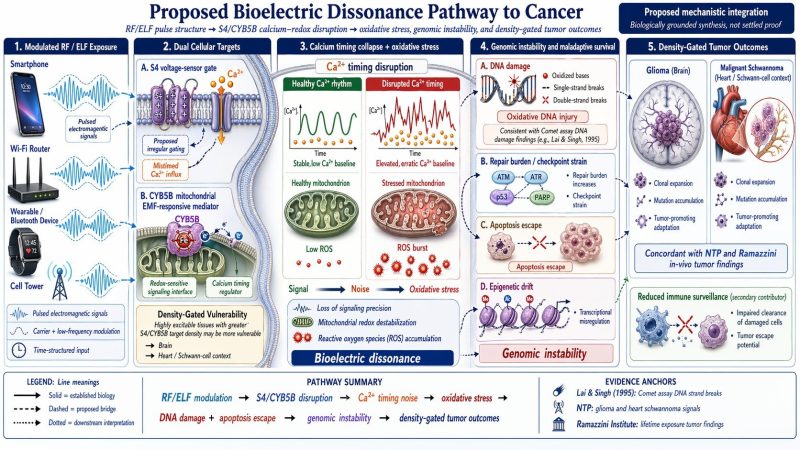
Hydroxyl radicals can damage DNA backbones. Peroxynitrite can oxidize DNA bases and proteins. Lipids, membranes, enzymes, and mitochondrial components can also be affected. This is why oxidative stress is not an isolated endpoint; it is a gateway mechanism that can connect RF exposure to inflammation, genomic instability, impaired repair, reproductive effects, neurodevelopmental changes, and cancer-related pathways.
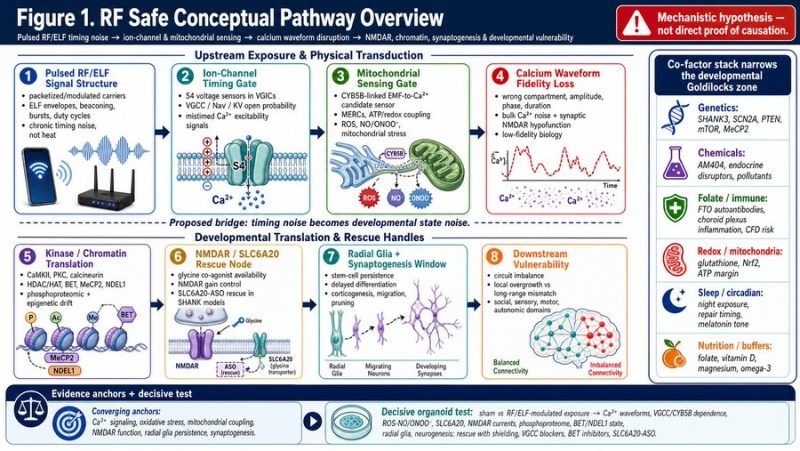
This is also where RF Safe’s “low-fidelity biology” framing becomes useful. A living cell does not need to be cooked to be disrupted. If calcium waveforms, mitochondrial redox signaling, and repair timing lose fidelity, the resulting biology may become noisier, less precise, and less resilient.
Phase 4: Molecular Decay and Cell Death
The fourth phase shows DNA fragmentation, p53 pathway activation, caspase signaling, apoptosis, and necrosis.
This phase is not claiming that every RF exposure kills cells. Rather, it illustrates the high-end consequence of cumulative oxidative and nitrosative stress: when damage exceeds repair capacity, the cell must either repair, malfunction, enter senescence, self-destruct, or progress toward disease-relevant instability.
This is why RF Safe’s position has always emphasized chronic exposure, vulnerable windows, and cumulative risk. A single exposure may not tell the story. Prenatal development, childhood, fertility, sleep physiology, immune stress, and long-term cancer latency are all domains where small disruptions repeated over time can matter.
Why the WHO Reviews Do Not Settle the Question
The first reference in the editorial is the 2025 paper by Melnick, Moskowitz, Héroux, Mallery-Blythe, McCredden, Herbert, and colleagues: “The WHO-commissioned systematic reviews on health effects of radiofrequency radiation provide no assurance of safety.” PubMed summarizes that WHO commissioned 12 systematic reviews and meta-analyses on RF-EMF health effects including cancer, electromagnetic hypersensitivity, cognition, birth outcomes, male fertility, oxidative stress, and heat-related effects.
The editorial’s critique is that WHO-linked review processes can reinforce the thermal-only paradigm when they discount mechanistic evidence, classify uncertain evidence as reassuring, or rely on epidemiological designs that are poorly suited to long-latency, misclassified, rapidly changing exposures.
RF Safe’s position is that “no conclusive proof” is not the same as “proof of safety.” This distinction is central. A public exposed continuously from fetal development through old age deserves standards based on biological protection, not merely on the absence of universally accepted harm under outdated assumptions.
Cancer Evidence: Animal Studies, Human Studies, and the GBM Problem
The editorial identifies Mevissen et al. as one of the more scientifically rigorous WHO-commissioned reviews. That review evaluated RF-EMF exposure and cancer in laboratory animal studies. PubMed describes its objective as a systematic evaluation of RF-EMF effects on cancer in experimental animals.
The editorial contrasts that with human observational review work by Karipidis et al., which it says was challenged by Moon et al.’s independent meta-analysis finding significant associations between mobile phone RF exposure and brain tumors, especially ipsilateral tumors in long-term, high-use categories.
This matters because RF Safe has always emphasized exposure geometry. Phones are not distant whole-body exposures. They are near-field, side-of-head, pocket, lap, and reproductive-organ exposures. Ipsilateral findings matter because they follow the exposure pattern. If the side of use matters, then treating mobile-phone exposure as a generic lifestyle variable can wash out the signal.
The editorial also raises an important point about glioblastoma multiforme, noting that GBM incidence in England more than doubled between 1994 and 2015 while some lower-grade tumors declined. The implication is not that RF exposure alone explains GBM trends. The implication is that serious tumor trends should not be dismissed by broad tumor grouping or weak exposure assessment.
RF Safe’s Longstanding Mechanism Argument
The importance of this editorial is that it validates the direction of the RF Safe argument:
The biological debate must move from heat to signaling.
RF Safe has repeatedly pointed toward mechanisms involving:
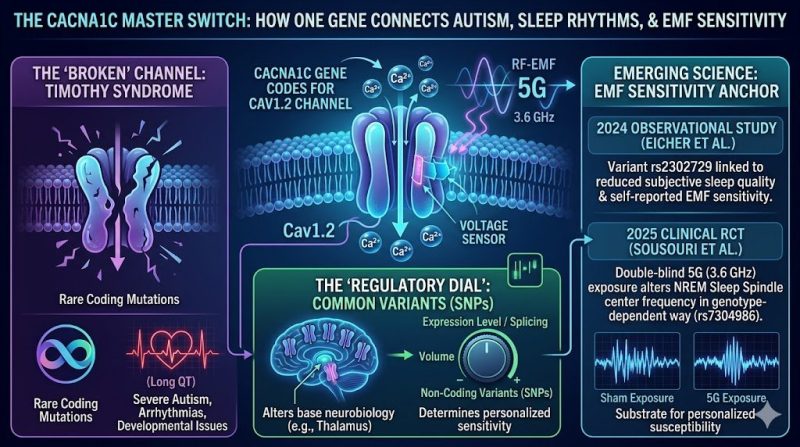
Voltage-gated calcium channels and membrane-level electrical sensitivity.
Calcium waveform disruption and loss of biological timing fidelity.
Mitochondrial redox stress and altered electron-flow stability.
Reactive oxygen and nitrogen species, including superoxide, nitric oxide interactions, hydroxyl radicals, and peroxynitrite.
DNA damage, impaired repair signaling, apoptosis, and long-latency disease relevance.
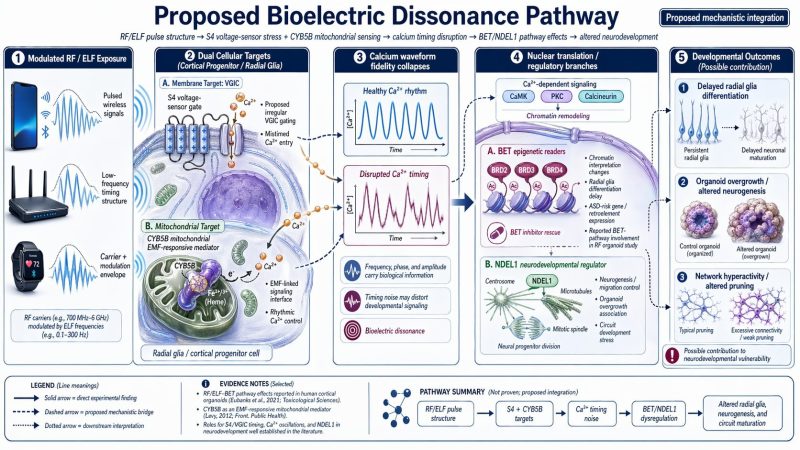
Developmental vulnerability, especially fetal and childhood sensitivity to calcium-dependent gene expression and neurodevelopmental timing.
The editorial’s discussion of fetal-brain sensitivity is especially important. It notes that original research in the Research Topic found prenatal RF-EMF implications in rats, including changes involving calcium homeostasis and gene/protein expression in the hypothalamus of exposed offspring.
That is exactly why RF Safe has argued that children cannot be treated as small adults. Development is timing. Neurodevelopment is bioelectric patterning, calcium signaling, mitochondrial metabolism, synapse formation, and gene regulation. Disrupt the timing, and the effect may not look like a burn. It may look like altered developmental trajectory.
The Policy Failure: Thermal Standards in a Non-Thermal World
The editorial is ultimately a policy document as much as a scientific one. It argues that existing standards and regulations may be inadequate because technological deployment has outrun health-protective science. It also says precaution should not be understood as opposition to technology, but as governance that aligns innovation with public and environmental health.
That is the RF Safe position in one sentence: safer technology is not anti-technology.
The solution is not to abandon communication. The solution is to stop pretending that a 1990s thermal compliance framework is sufficient for a 24/7 wireless world of smartphones, wearables, Wi-Fi, small cells, smart meters, Bluetooth devices, and dense infrastructure.
RF Safe’s preferred direction remains practical:
Reduce unnecessary exposure.
Restore informed consumer choice.
Protect children and pregnant women first.
Update exposure limits around biological endpoints, not just heating.
Require honest labeling and real-world testing.
Prioritize wired, fiber, and optical technologies where feasible.
Move schools, homes, and public infrastructure toward lower-RF designs.
Develop a Clean Ether approach: modern connectivity with biological compatibility.
What This Editorial Adds
This editorial does not end the debate. It does something more important: it reframes the debate.
For decades, the public was told that if wireless radiation does not heat tissue, it cannot matter. Figure 1 shows why that claim is biologically obsolete. The pathway from membrane disruption to calcium imbalance, radical generation, oxidative cascade, DNA damage, and cell fate is not fringe speculation. It is a coherent mechanistic model supported by decades of observations and increasingly visible in mainstream review discussions.
The editorial’s closing point is the one policymakers should hear clearly: the question is no longer whether RF-EMF can interact with biological systems. The question is how risks from those interactions should be reduced.
RF Safe has been asking that question for more than two decades. The answer is not fear. The answer is biologically informed design.
References
- Melnick RL, Moskowitz JM, Héroux P, Mallery-Blythe E, McCredden JE, Herbert M, et al. The WHO-commissioned systematic reviews on health effects of radiofrequency radiation provide no assurance of safety. Environmental Health. 2025;24:70. doi: 10.1186/s12940-025-01220-4.
- Steneck NH. The Microwave Debate. Cambridge, MA: MIT Press; 1984.
- Mevissen M, Ducray A, Ward JM, Kopp-Schneider A, McNamee JP, Wood WW, et al. Effects of radiofrequency electromagnetic field exposure on cancer in laboratory animal studies, a systematic review. Environment International. 2025;199:109482. doi: 10.1016/j.envint.2025.109482.
- Karipidis K, Baaken D, Loney T, Blettner M, Brzozek C, Elwood M, et al. The effect of exposure to radiofrequency fields on cancer risk in the general and working population: a systematic review of human observational studies, Part I: most researched outcomes. Environment International. 2024;108983. doi: 10.1016/j.envint.2024.108983.
- Moon J, Kwon J, Mun Y. Relationship between radiofrequency electromagnetic radiation from cellular phones and brain tumor: meta-analyses using various proxies for RF-EMR exposure-outcome assessment. Environmental Health. 2024;23:82. doi: 10.1186/s12940-024-01117-8.
- Zhang Y, Zhang Y, Ye Z, Yang S, Liu M, Wu Q, et al. Mobile phone use and risks of overall and 25 site-specific cancers: a prospective study from the UK Biobank Study. Cancer Epidemiology, Biomarkers & Prevention. 2024;33:88-95. doi: 10.1158/1055-9965.EPI-23-0766.
- Hardell L, Nilsson M, Koppel T, Carlberg M. Aspects on the International Commission on Non-Ionizing Radiation Protection (ICNIRP) 2020 guidelines on radiofrequency radiation. Journal of Cancer Science and Clinical Therapeutics. 2021;5:250-285. doi: 10.26502/jcsct.5079117.
- Nordhagen EK, Flydal E. WHO to build neglect of RF-EMF exposure hazards on flawed EHC reviews? Case study demonstrates how “no hazards” conclusion is drawn from data showing hazards. Reviews on Environmental Health. 2024;40:27788. doi: 10.1515/reveh-2024-0089.
- Philips A, Henshaw DL, Lamburn G, O’Carroll MJ. Brain tumours: rise in glioblastoma multiforme incidence in England 1995-2015 suggests an adverse environmental or lifestyle factor. Journal of Environmental and Public Health. 2018;2018:7910754. doi: 10.1155/2018/7910754.
- Meyer F, Bitsch A, Forman HJ, Fragoulis A, Ghezzi P, Henschenmacher B, et al. The effects of radiofrequency electromagnetic field exposure on biomarkers of oxidative stress in vivo and in vitro: a systematic review of experimental studies. Environment International. 2024;194:108940. doi: 10.1016/j.envint.2024.108940.