
Every weekday morning, my eight-year-old daughter walks into a second-grade classroom that sits 465 feet from a three-sector cell tower.
That number should matter.
It should matter to parents. It should matter to school boards. It should matter to city councils. It should matter to every mayor, zoning board, pediatrician, legislator, and federal official who claims to care about children.
But under federal law, it is not allowed to matter.
That is the moral obscenity of Section 704 of the Telecommunications Act of 1996.
In one quiet preemption clause, Congress stripped local governments of the power to reject wireless facilities on the basis of the environmental effects of radiofrequency emissions, so long as those facilities comply with FCC limits. In plain English: if a cell tower meets the FCC’s outdated exposure rules, your town cannot say no because of health concerns.
Not near a playground.
Not near a school.
Not near a child’s bedroom.
Not even when parents bring scientific evidence, medical testimony, and legitimate concern for the developing bodies of their children.
Section 704 did not merely streamline telecommunications deployment. It created a legal gag order around one of the most important public-health questions of the wireless age.
It turned children into silent stakeholders in a national experiment they never consented to.
The Law That Made Health Legally Irrelevant
On February 8, 1996, President Bill Clinton signed the Telecommunications Act of 1996 into law. It was sold to the American people as modernization, competition, and connection. It promised a new digital future.
But hidden inside that future was a trap.
Section 704 preserved local zoning authority with one hand, then hollowed it out with the other. Cities and counties could still debate setbacks, aesthetics, paperwork, and tower height. But the one issue parents care about most — the biological impact of chronic radiofrequency exposure — was removed from local decision-making.
That is the poison pill.
A community can argue that a tower is ugly. It can argue that the application is incomplete. It can argue about landscaping.
But it cannot reject a tower because parents fear what continuous microwave exposure may do to children.
This is not democracy. This is managed consent.
This is not local control. This is federal preemption on behalf of a private wireless buildout.
This is not science-based public policy. This is a legal shield built around an assumption: that the FCC’s exposure limits are good enough, forever, for everyone.
But they are not good enough. They were never designed around children’s chronic, real-world exposure in the wireless-saturated environment we live in today.
The Constitutional Wound
Section 704 should be understood as more than bad policy. It is a constitutional wound.
The First Amendment concern is obvious: parents, doctors, scientists, and residents may speak, but their speech is made legally irrelevant at the decisive moment. They can stand at a public hearing and warn about health risks, but local officials are barred from acting on those warnings if the facility complies with FCC standards.
That is a hollow version of petitioning government. The mouth is permitted to move, but the government’s ears are sealed by statute.
The Tenth Amendment concern is just as clear. Land use, zoning, schools, neighborhoods, and protection of local welfare have traditionally belonged to states and local governments. Section 704 reaches into that local police power and says: you may govern your community, except when the wireless industry needs your silence.
The Fifth Amendment issue should be raised as a serious constitutional argument. Radiofrequency energy does not stop at a property line. It crosses into homes, bedrooms, classrooms, and playgrounds. When the federal government authorizes a physical environmental exposure that property owners cannot exclude, cannot vote away, and cannot challenge on health grounds, the taking question belongs on the table.
Maybe courts have not yet had the courage to confront RF exposure in those terms. But parents do not need a judge’s permission to recognize the invasion.
When a force crosses the boundary of your home and your child’s body, and the law forbids you from objecting on health grounds, something has gone profoundly wrong.
The FCC Was Never the Nation’s Pediatrician
The FCC is not a medical agency.
It auctions spectrum. It licenses communications infrastructure. It manages markets, carriers, technical standards, and deployment. Its institutional center of gravity is commerce, not children’s biology.
Yet Section 704 effectively makes FCC compliance the master key that unlocks every neighborhood in America.
That is backwards.
The agency that profits the federal government through spectrum auctions should not be the final guardian of children’s exposure to the very emissions that make those auctions valuable.
This is the conflict at the heart of the wireless era: the federal government sells access to the electromagnetic commons, industry monetizes that access, and children absorb the externalized risk in homes and schools.
That is why “The Silent Auction of Childhood” is not just a metaphor. It is the structure of the system.
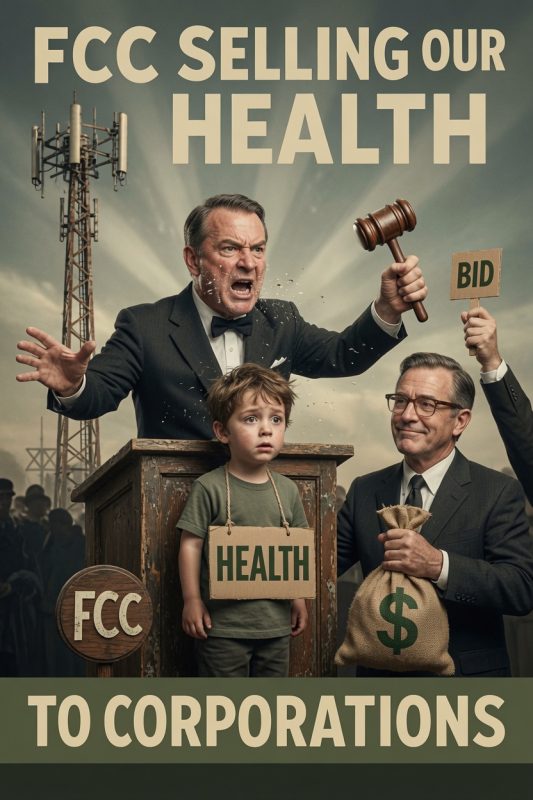
The auction happens in Washington.
The exposure happens in the classroom.
The profit is booked by shareholders.
The risk is carried by children.
The Science Was Never Settled
The wireless industry wants a simple story: if it does not heat tissue, it does not harm tissue.
That thermal-only worldview is the foundation of the regulatory failure.
But biological systems are not buckets of water. Children are not plastic test dummies. Living tissue communicates through electrical gradients, calcium signaling, redox balance, membranes, mitochondria, and exquisitely sensitive regulatory networks.
The question was never merely: does RF radiation cook tissue?
The real question is: can chronic, pulsed, polarized, non-native electromagnetic exposure interfere with biological regulation below the heating threshold?
For decades, studies have raised concerns involving oxidative stress, DNA damage, fertility, neurological effects, sleep disruption, blood-brain-barrier changes, and tumor findings in animal models. Reasonable people can debate mechanisms, dose-response, and causality. But what cannot be honestly defended is the claim that the science is settled enough to silence local governments.
In 2021, the D.C. Circuit Court of Appeals rebuked the FCC for failing to provide a reasoned explanation for keeping its 1996-era RF exposure framework in place. The court specifically faulted the agency for failing to adequately address evidence of harm unrelated to cancer, children’s vulnerability, long-term exposure, and the modern wireless environment.
That should have been a national turning point.
Instead, the machinery of delay kept grinding.
A federal court said the agency had not done its homework, and yet Section 704 continues to treat FCC compliance as the end of the health conversation.
That is not precaution.
That is institutional denial.
The NTP Warning Shot
The National Toxicology Program’s large-scale animal studies should have triggered urgent follow-up. The NTP reported clear evidence of malignant heart schwannomas in male rats exposed to high levels of cellphone-type radiofrequency radiation, along with some evidence of brain and adrenal tumors.
Industry tried to minimize it. Regulators tried to contextualize it away. But the finding remains a warning shot from one of the most important toxicology programs in the country.
The rational response would have been more research, better exposure standards, child-specific safety margins, and serious re-evaluation of tower siting near schools.
Instead, the country got more antennas, more preemption, more small cells, more wireless dependency, and less meaningful public oversight.
That is the pattern: when the evidence becomes inconvenient, the system does not strengthen child protection. It strengthens the shield around deployment.
Children Are Not Infrastructure
A child’s body is not a cost center.
A school is not a convenient antenna zone.
A neighborhood is not merely a coverage map.
And the electromagnetic environment is not private property to be carved up, auctioned, licensed, and filled with chronic emissions while the people living inside that environment are told their health objections are inadmissible.
This is the great inversion of Section 704: the law treats corporate deployment as urgent and children’s biology as speculative.
But childhood is the most precaution-worthy stage of human life. Children have developing brains, thinner skulls, rapidly dividing cells, longer lifetime exposure windows, and no meaningful ability to consent. They are not small adults. They are biologically vulnerable citizens whose rights must come before carrier convenience.
If we apply the precautionary principle anywhere, it should be where children sleep, learn, and grow.
Safer Paths Were Always Available
The tragedy is that the choice was never between connectivity and protection.
America could have prioritized fiber. We could have built wired-first schools. We could have promoted low-power indoor networks, optical wireless systems, Li-Fi, and infrastructure designs that minimize unnecessary exposure. We could have separated essential communications from convenience-driven saturation.
We still can.
But Section 704 blocks the democratic pressure that would force those safer designs into the marketplace.
If local communities could say, “Not next to our school,” industry would innovate around that boundary.
If parents could demand fiber-first classrooms, policymakers would have to listen.
If cities could weigh health evidence honestly, telecom companies would have to compete on safety, not just speed.
That is why Section 704 must go.
It does not merely protect existing infrastructure. It protects a business model from democratic correction.
Repeal Section 704
Repealing Section 704 does not mean banning technology.
It means restoring constitutional balance.
It means allowing local governments to consider health evidence.
It means allowing parents to petition their officials with arguments that can actually be acted upon.
It means forcing federal agencies to update exposure standards in the real world, not in a frozen 1990s regulatory fantasy.
It means admitting that the wireless revolution was built too quickly, with too little accountability, and with children placed too close to the infrastructure of profit.
This is not a left issue or a right issue.
This is a parent issue.
This is a local-control issue.
This is a bodily-autonomy issue.
This is a constitutional issue.
This is a children’s-right-to-safety issue.
The wireless industry got its federal shield in 1996. For nearly three decades, communities have lived under that shield while towers multiplied, exposures increased, and agencies failed to modernize the science.
Enough.
No corporation should have the power to place chronic RF emissions near children and then hide behind a federal law that forbids parents from objecting on health grounds.
No agency should be allowed to auction spectrum while ignoring the biological cost of the exposure it enables.
No law should make a child’s health legally irrelevant.
Section 704 was the original sin of the wireless age.
Repeal it.
Restore local rights.
Protect the children.
End the silent auction of childhood.