
Proposed FCC Comments Section
Download, print, and share the PDF version here nonthermal_emf_comments.pdf
Non-Thermal, Nonlinear, and Tissue-Specific EMF Mechanisms Now Require Immediate Investigation Under Public Law 90-602
The Commission should not expand federal preemption, accelerate deemed approvals, or further rely on existing RF exposure limits as a complete answer to health and environmental objections while material scientific questions remain unresolved. The D.C. Circuit has already held that the FCC failed to provide a reasoned explanation that its 1996-era guidelines adequately protect against harmful effects of RF exposure unrelated to cancer, and the court specifically required the Commission to address testing procedures, children, long-term exposure, RF pulsation/modulation, wireless ubiquity, technological developments including Wi-Fi and 5G, and environmental effects.
That remand is now more urgent, not less urgent. Over the last 12 to 24 months, the scientific record has moved beyond generalized debate over “thermal” versus “non-thermal” effects. It now includes specific, falsifiable molecular targets and tissue-specific hypotheses that HHS and FCC can test directly. Those mechanisms include:
- S4 voltage-sensor perturbation in voltage-gated ion channels;
- CYB5B-mediated electromagnetic-field-responsive calcium oscillation at the outer mitochondrial membrane;
- mitochondrial redox and nitric-oxide signaling;
- tissue-specific susceptibility based on the density of excitable membrane machinery, voltage-gated channels, mitochondria, and redox/calcium signaling systems.
Commenters do not assert that these mechanisms conclusively prove that any specific wireless technology causes any specific disease. The point is narrower and stronger: these mechanisms now make non-thermal, nonlinear EMF bioeffects experimentally tractable, biologically plausible, and statutorily impossible for HHS and FCC to ignore.
I. The relevant exposure question is not merely carrier frequency or average power
The FCC’s current compliance structure remains centered on time-averaged SAR and power-density metrics that were designed primarily to prevent excessive tissue heating. That framework does not adequately answer whether biologically timed, pulsed, modulated, polarized, coherent, multi-source emissions can perturb calcium, redox, and excitable-membrane signaling without bulk heating.
Wireless communication fields are not simple continuous sine waves. Panagopoulos et al. describe wireless communication EMFs as microwave carrier waves modulated by extremely-low-frequency signals and included in on/off pulses repeated at ELF rates, with substantial low-frequency variability. They identify this low-frequency variability as central to the proposed bioactivity of modern wireless fields.
That distinction matters. A GHz carrier may be the nominal spectrum allocation, but biological systems may respond to the low-frequency envelope, pulse repetition, duty cycle, peak-to-average ratio, and temporal structure carried by the signal. For example, Panagopoulos et al. identify GSM frame repetition near 217 Hz and newer cellular systems with nominal frame structures around 100 Hz, while emphasizing that real-world wireless emissions vary with technology, traffic, and modulation. Common Wi-Fi beacon intervals are often configured at 100 time units, and 100 TUs equals 102.4 milliseconds, which corresponds to approximately 9.77 Hz.
The policy consequence is direct: FCC compliance analysis should not treat biologically relevant exposure as equivalent to average RF carrier power alone. It must also evaluate carrier frequency, low-frequency envelope, pulse repetition, duty cycle, peak-to-average ratio, rise/fall time, modulation type, traffic-load variability, beamforming maxima, and aggregate exposure from multiple sources.
II. S4 voltage sensors provide a nanoscale, mathematically specified non-thermal mechanism
Voltage-gated ion channels are fundamental biological switching elements. Their S4 segments are positively charged voltage sensors that help determine when the channel opens or closes. Panagopoulos et al. describe the voltage sensors of VGICs as four symmetrically arranged S4 helices, with an effective net charge of approximately 1.7 elementary charges per S4 sensor. They further state that at least four dehydrated mobile ions are positioned less than 1 nanometer from the S4 sensors near the channel gate.
That geometry is critical. In the Ion Forced Oscillation–VGIC model, an external polarized, coherent, slow-varying electromagnetic field need not directly force the entire channel gate open. Instead, the field can induce oscillatory displacement of mobile ions within or near the ion channel pore. Because those ions are within roughly 1 nanometer of the S4 voltage sensors, extremely small ion displacements can alter the Coulomb force on the voltage sensor. Panagopoulos et al. state that this additional Coulomb force can contribute to channel opening or closing and provide the relevant equation using q = 1.7qe, mobile ion charge zqe, relative permittivity near 4, and initial charge distance r = 1 nm.
The simplified force relationship can be expressed as: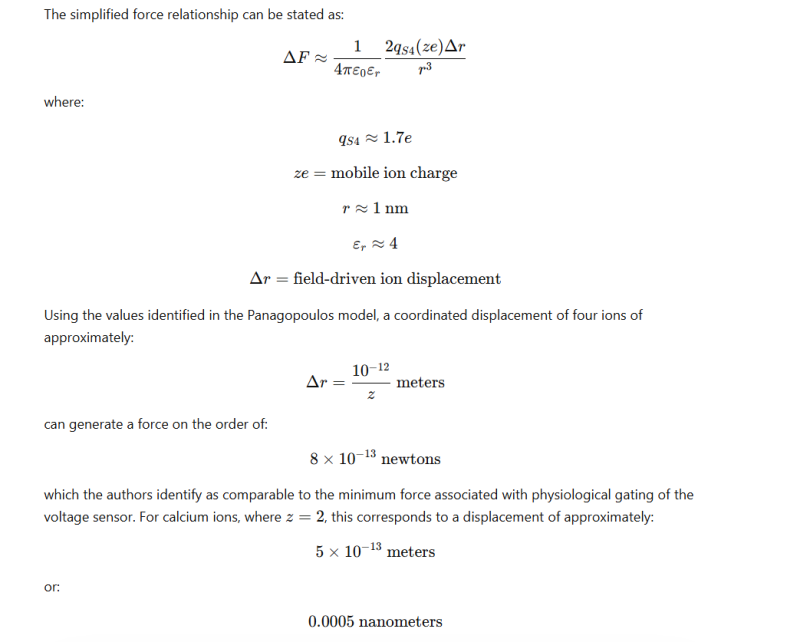
Commenters do not ask the FCC to accept this model as finally proven. Commenters ask the FCC and HHS to do what the law requires: test it. The S4/VGIC model is not speculative in the legally irrelevant sense; it is a concrete mechanistic hypothesis with defined geometry, defined molecular targets, defined electrical variables, and testable predictions.
If FCC compliance metrics average exposure over 6 or 30 minutes while the biologically relevant endpoint is nanometer-scale perturbation of ion-channel timing, then the existing metric may be measuring the wrong variable.
III. CYB5B changes the evidentiary posture because it supplies a specific mitochondrial EMF-responsive target
The 2026 Cell paper by Kim et al. materially changes the mechanistic record. According to the Cell/ScienceDirect/PubMed abstract and indexing materials, the authors developed an electromagnetic-field-inducible in vivo gene switch and used a CRISPR-Cas9 screen to identify cytochrome b5 type B, Cyb5b, as an essential mediator likely acting as an EMF sensor. The same abstract materials report that the switch was activated through rhythmic oscillatory calcium dynamics rather than generic calcium influx.
This finding should be used with precision. The Cell paper does not prove that ordinary Wi-Fi routers, cell phones, or towers cause any particular disease. It does something narrower but highly significant: it identifies a specific protein and calcium-oscillation pathway through which electromagnetic fields can be transduced into controlled gene expression under defined experimental conditions.
That is precisely the kind of evidence that agencies have historically claimed was missing from the non-thermal EMF debate: a candidate transducer.
CYB5B is not a vague or hypothetical biological concept. NCBI identifies CYB5B as a protein-coding gene whose official full name is cytochrome b5 type B. NCBI states that CYB5B enables heme binding activity, contributes to nitrite reductase activity, is involved in nitric oxide biosynthetic processes, is located in membranes, and is part of a nitric-oxide synthase complex. NCBI also annotates CYB5B as involved in response to oxidative stress and located or active in the mitochondrial outer membrane.
That “day job” matters. CYB5B sits at the intersection of heme chemistry, membrane biology, nitric oxide, oxidative stress, mitochondrial signaling, and calcium-redox regulation. Those are the very biological domains implicated in non-thermal EMF hypotheses. The discovery of CYB5B as a likely EMF-responsive mediator therefore creates a specific and falsifiable research target.
Before this paper, agencies could more easily claim that weak-field, non-thermal biology lacked a defined molecular transducer. After this paper, that claim is no longer adequate. The correct federal response is not dismissal. It is targeted investigation.
IV. The S4–CYB5B framework converges on calcium timing and mitochondrial redox fidelity
The S4/VGIC model and the CYB5B finding converge on a common biological theme: disruption or modulation of calcium timing.
Calcium is not merely a bulk concentration variable. Cells use calcium as a temporal code. The frequency, amplitude, phase, duration, localization, and recovery kinetics of calcium oscillations can determine downstream gene expression, mitochondrial function, enzyme activity, immune signaling, neuronal signaling, cardiac excitability, and redox state. A generic increase in calcium is not biologically equivalent to a rhythmic oscillatory calcium pattern.
That is why the Cell finding is important: according to the abstract materials, the EMF-inducible gene switch was activated by rhythmic oscillatory calcium dynamics, not by generic calcium influx. The regulatory implication is that SAR and average power density are incomplete metrics if the relevant endpoint is not heat but biological timing fidelity.
Commenters use “low-fidelity biology” in this specific sense: loss of temporal fidelity in endogenous signaling systems, especially calcium and redox signaling, caused or amplified by externally imposed electromagnetic timing patterns. That phrase should not be read as a disease diagnosis or a claim that wireless radiation directly causes a particular endpoint. It is a mechanistic risk concept. Modern pulsed and modulated EMF exposure may act as a timing perturbagen: a physical exposure capable of degrading the fidelity of calcium, membrane-potential, mitochondrial, and redox signaling without requiring bulk tissue heating.
That is the non-thermal, nonlinear risk question HHS and FCC must now resolve.
V. Tissue-specific “density gating” is the proper hypothesis for explaining target-organ signals
The most important next step is not merely to test S4 or CYB5B in isolation. HHS must also test whether tissue susceptibility is governed by what commenters call density gating.
“Density gating” means that the probability of biological perturbation may depend on the local density and functional coupling of susceptible targets: S4-bearing voltage-gated ion channels, excitable membranes, mitochondria, CYB5B/redox machinery, calcium-handling systems, and electron-transfer proteins. In this model, tissue risk would not be uniform across the body. It would be expected to concentrate where excitable-membrane density, mitochondrial density, calcium flux, and redox demand are highest.
This is a hypothesis, not a conclusion. But it is exactly the kind of hypothesis HHS is required to investigate.
The heart is a prime candidate tissue under this framework. Cardiomyocytes have extremely high mitochondrial density; a 2025 Frontiers review states that cardiomyocytes exhibit the highest mitochondrial density among cell types, with mitochondria occupying approximately 40% of cell volume and possessing the highest respiratory capacity. Other cardiac literature states that adult ventricular myocyte mitochondria occupy 30% to 40% of intracellular volume, reflecting the huge energetic demands of the heart. Cardiac myocytes are also electrically excitable cells that depend on tightly timed calcium flux and voltage-gated channel function.
Nervous tissue is also a prime candidate. Neurons are excitable cells that rely on action potentials, ion-channel timing, synaptic transmission, calcium signaling, local ATP supply, and mitochondrial positioning. A 2026 review on neuronal mitochondria states that mitochondrial positioning, ATP generation, calcium buffering, neurotransmitter metabolism, and local protein translation are central to neuronal function.
This matters because the animal evidence has repeatedly raised signals in tissues that are rich in excitable membranes and mitochondrial/redox machinery: brain/glial tumors and cardiac Schwann-cell tumors. Commenters do not claim that density gating proves causation. But density gating is a coherent hypothesis linking:
- the S4 voltage-sensor model;
- CYB5B and mitochondrial redox biology;
- calcium rhythm fidelity;
- heart and nervous-system tissue susceptibility;
- observed animal tumor patterns.
That hypothesis is now sufficiently specific that HHS and FCC must investigate it.
VI. Ramazzini genetic profiling strengthens the translational relevance of the target-tissue signal
The Ramazzini Institute lifetime RFR study reported increased incidences of gliomas and cardiac schwannomas in Sprague Dawley rats. The important question is whether those rare rodent tumors have any translational relevance to human disease. Brooks et al. directly examined that question using targeted next-generation sequencing of rat gliomas and cardiac schwannomas from the Ramazzini study. Their PLOS One abstract states that the rat gliomas histologically resembled low-grade human gliomas, appeared to share some genetic alterations with IDH1-wildtype human gliomas, and that rat cardiac schwannomas also harbored mutations in queried cancer genes.
The paper further reports that multiple variants in genes such as Cdkn2a, Erbb2, Pik3r1, and Tp53 were described in the COSMIC human cancer database for both brain and heart tumors, and that a subset of rat glioma mutations had orthologous relationships to mutations implicated in human gliomas.
This evidence must be framed carefully. The authors noted limitations, including low tumor incidence and limited statistical power. But the study does undercut the categorical dismissal that rodent gliomas and cardiac schwannomas are biologically irrelevant artifacts. When tumor signals occur in brain and heart/Schwann-cell tissues, and when new mechanistic evidence points to S4 voltage sensing, mitochondrial outer membrane signaling, calcium rhythm, and redox biology, the responsible agency response is targeted investigation—not dismissal.
VII. WHO-commissioned animal evidence and EPA-style risk assessment require independent reevaluation
Recent WHO-commissioned systematic-review work and related toxicological risk assessment further underscore the need for agency action. Melnick, Moskowitz, and ICBE-EMF report that recent WHO-commissioned systematic reviews concluded with “high certainty” that RF-EMF exposure increases cancer risk and reduces male fertility in experimental animals. They then applied benchmark-dose and traditional uncertainty-factor methods to estimate health-protective whole-body SAR values.
Their reported cancer-risk SAR estimates range from approximately 0.8 to 5 mW/kg for a 1-in-100,000 cancer-risk level, and their male-fertility protective estimates range from approximately 3.3 to 10 mW/kg. They compare those values with the current general-public whole-body SAR limit of 0.08 W/kg, or 80 mW/kg, used by ICNIRP and FCC. They conclude that current general-public limits are 15- to 900-fold higher than their cancer-risk estimates, depending on exposure duration, and 8- to 24-fold higher than their male-fertility estimates.
Commenters do not ask the FCC to treat that paper as a final consensus regulatory limit. But it is a major risk-assessment signal using health-protective toxicological methods. It directly refutes any claim that the animal evidence can be brushed aside without a transparent dose-response and uncertainty-factor analysis. At minimum, the FCC and HHS must explain whether current thermal-centered SAR limits remain adequate when evaluated under conventional toxicological risk-assessment tools applied to chronic, multi-source, pulsed, modulated, non-thermal exposure scenarios.
VIII. Competing human epidemiology must be weighed with conflict and institutional-bias disclosure
If the FCC relies on Karipidis et al. to dismiss non-thermal or carcinogenic concerns, it must disclose the institutional and positional conflicts surrounding that work.
Karipidis et al.’s 2024 WHO-commissioned human observational systematic review concluded, among other things, that RF exposure from mobile-phone use likely does not increase risk of several brain/head tumors and that RF from fixed-site transmitters likely does not increase childhood cancer risk. But the same author list includes Ken Karipidis, Dan Baaken, and Martin Röösli. ICNIRP’s own website identifies Ken Karipidis as ICNIRP Vice Chair and states that he joined ICNIRP’s Scientific Expert Group in 2015, joined the Main Commission in 2020, and has served as Vice Chair since July 2024. ICNIRP identifies Dan Baaken as ICNIRP Scientific Secretary and a member of the ICNIRP Board since July 2024. ICNIRP identifies Martin Röösli as having served as an ICNIRP Commissioner from 2016 to 2024 and as currently contributing to ICNIRP as a Scientific Expert Group member.
This does not prove misconduct, and commenters do not ask the FCC to reject the review solely on that basis. But it is a material institutional and viewpoint conflict—or at minimum an appearance of conflict—because ICNIRP’s guideline paradigm is part of the very thermal-centered framework under review. FCC cannot treat such work as a neutral endpoint while discounting independent or competing evidence on non-thermal mechanisms, animal carcinogenicity, reproductive toxicity, oxidative stress, calcium signaling, and mitochondrial redox effects.
The proper approach is transparency: disclose author affiliations, disclose institutional commitments, identify methodological assumptions, and weigh the evidence against independent lines of animal, mechanistic, toxicological, and molecular evidence.
IX. Public Law 90-602 gives HHS both the duty and the authority to investigate
Congress already created the relevant statutory framework. Public Law 90-602, the Radiation Control for Health and Safety Act of 1968, is now reflected in the Electronic Product Radiation Control provisions of the Federal Food, Drug, and Cosmetic Act. FDA’s own summary states that these provisions apply to electronic products that contain or act as part of an electronic circuit and emit electronic product radiation; it defines electronic product radiation to include ionizing or non-ionizing electromagnetic radiation emitted from an electronic product as a result of operation of an electronic circuit. FDA’s examples of non-medical covered electronic products include cordless and cellular telephones.
21 U.S.C. § 360ii requires the Secretary to establish and carry out an electronic product radiation control program designed to protect public health and safety. That program includes developing and administering performance standards, conducting and supporting research to minimize unnecessary electronic product radiation, studying and evaluating emissions and exposure conditions, and developing and testing procedures for minimizing exposure.
21 U.S.C. § 360kk authorizes the Secretary to prescribe performance standards for electronic products to control radiation emissions when necessary to protect public health and safety. In developing those standards, the Secretary must consider the latest available scientific and medical data, standards recommended by expert bodies, technical feasibility, and testing reliability. FDA also states that it shares regulatory responsibilities for cell phones with FCC, provides scientific input and expertise to FCC, and is responsible for collecting, analyzing, and making available scientific information on the hazards and control of electronic product radiation.
Thus, HHS and FDA cannot treat the S4/VGIC model, CYB5B, mitochondrial redox signaling, and density-gating hypotheses as someone else’s problem. Congress assigned HHS the job of studying electronic product radiation, evaluating exposure conditions, and developing procedures and standards to minimize unnecessary exposure.
X. Required federal research agenda
HHS, FDA, NIH, NIEHS, and FCC should immediately initiate or fund a coordinated research program addressing the following questions.
First, agencies should test CYB5B necessity and sufficiency. Experiments should use CYB5B knockout, knockdown, overexpression, and rescue models to determine whether CYB5B is necessary or sufficient for EMF-induced calcium oscillation under defined exposure conditions.
Second, agencies should test CYB5B redox-domain specificity. Studies should determine whether mutations affecting CYB5B heme binding, membrane localization, electron-transfer function, nitric-oxide biology, or redox activity alter EMF responsiveness.
Third, agencies should test telecom-like waveforms, not merely idealized 50/60 Hz fields. Experiments should include low-frequency envelopes and pulse structures relevant to wireless systems, including approximately 9.77 Hz Wi-Fi beacon periodicity, GSM-like 217 Hz repetition, nominal 100 Hz frame structures, Bluetooth/Wi-Fi duty cycles, LTE/5G traffic-dependent TDD patterns, and beamforming-related peak dynamics.
Fourth, agencies should test S4/VGIC involvement using voltage-gated calcium, sodium, potassium, and proton channel systems. Studies should include channel blockers, S4-domain mutants, electrophysiology, and live-cell calcium imaging.
Fifth, agencies should test density gating directly. Tissues and cell types should be compared according to mitochondrial density, CYB5B expression, voltage-gated channel density, calcium-handling intensity, and redox demand. Cardiomyocytes, neurons, glia, Schwann cells, sperm, immune cells, and stem/progenitor cells should be prioritized.
Sixth, agencies should measure calcium rhythm fidelity, not merely total calcium influx. Endpoints should include oscillation frequency, amplitude, phase coherence, burst structure, recovery time, spatial localization, and coupling to gene expression.
Seventh, agencies should measure mitochondrial redox endpoints, including mitochondrial membrane potential, NADH/NAD+ ratio, FAD/FADH2 dynamics, reactive oxygen species, nitric oxide, peroxynitrite, glutathione status, electron transport chain function, oxidative DNA damage, and mitochondrial calcium handling.
Eighth, agencies should measure exposure using biologically relevant physical metrics: carrier frequency, electric and magnetic field strength, SAR, absorbed power density, peak field, RMS field, duty cycle, pulse repetition frequency, rise/fall time, crest factor, peak-to-average ratio, modulation type, polarization, traffic loading, beamforming behavior, and aggregate exposure from multiple simultaneous sources.
Ninth, agencies should test everyday and FCC-compliant exposure levels, not only high-intensity laboratory exposures. The regulatory question is whether current legal exposure conditions are adequately protective.
Tenth, all work should be blinded, sham-controlled, independently replicated, and accompanied by full waveform disclosure and raw data availability.
XI. Requested FCC and HHS action
Commenters respectfully request that the FCC not finalize any rule that expands preemption, accelerates deemed approvals, narrows local review, or increases reliance on existing RF compliance determinations until the Commission has coordinated with HHS/FDA and provided a reasoned response to the non-thermal, nonlinear, pulsed, modulated, aggregate, and tissue-specific mechanisms described above.
At minimum, the FCC and HHS must answer the following questions before using current RF compliance as a basis for further federal preemption:
- Are SAR and time-averaged power density sufficient metrics for biological endpoints governed by calcium rhythm, ion-channel gating, mitochondrial redox state, nitric-oxide signaling, and gene-expression control?
- Do current FCC testing protocols adequately account for low-frequency envelopes, pulse repetition, peak-to-average ratio, duty cycle, rise/fall time, traffic variability, and beamforming maxima?
- Does CYB5B function as an EMF-responsive biological mediator under exposure conditions relevant to wireless technologies?
- Do S4 voltage sensors in VGICs provide a plausible pathway for non-thermal perturbation of excitable-cell timing?
- Are heart, nervous-system, Schwann-cell, glial, reproductive, or immune tissues more susceptible because of density gating—i.e., high density of mitochondria, CYB5B/redox machinery, voltage-gated channels, and calcium-handling systems?
- Do existing limits remain adequate when evaluated using conventional toxicological risk-assessment methods applied to animal cancer and reproductive-toxicity data?
- Are current rules adequate for chronic, aggregate, multi-source exposures from fixed infrastructure, portable devices, Wi-Fi, Bluetooth, IoT systems, smart meters, and other electronic products?
- What uncertainty factors should apply to children, pregnant persons, workers, medically vulnerable populations, and sensitive biological developmental windows?
- What post-market surveillance, exposure measurement, public disclosure, and adverse-event reporting systems are necessary under the Electronic Product Radiation Control framework?
- What performance standards, warnings, exposure-minimization procedures, or product-design requirements are necessary under 21 U.S.C. §§ 360ii and 360kk?
XII. Proposed conclusion language
The Commission may not lawfully treat unresolved biological questions as resolved merely because the existing framework measures heat. The current record now includes nanoscale S4 voltage-sensor modeling, a newly identified CYB5B-mediated EMF-responsive calcium-oscillation pathway, mitochondrial redox and nitric-oxide biology, animal cancer and reproductive-toxicity evidence, translational genetic profiling of RF-associated rodent tumors, and a coherent tissue-specific density-gating hypothesis.
This record does not require the FCC to declare that wireless radiation causes any particular disease. It does require the FCC and HHS to stop pretending that the only scientifically relevant question is tissue heating. The legal question after the D.C. Circuit remand is whether the FCC can give a reasoned explanation that its rules protect against the full range of biologically plausible harmful effects. The answer cannot be reasoned if it ignores the specific mechanisms that recent science has now placed directly before the agencies.
HHS has a statutory duty under Public Law 90-602 and the Electronic Product Radiation Control provisions to study and evaluate electronic product radiation emissions and exposure conditions, support research to minimize unnecessary exposure, and consider the latest available scientific and medical data when developing performance standards. FCC has a corresponding obligation not to expand reliance on an incomplete RF framework while the agency charged with electronic-product radiation health evaluation has not addressed these newly identified mechanisms.
Accordingly, the FCC should defer any expansion of wireless deployment preemption until HHS/FDA completes an updated, transparent, independent, conflict-disclosed review of non-thermal, nonlinear, pulsed, modulated, aggregate, and tissue-specific EMF bioeffects, including the S4/VGIC, CYB5B, mitochondrial redox, calcium-rhythm, and density-gating hypotheses. Anything less would perpetuate the very analytical failure the D.C. Circuit already remanded.