
The World Health Organization’s recent declaration of the Bundibugyo Ebola outbreak in the Democratic Republic of Congo and Uganda as a Public Health Emergency of International Concern (PHEIC) highlights a terrifying reality. As cases surge across Ituri Province and spill over borders into capitals like Kampala, the international community is facing this crisis missing its most reliable weapon.
Unlike the more common Zaire strain, there is no approved vaccine or specific therapeutic for the Bundibugyo virus. We are fighting a deadly filovirus using the exact same behavioral interventions we have used for decades: isolation, contact tracing, and hoping human beings do not make mistakes. Meanwhile, frontline healthcare workers at facilities like the Bunia Evangelical Medical Centre are actively dying from healthcare-associated (nosocomial) transmission. When behavioral gaps cost lives, we must stop treating an infection control problem purely as a human management issue. We need to treat it as a hard physics problem.
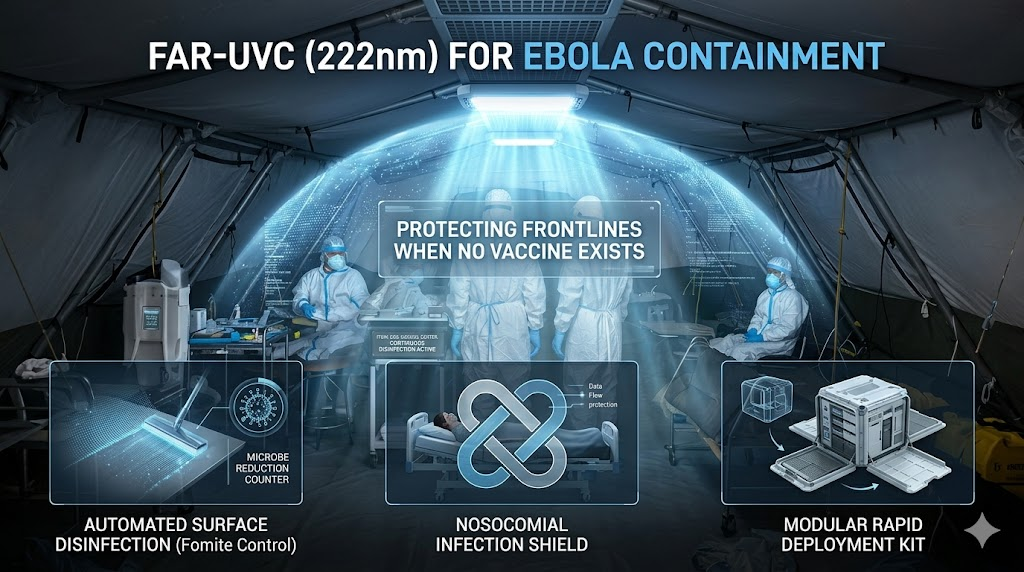
By deploying heavy Far-UVC (222 nm filtered Krypton Chloride excimer) infrastructure to the epicenters, we can implement an environmental shield that protects healthcare workers and halts transmission at the source.
The Exploit: Turning PPE into Radiation Shielding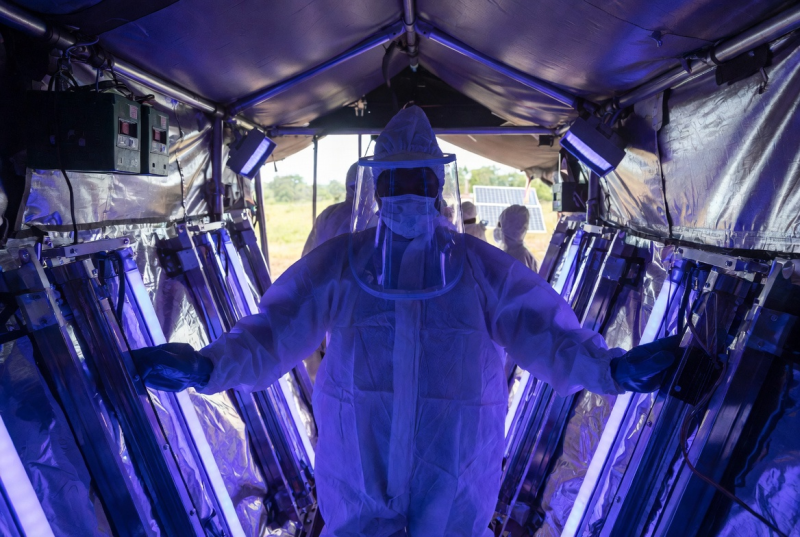
The primary regulatory hurdle for implementing ultraviolet germicidal irradiation in occupied spaces has always been human exposure limits. Even though the American Conference of Governmental Industrial Hygienists (ACGIH) dramatically raised the daily allowable thresholds in 2022—acknowledging that 222 nm light is safely absorbed by the dead outer layer of human skin and the eye’s tear film—bureaucracy moves slow.
But in an Ebola triage center, we can completely bypass this debate by applying a classic engineering exploit: The healthcare workers are already wearing armor.
          [High-Power 222nm KrCl Lamps]
                  \    |    /
                   \   v   /
  [Polycarbonate Visor] -> 100% Opaque to UVC
  [Tyvek Suit / Rubber] -> 100% Absorptive/Shielded
                   |       |
                   v       v
      [Worker Inside is Completely Safe]
Full-body Personal Protective Equipment (PPE)—including thick rubber gloves, Tyvek suits, and polycarbonate or PET face visors—is entirely opaque to UVC light. Because the absorption coefficient of these materials at 222 nm is astronomical, the photons cannot penetrate even a fraction of a millimeter into the suit. The human inside is perfectly insulated.
This means we do not need to trickle the ultraviolet dose to stay under conservative skin and eye limits. Inside dedicated decontamination areas, we can scale the lamp arrays up to high-kilowatt outputs, dropping a massive photon hammer onto the exterior of the suits to destroy viral RNA in seconds.
Circuit-Breaking the Deadliest Room in the Hospital
Ebola is primarily a contact-driven virus, spreading through infectious bodily fluids (blood, vomit, sweat) that heavily contaminate hospital environments. Because of this, the single most dangerous room in an Ebola treatment unit is the doffing area—the room where healthcare workers take off their PPE.
After a grueling, exhausting 4-to-6-hour shift in a sweltering isolation ward, a worker’s cognitive load is spent. A clumsy movement, a splash of sweat, or a minor slip while peeling off a fluid-splattered suit is when self-contamination and lethal exposure most frequently occur.
By building high-power Far-UVC walkthrough decontamination portals directly adjacent to the hot zones, we can completely neutralize this vector.
The “Starfish” Protocol
Instead of a slow chemical wipe-down that relies on manual labor and introduces human error, a worker steps into a continuous-wave KrCl walkthrough chamber for a 10-to-15-second cycle.
-
The Stance: The worker assumes a wide “starfish” pose, opening up armpits and geometric folds to direct line-of-sight exposure.
-
The Scattering Cavity: By lining the interior of the portal with materials featuring high diffuse reflectance for 222 nm light (such as expanded PTFE/Teflon or micro-thin aluminum oxide coatings on the PPE itself), the light bounces dynamically into creases and shadows.
-
The Sole Solution: Utilizing a structural metallic grating or heavy-duty quartz glass floor plate allows lamps to fire from the bottom up, instantly sanitizing the treads of heavy rubber boots to prevent tracking the virus into clean zones.
By hitting the suit with an intense photon blast before it is ever touched or removed, we sanitize the armor while the worker is still safely sealed inside it.
Overcoming Remote Field Logistics
The standard bureaucratic pushback to deploying heavy technology to remote conflict zones like Ituri Province is infrastructure. Diesel fuel is scarce, supply lines are routinely choked by instability, and traditional 254 nm mercury vapor lamps degrade plastics rapidly while generating hazardous waste.
Filtered KrCl excimer technology answers every single one of these constraints:
-
Solar-First Off-Grid Power: Unlike massive HVAC air-filtration systems, modern Far-UVC lamp arrays have a relatively low continuous power draw. They can be configured to run entirely on high-capacity lithium iron phosphate (LiFePO4) battery bricks paired with rapidly deployable, foldable solar blankets. This creates self-sustaining biodefense “islands” that require zero diesel logistics.
-
Material Integrity: Unlike aggressive 254 nm light which rapidly degrades polymers and turns PPE brittle, filtered 222 nm light is absorbed so superficially that it minimizes structural damage to plastic visors and suits, allowing gear to maintain its protective integrity.
A Challenge to First-Principles Engineering
During the COVID-19 pandemic, the Far-UVC manufacturing industry scaled by roughly 10 times. The engineering has been done, the supply chains exist, and the product is sitting on manufacturer shelves worldwide right now. What is entirely missing is the political courage and logistical priority to ship these systems where they are needed most.
This is a direct call to first-principles thinkers, tech leaders like Elon Musk, and innovative logistical arms of organizations like Médecins Sans Frontières (MSF) and the Africa CDC: Stop waiting for a vaccine that hasn’t been engineered yet for this strain. We have the physics, we have the manufacturing scale, and we have an ironclad safety profile when combined with standard medical gear. It is time to assemble modular, ruggedized Far-UVC tactical kits, couple them with off-grid power solutions, and blanket the treatment wards and transit hubs of this outbreak before the frontlines are completely overwhelmed.
Let’s use real physics to solve the problem and protect the biology.