
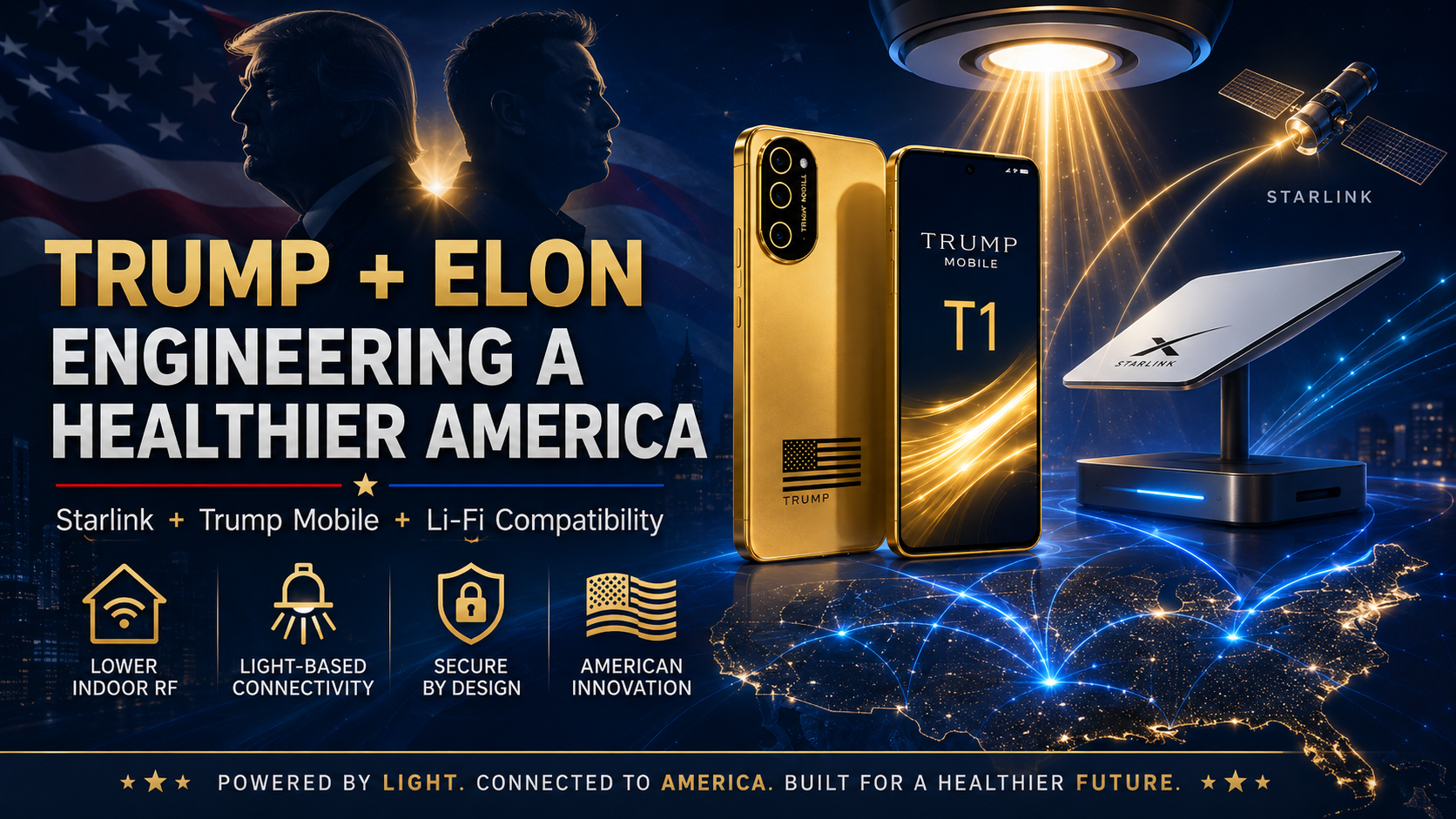
The next move cannot be another press release. It has to be a real engineering alliance.
RF Safe is calling for an immediate partnership between Elon Musk, SpaceX/Starlink, President Trump, Trump Mobile, and the Make America Healthy Again movement to build the world’s first mass-market satellite-to-light consumer connectivity ecosystem: Starlink broadband brought into the home, school, or business, then distributed indoors through Li‑Fi instead of unnecessary microwave radiation.
Starlink has already solved one of the hardest infrastructure problems on Earth: high-speed broadband from low Earth orbit. Starlink describes its network as a low-Earth-orbit satellite constellation capable of delivering broadband for streaming, online gaming, video calls, and other high-data applications, and Starlink is a division of SpaceX. But once that signal reaches the home, today’s router still pushes the final connection through conventional RF Wi‑Fi. Starlink’s Gen 3 router specifications list 802.11 a/b/g/n/ac/ax, Wi‑Fi 6, tri-band 4×4 MU‑MIMO, and two Ethernet LAN ports. That means the missing piece is obvious: make the Starlink router Li‑Fi compatible.
Trump Mobile has the other half of the equation: the branded handset. The T1 already deserves praise for keeping the 3.5mm headphone jack, a feature the video transcript specifically calls out around the 3:07–3:34 mark as an unusual throwback that lets users plug in wired headphones instead of relying only on wireless earbuds. For RF Safe, that matters because the jack makes safer wired and air-tube headset use simple again. But the phone cannot stop there. A Trump phone that truly claims to represent American leadership must not merely be another RF-dependent smartphone. It must become Li‑Fi ready.
The architecture is simple:
Starlink to the roof. Ethernet to the router. Li‑Fi to the room. Trump T1 to the user. Air-tube headset to the ear.
That is the Light Age stack.
RF remains available where RF is necessary: outdoors, in vehicles, in emergency networks, in rural mobility, and anywhere line-of-sight light communication is not practical. But indoors, where Americans spend most of their lives, it is irrational to keep forcing homes, classrooms, hospitals, offices, nurseries, and bedrooms to rely on microwave-based connectivity when light can carry the data.
Li‑Fi is no longer a fantasy. IEEE 802.11bb-2023 is already a formal standard for light communications inside the 802.11 wireless networking family, defining MAC and PHY specifications for wireless connectivity using light. The security case is equally direct: Li‑Fi companies such as pureLiFi emphasize that light does not penetrate walls the way RF signals do, allowing communication to remain physically contained within a room or coverage cone. In a world of cyberattacks, foreign interception, data leaks, and surveillance risk, that is not a limitation. That is a national security advantage.
This is the partnership America needs:
Starlink must build the Li‑Fi router. Trump Mobile must build the Li‑Fi phone. The federal government must require Li‑Fi compatibility in the electronics it buys.
The science makes delay unacceptable. The FCC lost in federal court because it failed to provide a reasoned explanation that its 1996 RF exposure guidelines adequately protect against harmful effects unrelated to cancer. Melnick and Moskowitz’s 2026 risk-assessment paper concluded that current FCC and ICNIRP public whole-body exposure limits are 15- to 900-fold higher than levels estimated to correspond to a 1-in-100,000 excess cancer-risk benchmark, and that those limits also fail to account for reproductive-toxicity endpoints in experimental animals. WHO-commissioned evidence reviews have now reported high-certainty cancer findings in experimental animals, including glioma and heart schwannoma endpoints. Reuters also reported that HHS would launch a new study on cellphone radiation and that FDA removed old webpages containing categorical “cellphones are not dangerous” conclusions while HHS evaluates knowledge gaps around electromagnetic radiation and modern technologies.
This is not the time for “wait and see.” This is the time to engineer exposure reduction into the network itself.
RF Safe’s position is clear: the problem is not merely heat. The problem is biological fidelity. The body is not a thermal sponge. It is a living timing system built on calcium signaling, mitochondrial regulation, redox balance, membrane voltage, and ultra-sensitive biological communication. Chronic, chaotic, unnecessary RF exposure adds timing noise to that system. RF Safe calls this low-fidelity biology: a state where the body must waste repair energy defending itself against entropic electromagnetic noise instead of using that energy for sleep, immune function, development, reproduction, cognition, and cellular restoration. The White House Photonics Pilot proposal already frames Li‑Fi as a secure, biologically aligned alternative that can reduce microwave exposure while improving room-contained communications and national-security resilience.
That same principle must now leave the memo and enter the marketplace.
The Immediate Demand: Launch the Starlink–Trump Mobile Li‑Fi Compatibility Project
Elon Musk and Trump Mobile should announce a joint Li‑Fi compatibility project immediately, with three deliverables.
First, Starlink should develop a Li‑Fi-compatible router platform. That means a Starlink router with conventional Wi‑Fi for legacy support, but with a built-in or modular IEEE 802.11bb Li‑Fi pathway for rooms where users want lower-RF indoor connectivity. The router should support ceiling-mounted, lamp-integrated, and PoE-powered Li‑Fi access points so families, schools, and businesses can convert indoor data traffic from RF to light.
Second, Trump Mobile should make the T1 Li‑Fi ready now through a certified USB‑C Li‑Fi accessory and make the next hardware revision natively Li‑Fi compatible. The phone should include a “Light Mode” that prioritizes Li‑Fi, Ethernet accessories, wired audio, and air-tube headset use while reducing Wi‑Fi, Bluetooth, and other unnecessary RF transmitters when indoors.
Third, Starlink and Trump Mobile should launch pilot deployments in homes, schools, small businesses, veterans’ facilities, rural clinics, and secure government spaces. The pilot should measure RF reduction, network performance, cybersecurity containment, user experience, and biological-wellness markers such as sleep quality, headache incidence, cognitive fatigue, and environmental RF density.
This is how America leads: not by arguing forever over obsolete exposure limits, but by building the safer network before the old system admits defeat.
The Five-Year Procurement Mandate
The federal government should use its purchasing power to force the market forward. The White House itself has recognized that the federal government is the world’s largest buyer of goods and services, and that the federal acquisition system is supposed to deliver best value while fulfilling public-policy objectives. Federal procurement already uses technical requirements to shape cybersecurity and connected-device standards, including IoT cybersecurity requirements tied to NIST guidance. The same logic should now apply to wireless biological safety and optical-network readiness.
Within five years, no federal agency should purchase a router, laptop, tablet, mobile phone, headset, classroom connectivity system, hospital communications system, or government wireless device unless it meets one of two standards:
Native Li‑Fi compatibility, preferably IEEE 802.11bb or successor optical wireless standards.
Certified Li‑Fi expandability, meaning the device can securely support approved Li‑Fi modules through USB‑C, PCIe, Ethernet, PoE, or another high-integrity interface.
This is not a ban on RF. It is a compatibility mandate. It says the government will no longer buy devices that trap America inside a microwave-only indoor network model.
The standard should begin with federal buildings, the White House, military installations, VA hospitals, HHS facilities, secure conference rooms, and government-funded school connectivity projects. Then it should expand across federal procurement and grant programs until Li‑Fi readiness becomes as normal as Wi‑Fi readiness.
Musk, Trump, and the Light Age
Elon Musk has built rockets, electric vehicles, satellites, AI systems, tunnel boring machines, and planetary-scale infrastructure. Starlink has already changed the global connectivity map. But the next frontier is not only space. It is the room.
President Trump and Trump Mobile have a chance to turn a criticized phone launch into a historic technology pivot. The T1 should not be remembered as a gold Android phone that arrived late. It should be remembered as the handset that forced America to ask the right question:
Why are we still using microwave radiation indoors when light can carry the data?
Together, Musk and Trump can bridge the system:
Starlink brings broadband from space. Trump Mobile puts the device in the hand. Li‑Fi brings the signal through light. RF Safe brings the biological-fidelity mission.
That is the alliance.
That is the demand.
That is the path to safer homes, safer schools, safer businesses, and a safer world.
The goal is not less technology. The goal is better technology. The goal is not fear. The goal is biological fidelity by design.
Starlink must become Li‑Fi compatible. Trump Mobile must become Li‑Fi compatible. Federal procurement must require Li‑Fi compatibility within five years.
America should not merely connect the world.
America should connect the world without sacrificing the biological integrity of the people living in it.
Keep the jack. Add the light. Build the Starlink–Trump Mobile Li‑Fi network. Lead the world into the Light Age.