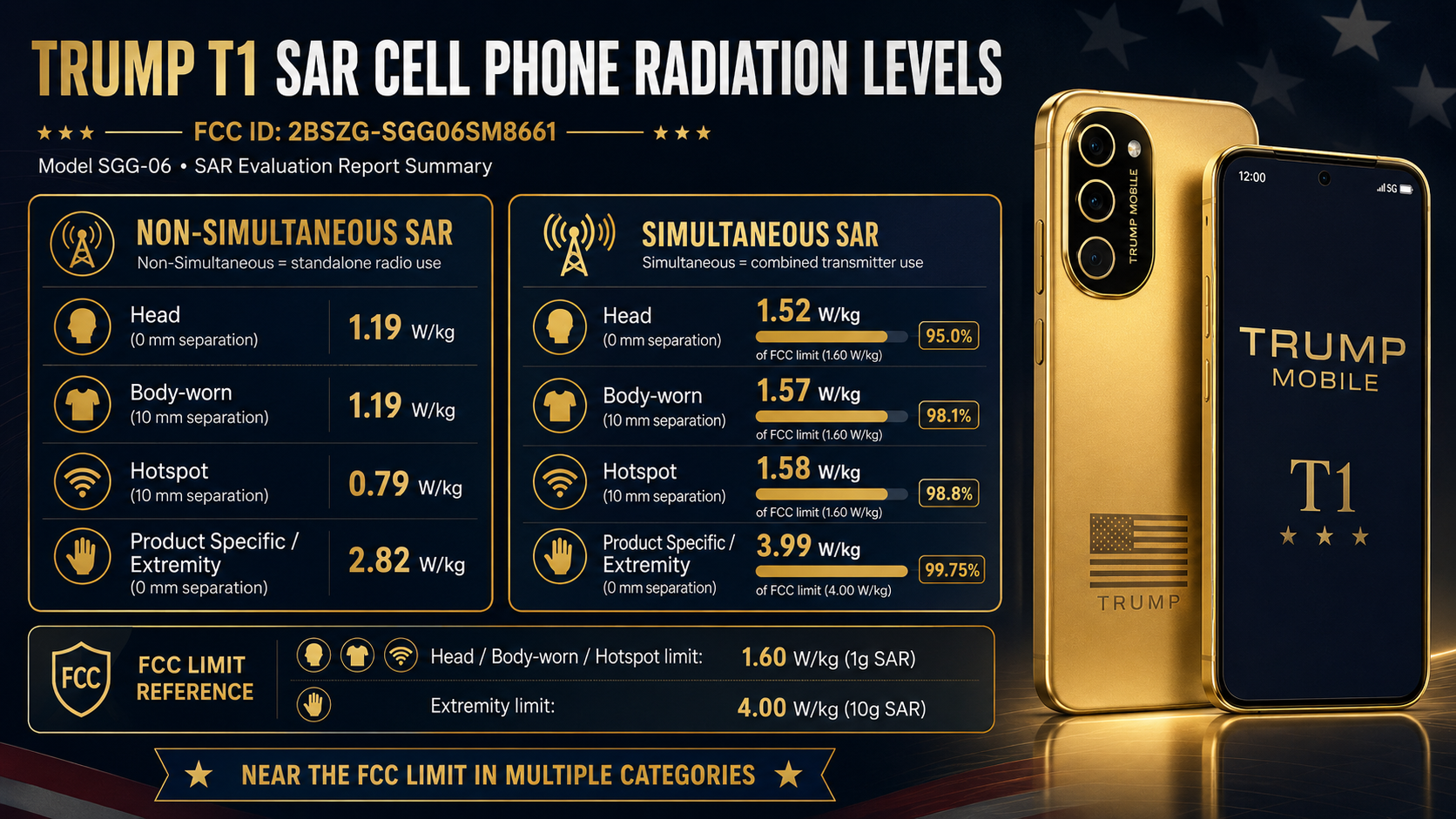
The Trump Mobile T1 is not a low-radiation phone. Based on its SAR Evaluation Report for FCC, the T1 comes in just under the FCC’s legal ceiling in multiple real-world use categories: head, body-worn, hotspot, and extremity exposure. The phone may be “compliant,” but compliance with an outdated thermal rule is not the same thing as biological safety.
The FCC filing identifies the device as a Smart Phone, brand name T1, model SGG-06, with FCC ID 2BSZG-SGG06SM8661. The SAR report was issued on Jan. 7, 2026, by Eurofins E&E Wireless Taiwan Co., Ltd., for applicant Smart Gadgets Global, LLC.
The Trump T1’s Reported SAR Levels
SAR stands for Specific Absorption Rate. It is the rate at which RF energy is absorbed by tissue, expressed in watts per kilogram. The T1 SAR report itself defines SAR as the rate of energy absorbed per unit mass in an object exposed to a radio field.
Here are the key T1 SAR results from the FCC compliance table.
| Exposure condition | Separation distance | Highest simultaneous SAR | FCC limit | Percent of FCC limit |
|---|---|---|---|---|
| Head | 0 mm | 1.52 W/kg | 1.60 W/kg, 1g SAR | 95.0% |
| Body-worn | 10 mm | 1.57 W/kg | 1.60 W/kg, 1g SAR | 98.1% |
| Hotspot | 10 mm | 1.58 W/kg | 1.60 W/kg, 1g SAR | 98.8% |
| Product Specific / Extremity | 0 mm | 3.99 W/kg | 4.00 W/kg, 10g SAR | 99.75% |
The report’s “Highest Reported SAR” table lists Simultaneous SAR per KDB 690783 at 1.52 W/kg head, 1.57 W/kg body-worn, 1.58 W/kg hotspot, and 3.99 W/kg extremity, with the FCC limits shown as 1.60 W/kg and 4.00 W/kg.
That means the Trump T1 is not merely near the regulatory line. In hotspot mode, it is less than 0.02 W/kg below the FCC 1g SAR ceiling. For extremity exposure, it is only 0.01 W/kg below the 10g extremity ceiling.
This is the simplest public takeaway:
The Trump T1 appears to operate essentially right up against the FCC’s maximum allowable SAR limit in simultaneous transmission scenarios.
Standalone vs. Simultaneous SAR: Why the Simultaneous Number Matters
The standalone SAR numbers are lower, but the simultaneous SAR numbers are the ones that reveal the modern exposure problem. A smartphone is not just one transmitter. It can combine cellular, Wi‑Fi, Bluetooth, hotspot, carrier aggregation, and other radios depending on use.
The T1 report explains that for simultaneous transmission, aggregate SAR is scaled according to the maximum tune-up tolerance and actual power used to test each transmitter. It also states that “reported SAR” refers to SAR measured or scaled to the maximum tune-up tolerance limit.
The report also says that when hotspot functions are enabled, actual operations include simultaneous transmission of Wi‑Fi with a separate licensed transmitter, and SAR must be evaluated for each frequency and then spatially summed.
That is why the simultaneous SAR table matters. It reflects the combined-use reality of a modern smartphone.
The FCC Limit Is a Thermal Limit, Not a Biological-Fidelity Limit
The T1 report shows legal compliance. It does not show biological safety.
The FCC general-population SAR limits are 1.6 W/kg averaged over 1 gram of tissue for head/body and 4 W/kg averaged over 10 grams for extremities. The T1’s own SAR report reproduces those FCC exposure limits for the general population / uncontrolled category. Cornell’s e-CFR version of 47 CFR § 1.1310 likewise lists the general-population SAR limits as 0.08 W/kg whole-body, 1.6 W/kg over 1 gram, and 4 W/kg over 10 grams for extremities.
But those limits are built around the old assumption that the main danger is tissue heating. That is the problem.
In Environmental Health Trust v. FCC, the D.C. Circuit found the FCC’s 2019 decision arbitrary and capricious because the agency failed to respond to evidence that RF exposure below current limits may cause negative health effects unrelated to cancer. The court also held that this failure undermined the FCC’s explanations about testing procedures, children, long-term exposure, RF pulsation or modulation, and technological developments since 1996.
The court specifically said the FCC failed to give a reasoned explanation addressing children, long-term exposure, wireless ubiquity, technological developments, and environmental impacts.
That means the old line — “it meets FCC limits, therefore it is safe” — is no longer good enough. It is legally, scientifically, and morally obsolete.
The New Mandamus Petition: FCC Still Has Not Fixed the Problem
The recent filing you were thinking of is a Petition for a Writ of Mandamus.
On May 18, 2026, Children’s Health Defense and co-petitioners filed a new federal action asking the D.C. Circuit to force the FCC to comply with the 2021 mandate. The petition asks the court to direct the FCC to provide the required reasoned explanation within 90 days.
Children’s Health Defense says the case asks the court to issue a Writ of Mandamus requiring the FCC to comply with the 2021 order within 90 days, and to require a 45-day status update.
The petition states that the current RF limits were issued in 1996 and are designed to protect against thermal effects, not non-thermal effects.
That is the central issue: the Trump T1 is being judged by a 1996 thermal framework, while the biological evidence base has moved far beyond heat.
The Melnick–Moskowitz Paper: Current Limits Are Far Too High
The most important recent risk-assessment paper is by Ronald L. Melnick and Joel M. Moskowitz, on behalf of the International Commission on the Biological Effects of Electromagnetic Fields. The paper is titled:
“Exposure limits to radiofrequency EMF do not account for cancer risk or reproductive toxicity assessed from data in experimental animals.”
The paper states that recent WHO-commissioned systematic reviews concluded with high certainty that RF-EMF exposure increases cancer risk and reduces male fertility in experimental animals. It then applies public-health risk-assessment methods to animal cancer and reproductive toxicity data.
The results are devastating for the thermal-only paradigm.
Melnick and Moskowitz report that current FCC and ICNIRP public exposure limits are:
15- to 900-fold higher than exposure levels estimated to correspond to a 1-in-100,000 excess cancer-risk benchmark.
8- to 24-fold higher than levels estimated to protect male reproductive health.
This does not mean the Trump T1’s localized head SAR table is directly “900 times too high” in a simple one-to-one comparison. The paper is addressing whole-body exposure-limit risk assessment. But it does mean something extremely important: the regulatory framework behind the T1’s compliance label is not health-protective enough when modern cancer and fertility endpoints are considered.
In plain English:
A phone can pass FCC SAR testing and still be judged by a standard that leading public-health risk assessment now indicates is orders of magnitude too permissive.
The WHO-Commissioned Animal Evidence Is No Longer Reassuring
The WHO-commissioned animal cancer review included 52 studies and judged the certainty of evidence as high for increased glioma and high for increased heart schwannomas in male rats. The review also says high certainty means the true effect is highly likely to be reflected in the apparent relationship, and it notes that animal cancer bioassays are commonly used to identify potential human carcinogens.
The male-fertility review included 117 animal-study papers and 10 human sperm in vitro papers. Its original publication reported evidence of adverse effects in animal meta-analyses and assigned moderate certainty to reduced pregnancy rate and low certainty to reduced sperm count. A later Environmental Health analysis of the WHO-commissioned reviews notes that the corrigendum changed the certainty grade to “high certainty of evidence that RF-EMF exposure reduces rate of pregnancy” in experimental animal studies, with pregnancy rate treated as a male-fertility endpoint.
The pregnancy and birth-outcomes review is also serious. It reported statistically significant increases in resorbed and dead fetuses, decreases in fetal weight and fetal length, increases in fetal malformations, and detrimental neurobehavioral findings in experimental animals, while also noting limitations in determining effects below heating levels.
Even if policymakers want to debate mechanisms, exposure metrics, or translation from animals to humans, the old blanket reassurance is gone. The evidence now demands precaution, engineering controls, and lower-RF alternatives.
The FDA Has Walked Back Blanket Safety Assurances
The FDA’s old public posture has also changed. Reuters reported in January 2026 that HHS would launch a new study on cellphone radiation and that the FDA had taken down old webpages saying cellphones are not dangerous. HHS spokesman Andrew Nixon said the FDA removed webpages with old conclusions about cellphone radiation while HHS studies electromagnetic radiation, health research, knowledge gaps, and new technologies.
That is a federal walk-back from blanket reassurance.
The government cannot credibly say “we need a new study” while simultaneously telling the public the issue is settled. The issue is not settled. The FDA removal confirms that the old messaging was too categorical for the current evidence base.
NTP Already Found a Cancer Signal
The National Toxicology Program’s cellphone RF radiation studies were nominated by the FDA because of widespread cellphone use and limited knowledge about long-term health effects. NTP found clear evidence of malignant heart schwannomas in male rats, some evidence of malignant brain gliomas in male rats, and some evidence of adrenal gland tumors in male rats.
That finding lines up with the WHO-commissioned animal review’s high-certainty cancer endpoints: glioma and heart schwannoma.
This is not internet speculation. This is the government’s own toxicology program, WHO-commissioned reviews, and peer-reviewed risk assessment converging around the same warning: the thermal-only safety model is not adequate.
Why the Trump T1’s High SAR Matters
Some people will say, “The T1 passed the FCC test.”
That is true — and that is exactly the problem.
The T1 appears to be compliant because the FCC’s SAR ceiling allows it to be compliant. But when a phone bearing the President’s name reaches 98.8% of the FCC 1g hotspot SAR limit and 99.75% of the FCC 10g extremity limit, it exposes the absurdity of calling that “safe” in any meaningful biological sense.
The phone is not failing the old rule.
The old rule is failing the public.
A presidential-branded phone should not aim to barely squeeze under a 1996 thermal ceiling. It should lead a new standard: lower exposure by design, wired-first accessories, air-tube headset compatibility, automatic RF-reduction modes, and Li‑Fi compatibility for indoor connectivity.
Biological Fidelity: The Real Safety Standard
The body is not a sack of water waiting to be heated. It is a living timing system.
Cells communicate through voltage gradients, calcium signaling, mitochondrial redox balance, membrane potentials, and oscillatory biochemical timing. Voltage-gated calcium channels contain S4 segments with gating charges that sense changes in the electric field and initiate conformational changes that open the pore. Calcium oscillation frequency is also a biological information channel; frequency modulation of calcium oscillations helps differentiate cellular responses in health and disease.
That means safety cannot be reduced to “did it heat tissue?”
RF Safe’s biological-fidelity argument is straightforward: chronic, pulsed, modulated, non-native RF exposure can act as timing noise. It can degrade the precision of biological signaling without needing to cook tissue. The key question is not only how much energy is absorbed. The key question is whether absorbed electromagnetic noise disrupts the fidelity of biological timing.
Emerging research makes this timing issue even harder to ignore. A 2026 Cell paper identified Cyb5b as an essential mediator in an EMF-inducible gene-switch system and described EMF-specific calcium oscillatory dynamics.
That is why RF Safe calls this low-fidelity biology: biology forced to spend energy correcting environmental signal disorder instead of using that energy for sleep, repair, development, fertility, immune function, cognition, and resilience.
Why Li‑Fi Compatibility Is the Solution Trump Mobile Should Lead
Li‑Fi is not a fantasy. IEEE 802.11bb-2023 is an official light-communications amendment in the IEEE 802.11 wireless LAN family. It specifies operation over light in the 800 nm to 1000 nm band, with bidirectional throughput from 10 Mb/s to 9.6 Gb/s.
Li‑Fi does not replace every RF system. Cellular networks will still matter outdoors, in vehicles, in rural areas, and in emergencies. But Li‑Fi can replace unnecessary indoor RF data traffic where people live, sleep, learn, and work.
That distinction is critical because Americans spend approximately 90 percent of their time indoors.
Indoors is where RF exposure reduction matters most. Homes, bedrooms, classrooms, offices, hospitals, and nurseries should not be saturated with avoidable microwave traffic when data can be carried through light.
Li‑Fi also improves security. PureLiFi explains that light does not penetrate walls or leak through materials the way RF can, allowing communication to be physically contained within a room or coverage area.
That gives Li‑Fi three major advantages:
Lower unnecessary indoor RF exposure.
Higher physical-layer security.
A cleaner biological environment for sleep, learning, pregnancy, childhood development, and recovery.
The T1 Has a Headphone Jack. Now It Needs Li‑Fi.
The Trump T1 deserves credit for one thing: it has a 3.5mm headphone jack. That matters because it supports wired and air-tube headset use, which helps keep the phone away from the head and reduces reliance on Bluetooth earbuds.
But the SAR report shows that the phone itself is still operating under the old microwave-era model. It is a conventional RF smartphone with simultaneous SAR values that press right up against the outdated FCC ceiling.
That is not enough.
The phone that bears President Trump’s name should not be a symbol of 1996 compliance. It should be a symbol of 2026 leadership.
Trump Mobile should immediately announce:
USB‑C Li‑Fi accessory compatibility for the current T1.
Native IEEE 802.11bb or successor Li‑Fi support in the next T1 hardware revision.
A “Light Mode” that prioritizes Li‑Fi, Ethernet, wired audio, and air-tube headset use while reducing Wi‑Fi, Bluetooth, and hotspot transmitters indoors.
A bundled RF Safe-style air-tube headset.
A federal procurement push requiring Li‑Fi compatibility in phones, laptops, tablets, routers, and school devices within five years.
The Presidential Standard: Keep the Jack, Add the Light
The Trump T1 SAR data should become a turning point. The public should understand exactly what the numbers mean:
1.52 W/kg at the head.
1.57 W/kg body-worn.
1.58 W/kg hotspot.
3.99 W/kg extremity.
Those are not low-radiation numbers. Those are “right below the ceiling” numbers.
The legal ceiling is outdated. The FCC lost the lawsuit. CHD has now filed for mandamus to force FCC compliance with the 2021 court order. FDA removed old blanket safety pages. NTP found clear cancer evidence in animals. WHO-commissioned reviews now report high-certainty animal cancer endpoints and high-certainty evidence for reduced pregnancy rate in animal fertility studies. Melnick and Moskowitz show that current whole-body RF exposure limits are 15 to 900 times too high for cancer-risk protection and 8 to 24 times too high for male reproductive-health protection.
The conclusion is unavoidable:
FCC compliance is not biological safety.
A safer America requires safer engineering. The next presidential push should be for Li‑Fi compatibility, lower-RF indoor networks, wired-first accessories, air-tube headset adoption, and biological fidelity by design.
The Trump T1 should become the flagship of that transition.
Keep the jack. Add the light. Lead America into the Light Age.