
When public-health agencies evaluate wireless radiation, the first question should be simple: who is doing the evaluating? In the case of the World Health Organization and ICNIRP, that question is impossible to avoid.
ICNIRP — the International Commission on Non-Ionizing Radiation Protection — is not a minor background organization. WHO openly identifies ICNIRP as the body whose electromagnetic-field exposure limits are formally recognized by WHO, and WHO states that exposures below ICNIRP’s recommended limits do not appear to have known health consequences. WHO also says it began a process of worldwide harmonization of EMF standards. In plain English, ICNIRP is one of the dominant gatekeepers of global wireless-radiation policy.
That is exactly why the public should be alarmed when WHO-commissioned reviews are written by people deeply embedded in the same standard-setting network.
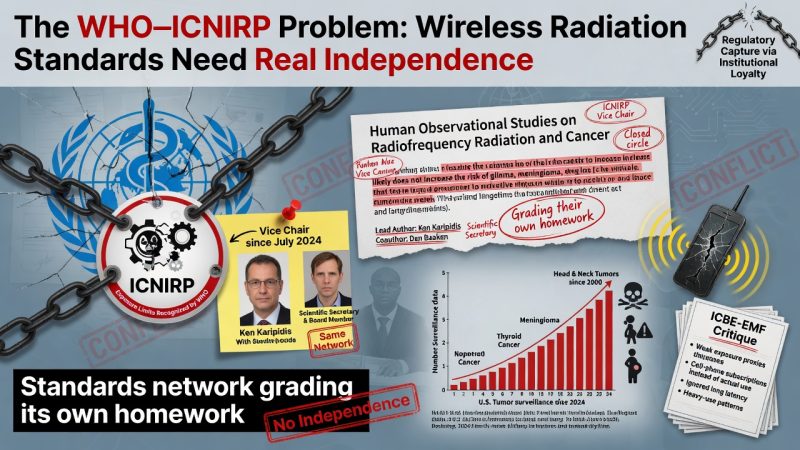
The 2024 WHO-commissioned human observational review on radiofrequency radiation and cancer listed Ken Karipidis as lead author and Dan Baaken as a coauthor. That review concluded that mobile-phone radiofrequency exposure “likely” does not increase the risk of glioma, meningioma, acoustic neuroma, pituitary tumors, salivary-gland tumors, or pediatric brain tumors, and the paper states that the project was commissioned and partially funded by WHO.
But Karipidis is not independent from the standard-setting system whose conclusions are being defended. ICNIRP’s own website says he joined ICNIRP in 2015 and has served as ICNIRP Vice Chair since July 2024. Baaken is also inside that system: ICNIRP says he has served as Scientific Secretary since July 2024 and is a member of the ICNIRP Board together with the Chair and Vice Chair.
That is not true independence. That is a closed circle.
The problem is not merely whether someone receives a direct industry check. Regulatory capture can happen through institutional loyalty, repeated committee memberships, shared assumptions, professional gatekeeping, and the constant recycling of the same experts into the same roles. When the people helping shape radiation standards also help write the reviews used to defend those standards, the public is not getting an independent scientific assessment. The public is getting the standards network grading its own homework.
Critics have called this out directly. ICBE-EMF argues that the Karipidis WHO review has critical methodological flaws that bias its conclusions toward understating cancer risk, and it specifically identifies Karipidis, Röösli, and Baaken as ICNIRP-linked authors. ICBE-EMF also criticizes reliance on weak exposure proxies, such as studies based on cell-phone subscriptions rather than actual use, and argues that the review fails to properly account for long latency and real-world heavy-use patterns.
This matters because wireless radiation is not an abstract policy debate. U.S. tumor surveillance highlighted by Joel Moskowitz shows age-adjusted increases since 2000 in head-and-neck tumor categories associated with cell-phone use, including non-malignant meningioma, thyroid cancer, and salivary-gland cancer. The same body of evidence questions whether current national and international microwave-radiation exposure guidelines are adequate.
The United States withdrew from WHO after citing failures in COVID-19, refusal to implement necessary reforms, and lack of accountability, transparency, and independence. That same principle must now be applied to wireless radiation. It is not only pharmaceuticals where conflicted global health governance matters. It is wireless radiation, too.
The solution is straightforward: WHO wireless-radiation reviews must be rebuilt outside the ICNIRP pipeline. Standard setters should not dominate hazard reviews. Review panels should include genuinely independent scientists, full conflict disclosures, dissenting expert viewpoints, long-term heavy-use exposure analysis, children’s risk, pregnancy outcomes, fertility endpoints, animal cancer evidence, and real-world cumulative exposure.
This is not about panic. It is about public trust. The public has a right to know when global safety standards are being shaped, reviewed, and defended by the same small network of insiders.
Wireless radiation policy needs independence, transparency, and precaution — not another self-reinforcing review from the same closed circle.