Bottom line:
-
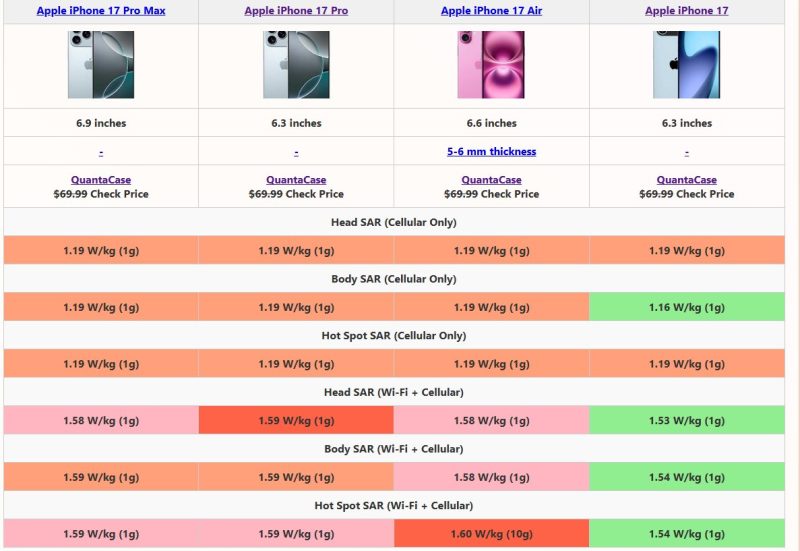
Apple’s iPhone 17 series passes today’s SAR rules at the as-tested separations (typically 5 mm for body, handset-to-phantom head spacing per the report setup).
-
Phonegate’s “≈ 7× higher at contact (0 mm)” result is not a lab re-test—it’s a physics-based transformation of the FCC’s own SAR numbers into 0 mm (true contact) conditions, where near/Fresnel-zone fields dominate and the simple 1/r² rule doesn’t apply.
-
Independent 3rd-party work (Chicago Tribune / RF Exposure Lab, 2019) found multiple phones exceeded limits at 2 mm, even though they passed at standard distances—exactly the pattern near/Fresnel physics predicts.
-
A D.C. Circuit court has already ruled the FCC’s decision to retain decades-old RF limits “arbitrary and capricious,” i.e., inadequately justified against modern evidence—so compliant ≠ biologically protective, especially for kids.
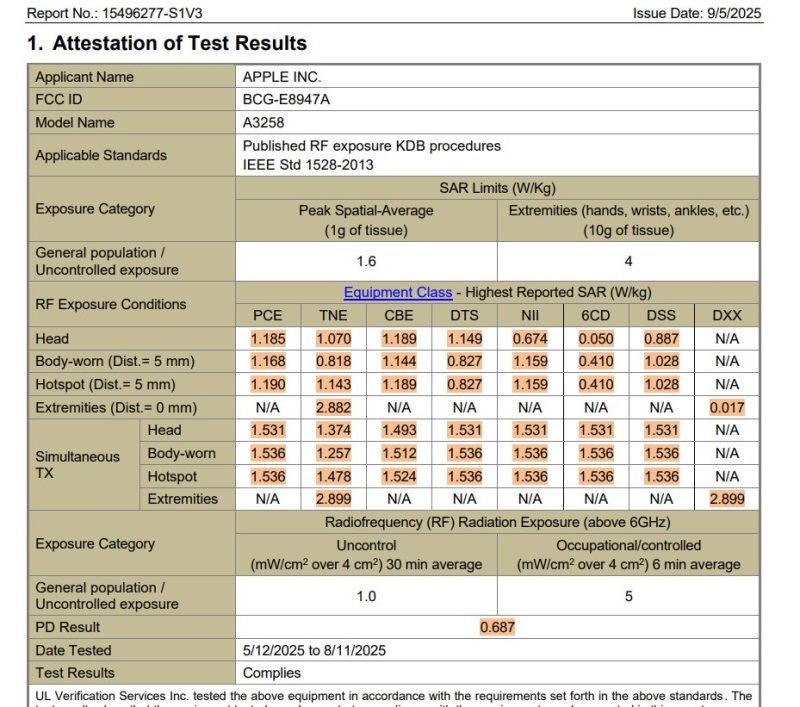
The official FCC SAR numbers for iPhone 17
FCC IDs and peak 1-g SAR (cellular only, highest reported):
-
iPhone 17 (A3258, BCG-E8947A)
Head: 1.19 W/kg Body-worn (5 mm): 1.16 W/kg Hotspot (5 mm): 1.19 W/kg
Simultaneous TX (cell+Wi-Fi): Head 1.53, Body 1.54, Hotspot 1.54 W/kg -
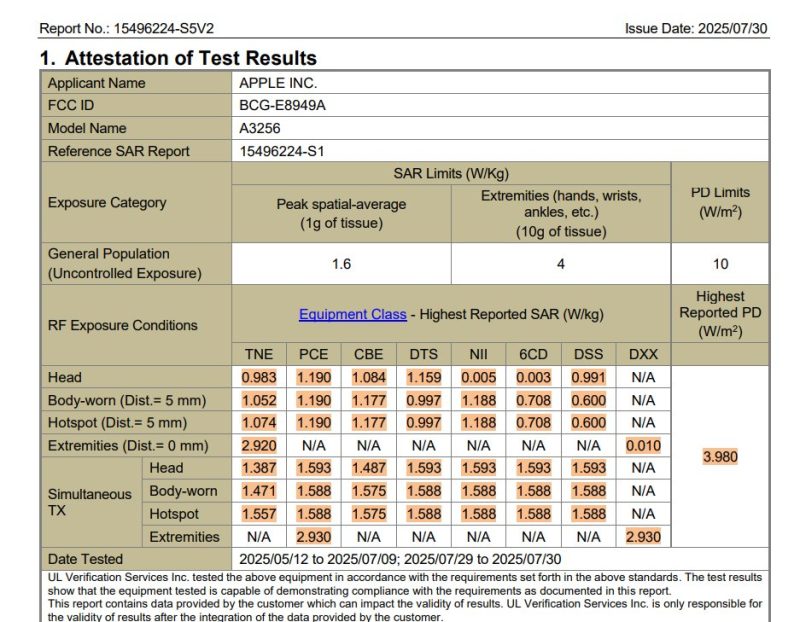
iPhone 17 Pro (A3256, BCG-E8949A)
Head: 1.19 Body-worn: 1.19 Hotspot: 1.19 W/kg
Simultaneous TX: Head 1.59, Body 1.59, Hotspot 1.59 W/kg -
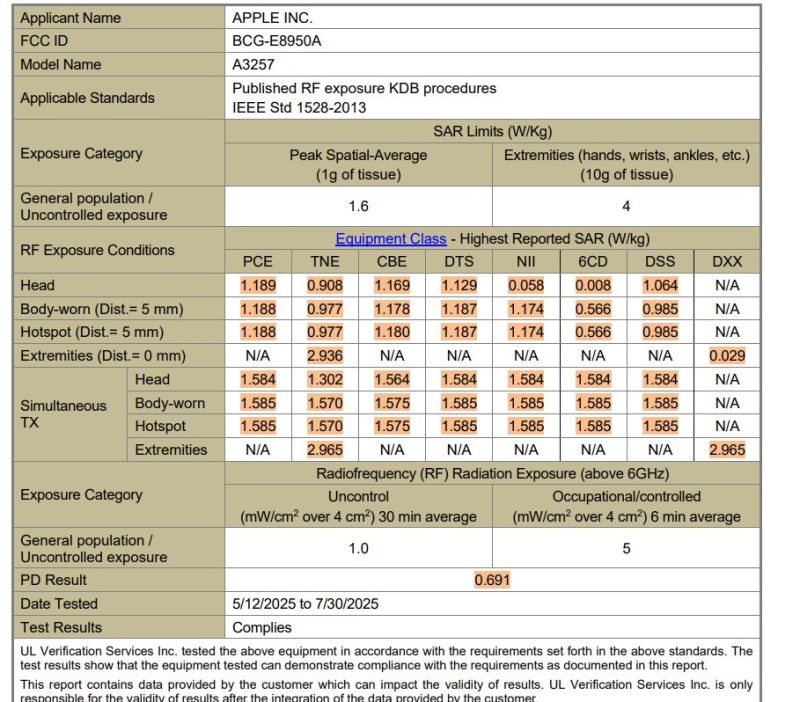
iPhone 17 Pro Max (A3257, BCG-E8950A)
Head: 1.19 Body-worn: 1.19 Hotspot: 1.19 W/kg
Simultaneous TX: Head 1.58, Body 1.59, Hotspot 1.59 W/kg -
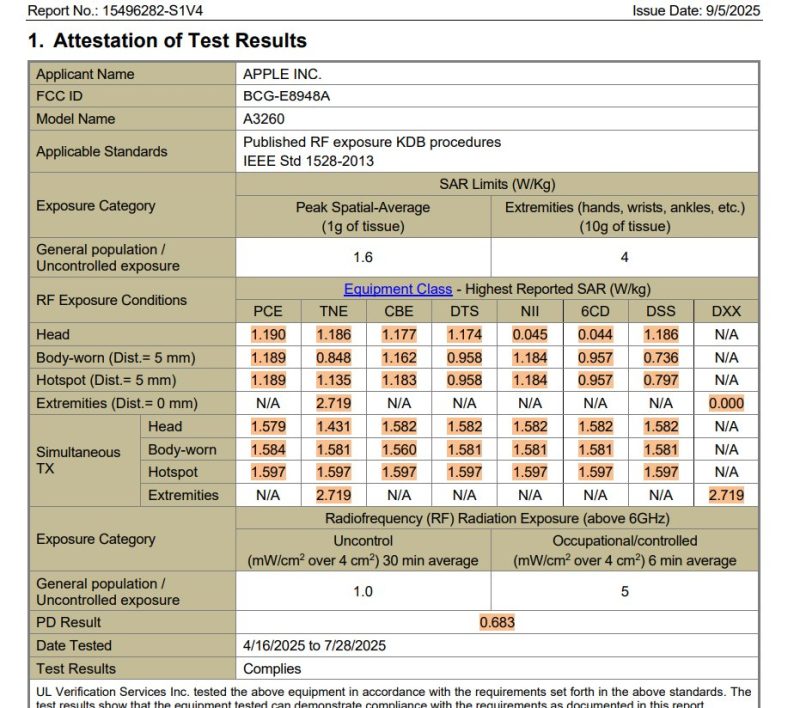
iPhone 17 Air (A3260, BCG-E8948A)
Head: 1.19 Body-worn: 1.19 Hotspot: 1.19 W/kg
Simultaneous TX: Head 1.58, Body 1.58, Hotspot 1.60 W/kg
Extremities @ 0 mm (10-g SAR, limit = 4 W/kg): the FCC tables you shared show ≈ 2.7–2.9 W/kg—i.e., below the 4 W/kg extremities limit.
Above 6 GHz (power density): the PD results in your reports are ≈ 0.68–0.69 mW/cm² vs a 1.0 mW/cm² “general population” limit.
These are as-tested compliance numbers at the specified separations. They are not contact-condition values.
Why “official SAR” and “real-use (0 mm) SAR” diverge
A quick physics refresher
-
SAR scales with the square of the local electric field, SAR∝σ∣E∣2/ρ\mathrm{SAR} \propto \sigma |E|^2/\rho.
-
Very close to a phone, you are not in the far field. You’re in the reactive near-field and then the Fresnel (radiating near-field). Here, the field contains 1/r31/r^3, 1/r21/r^2, and 1/r1/r terms, plus aperture interference and body coupling—so a few millimeters of extra separation do not follow a clean 1/r² curve.
-
Move from 5 mm → 0 mm and ∣E∣|E| can rise steeply; because SAR goes like ∣E∣2|E|^2, multipliers of 5×–8× are plausible. That’s exactly what Phonegate’s calculator is quantifying.
So what is Phonegate actually doing?
They take the certified SAR at 5–15 mm (from regulators’ reports) and apply well-established near/Fresnel field gradients to map that value to 0 mm (contact). This is a deterministic transformation grounded in the physics of the field region—not a fresh phantom test.
Independent 2 mm evidence
When the Chicago Tribune hired RF Exposure Lab (FCC-accredited) to retest phones at 2 mm to mimic pocket/close carry, several models exceeded limits (e.g., Galaxy S8 ≈ 8.22 W/kg; multiple iPhone 7 results > limit)—yet the same models passed at standard separations. That’s the same distance-regime effect Phonegate is highlighting: pass at 5–15 mm, fail at 0–2 mm.
Why standards lag—and why “compliant” ≠ “protective”
-
In Environmental Health Trust & Children’s Health Defense v. FCC, the D.C. Circuit ruled the FCC’s decision to keep legacy limits “arbitrary and capricious.” The court said the agency failed to give a reasoned explanation about non-thermal effects, children’s vulnerability, and long-term exposure—so the current framework isn’t a public-health gold standard.
-
France has already pushed Europe toward 0 mm (contact) testing, and ANFR forced an in-market fix on iPhone 12 when contact-condition limb SAR exceeded the limit. The direction of travel is clear: measure and disclose at contact.
What this means when you’re shopping an iPhone 17
If you use the phone at contact (pressed to the head, against the body, in a pocket, or under a pillow), your exposure is governed by near/Fresnel coupling, not the far-field inverse-square rule. That’s why a phone can be fully compliant in the lab and still produce much higher local absorption at 0–2 mm in the real world.
The transparent fix
Publish both numbers:
-
As-tested SAR (with the actual separation used), and
-
Contact-condition SAR (0 mm) for head and trunk.
That’s what consumers need to make an informed choice—and it’s the number parents, schools, and clinicians care about.
Practical exposure tips
-
Distance during heavy radio use. Use speakerphone/air-tube; don’t clamp the phone to your head during long calls, especially in poor signal.
-
Cut duty cycle. Download-then-read; message instead of long streaming while the phone is against the body.
-
Avoid detuning. Don’t stick metal plates/magnets over antenna areas—this can force higher transmit power.
-
Indoors: prefer wired or Li-Fi for high-duty tasks; keep high-duty RF away from where children learn and sleep.
The RFSafe position
-
Physics, not opinion. Phonegate’s “≈ 7× at 0 mm” is physics applied to regulators’ own inputs. Independent 2 mm tests have already shown the same trend.
-
Policy must catch up. After a federal court called the FCC’s retention of old limits arbitrary and capricious, it’s unreasonable to treat 5–15 mm compliance as sufficient public-health protection.
-
Call to action:
-
Publish 0 mm SAR alongside certified values, per model/band.
-
Update standards to reflect signal structure (pulsing/modulation) and continuous, real-world use.
-
Prefer wired/Li-Fi indoors and remove high-duty RF from classrooms/bedrooms.
-
Appendix: quick read of the FCC tables
-
iPhone 17 family: Head SAR ≈ 1.19 W/kg (cellular only), Body-worn ≈ 1.16–1.19 W/kg @ 5 mm, Simultaneous TX (cell+Wi-Fi) ≈ 1.53–1.60 W/kg.
-
Extremities (10-g) @ 0 mm: ~2.7–2.9 W/kg (below the 4 W/kg limit).
-
Above 6 GHz PD (over 4 cm², 30 min): ~0.68–0.69 mW/cm² (below the 1.0 mW/cm² limit).
Takeaway: compliance on paper does not tell you the contact number you actually care about. Until Apple and regulators publish 0 mm values, consumers will keep having to rely on independent physics-based estimates (like Phonegate’s) to understand real-use exposure.
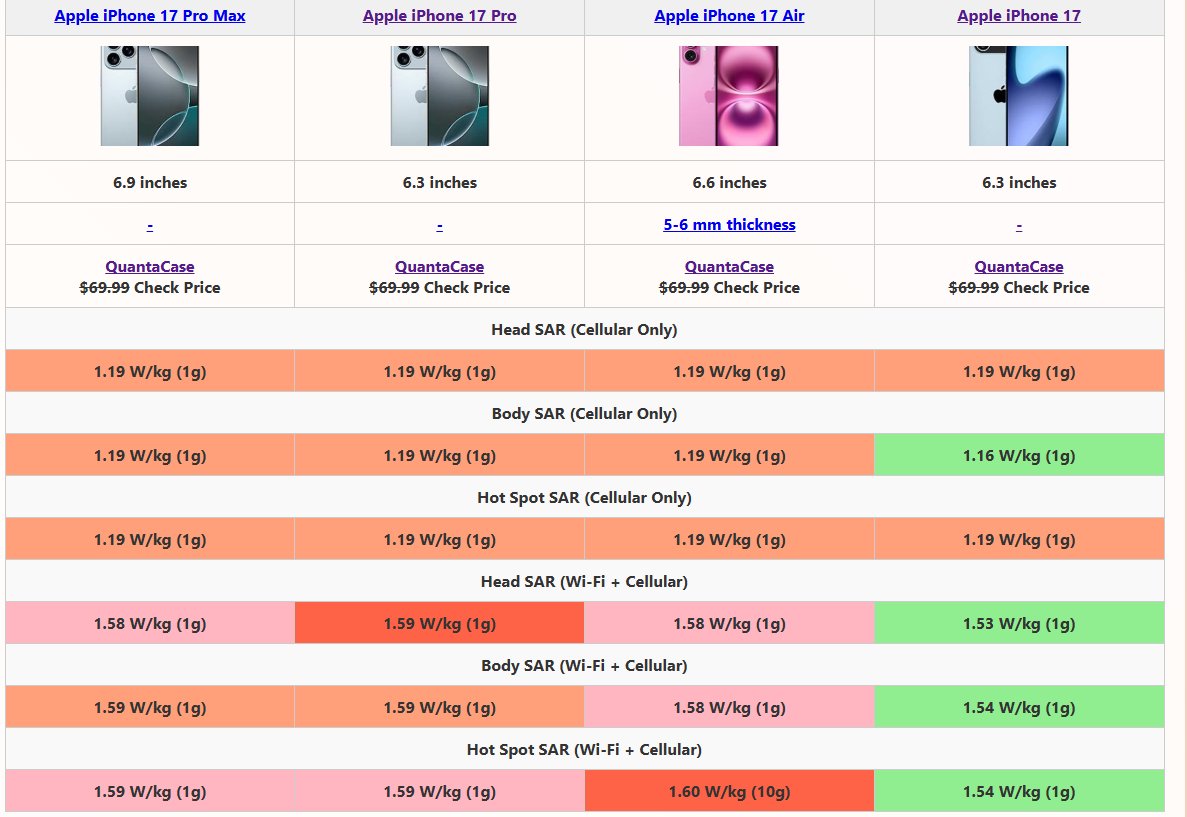
Apple iPhone 17 Pro Max SAR Level Summary: The cellular transmission SAR values for the Apple iPhone 17 Pro Max (FCC ID BCG-E8950A) are 1.19 W/kg (watts per kilogram) at the head and 1.19 W/kg when worn on the body. The hotspot/Airplay SAR level is 1.19 W/kg. The simultaneous transmission SAR values for iPhone 17 Pro Max (cellular plus Wi-Fi) is 1.58 W/kg at the head, 1.59 W/kg when worn on the body, and 1.59 W/kg when used as a hotspot simultaneously with other transmitters active.
Apple iPhone 17 Air SAR Level Summary: The cellular transmission SAR values for the Apple iPhone 17 Air (FCC ID BCG-E8948A) are 1.19 W/kg at the head and 1.19 W/kg when worn on the body. The hotspot/Airplay SAR level is 1.19 W/kg. The simultaneous transmission SAR values for iPhone 17 Air (cellular + Wi-Fi) is 1.58 W/kg at the head, 1.58 W/kg when worn on the body, and 1.60 W/kg when used as a hotspot simultaneously.
Apple iPhone 17 Pro SAR Level Summary: The cellular transmission SAR values for the Apple iPhone 17 Pro (FCC ID BCG-E8949A) are 1.19 W/kg at the head and 1.19 W/kg when worn on the body. The hotspot/Airplay SAR level is 1.19 W/kg. The simultaneous transmission SAR values for iPhone 17 Pro (cellular + Wi-Fi) is 1.59 W/kg at the head, 1.59 W/kg when worn on the body, and 1.59 W/kg when used as a hotspot simultaneously.
Apple iPhone 17 SAR Level Summary: The cellular transmission SAR values for the Apple iPhone 17 (FCC ID BCG-E8947A) are 1.19 W/kg at the head and 1.16 W/kg when worn on the body. The hotspot/Airplay SAR level is 1.19 W/kg. The simultaneous transmission SAR values for iPhone 17 (cellular + Wi-Fi) is 1.53 W/kg at the head, 1.54 W/kg when worn on the body, and 1.54 W/kg when used as a hotspot simultaneously.