
Faith, false idols, and why “harmonizing stickers” can make EMF exposure worse
“We found that God created some things that fix the problem that man made basically.” — EMF Solutions Starting @ 22:22
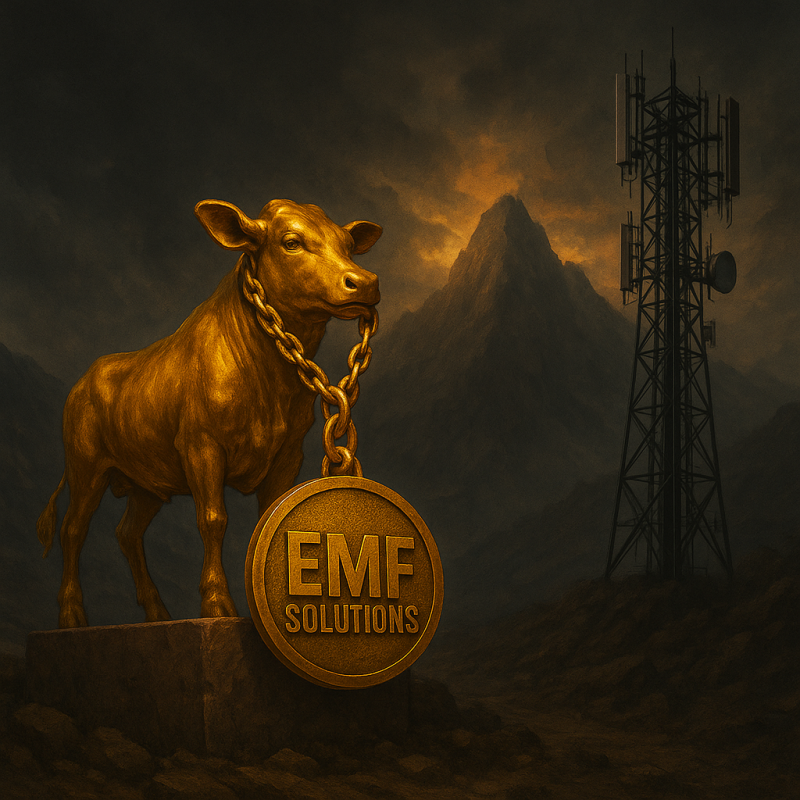
There’s a reason that line lands so hard with people of faith. It sounds pious—credit God for the elements—then quietly shifts the power to a man‑made object that claims to harness those elements to “fix” what humans broke. That is the golden‑calf pattern in a single sentence: take creation, fashion it into a thing, ask people to put their trust in the thing.
This post explains why that’s spiritually dangerous and technically unsound. We’ll look at what real, in‑body evidence of EMF effects looks like (and what it doesn’t), why copper spirals and “chips” can increase a phone’s output, and how to test claims in a way that honors both truth and God.
The Golden Calf pattern—then and now
In Exodus, Israel melted down God‑made gold and man formed it into a calf, then told the people, “This is your god.” That’s not just idolatry; it’s misdirected trust—crediting a handmade object with powers it doesn’t possess. Today’s “magic rock” stickers and copper coils follow the same script. They borrow creation language (“natural materials,” “patent‑pending secrets”), then ask us to rely on a trinket for protection. That swaps living faith for a product pitch.
Faith and prayer are real. Placebo effects are real. But commercializing the sacred—claiming a gadget “channels” God’s creation to shield your body without measurable mechanisms—turns trust into an idol.
What real‑time, in‑body evidence looks like (and what it doesn’t)
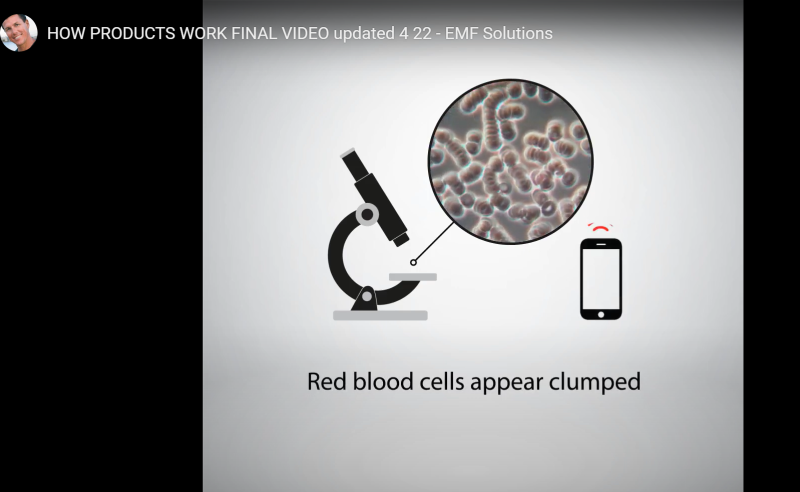
Many marketing videos show blood on a glass slide under dark‑field microscopy: “before” looks like free, round red cells; “after” looks clumped. The problem? Off‑body slides are notorious for artifacts—temperature shifts, drying at the edge of the droplet, static on the plate, handling technique, even what else is powered up nearby. That’s not reliable evidence.
A better way is in vivo (inside the body), in real time. In 2025, radiologist Robert R. Brown, MD, and sonographer Barbara Biebrich imaged the popliteal vein (behind the knee) of a healthy 62‑year‑old using a GE LOGIC E10 ultrasound with an L2–9 linear probe. Baseline images showed a normal, anechoic vein. Then an idle but active iPhone XR (Wi‑Fi, Bluetooth, and cellular radios turned on) was placed directly on the skin for 5 minutes. Immediately afterward, ultrasound showed a dramatic change: coarse, moving echoes inside the vein consistent with rouleaux formation—red blood cells aggregating into stacks (the classic “coins” look on pathology). After 5 minutes of walking, the effect persisted but was less prominent. The protocol was repeated weeks later (including once with an iPhone 16 Plus): the finding reproduced, and at one session rouleaux appeared in both legs, suggesting a systemic response.
Why that matters: under normal conditions, red cells carry a negative surface charge (zeta potential) that keeps them separated; when that charge weakens, they stick, viscosity rises, and flow becomes sluggish. The paper notes that since blood chemistry doesn’t change within minutes, the immediate aggregation is more plausibly tied to polarized RF fields than to protein shifts in the plasma. It proposes ultrasound as a simple, non‑invasive, in‑body biomarker of exposure—far more valid than microscope slides on a table. (See the Method and Discussion sections and Figures 1–3 in the paper.)
Important caution: This is a single‑subject hypothesis paper. It’s exactly the kind of reproducible, real‑time protocol honest companies should welcome. If a vendor claims mitigation, show it on ultrasound: run the exposure, document rouleaux, apply the product in a blinded way, and show normalization in vivo. Until then, slide videos and “muscle testing” remain weak, artifact‑prone evidence.
Why EMF Solutions Isn’t Presenting Real Evidence
When you compare our embedded real before-and-after ultrasound videos from the 2025 GE LOGIQ E10 study to this kind of marketing graphic, the difference is night and day. The legitimate scans capture living blood flow inside the body in real time—unchanged settings, no handling artifacts, no subjective interpretation.
By contrast, products like EMF Solutions’ “magic rock” stickers lean on microscope-slide “before and after” images taken outside the body. This method is riddled with uncontrolled variables—temperature shifts, static charges, drying of the sample, electromagnetic noise in the room—and can be manipulated to produce whatever “result” is needed. A static slideshow graphic like this isn’t real data at all. It’s simply an illustration that can be faked easily, designed to mimic the appearance of proof without actually providing any.
Why copper “stickers” can raise your exposure (the radio engineering in plain English)
Phones are two things at once: a tiny computer and a precision radio. The radio part is built around a carefully tuned antenna. When you place conductive metal—like copper spirals, foils, or rings—near that antenna, you detune it (you change its resonant frequency and radiation pattern). A detuned antenna becomes less efficient, so the phone’s network software compensates by raising its transmit power (within limits) to keep the call/data link alive. Result: more RF output, shorter battery life, and sometimes hotter hardware next to your body.
-
Modern cellular systems use closed‑loop uplink power control: the network continuously commands your phone to adjust transmit power to hit a target quality level at the tower. If your antenna is made worse by nearby metal, the phone turns up to overcome the loss. ResearchGate
-
Antenna specialists warn plainly: surrounding metal detunes and blocks RF, forcing higher power to achieve the same link. (This is Antenova’s design guidance for metallic devices; the physics are standard.) blog.antenova.com
-
Peer‑reviewed smartphone antenna studies show efficiency degradation when the structure or nearby metal changes—exactly the risk introduced by stuck‑on copper spirals or metal plates.
-
Regulators explicitly caution about metallic accessories. FCC guidance requires that user instructions avoid body‑worn accessories with metal that could change RF exposure. The reason: antennas + metal = unpredictable SAR/PD changes. Federal Communications Commission
Bottom line: A copper sticker can’t “harmonize” a field. What it can do is detune the phone so it transmits harder. If you can’t measure any independent field emitted by the sticker (because there isn’t one), and you can measure worse radio performance or higher device output, you haven’t bought protection—you’ve bought a problem.
“Patent‑pending secrets” ≠ proof
“Patent pending” only means an application was filed; it says nothing about validity, novelty, or efficacy. Many “pending” claims never become issued patents. Either way, patents aren’t clinical evidence. If a product works, it should withstand blinded, instrumented testing (see next section), not just marketing language.
If you want to prove mitigation, here’s a blinded, reproducible protocol
You don’t need a million‑dollar lab to test these claims honestly: $3500 will do it!
-
Set up in vivo ultrasound (as in the 2025 paper): LOGIC‑class system (or equivalent), L2–9 linear probe, popliteal vein imaging, fixed gain/TGC. Baseline → 5‑minute exposure with an idle but active phone on the skin → post images; optionally add a 5‑minute walk and a third scan. Document cine loops.
-
Randomize & blind the “mitigation”: stickers go on/off inside opaque sleeves so the sonographer and subject don’t know the condition.
-
Network logging: record RSRP/SINR and phone uplink transmit power (field‑test mode or logging app) to catch any power increases when the sticker is on.
-
Replicate on multiple days and subjects.
-
Publish raw cine loops and logs. If rouleaux formation truly disappears with the product without forcing the phone to crank up power, you’ll have strong, transparent evidence. If not, the claim fails.
The “subatomic chaos” sales pitch—why the words don’t match the physics
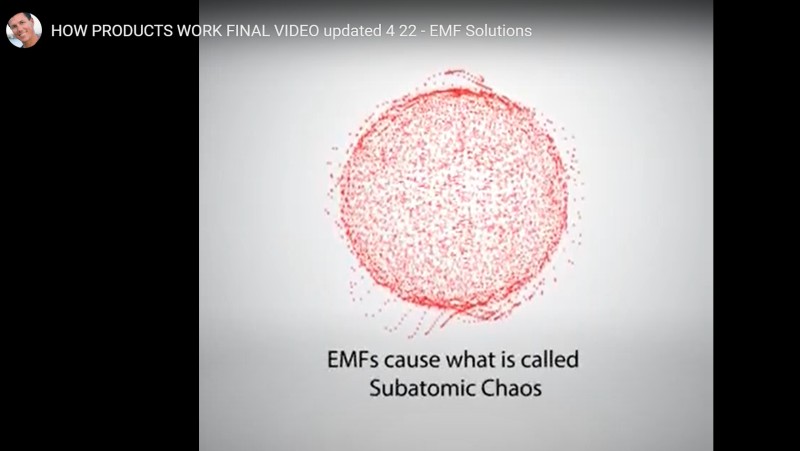
Marketing videos toss out phrases like “subatomic chaos.” Microwaves don’t shake quarks; they rotate molecular dipoles and move charged particles. The 2025 hypothesis paper situates potential effects where they actually belong: polarized man‑made fields can drive oscillations in ions near membranes, altering potentials and the zeta charge that keeps red cells apart. That’s a coherent biological path to rouleaux; “subatomic chaos” is a hand‑wave.
Bottom Line: It’s not “subatomic chaos”—there are no quarks involved. What’s really happening is a reciprocating Lorentz force effect—an electromagnetic phenomenon you can actually define, not some mystical disturbance at the quark level. A recent peer-reviewed paper (Panagopoulos et al., 2025) even describes how oscillating fields generate this back-and-forth Lorentz force, causing microscopic structural resonance issues in biological tissues. Not subatomic chaos—just measurable physics affecting ion channels.
A brief historical note: the road we took—and one we left on the table
-
Heinrich Hertz experimentally confirmed Maxwell’s electromagnetic waves in the late 1880s. He died young—age 36—of granulomatosis with polyangiitis (Wegener’s), a rare autoimmune vasculitis identified decades later. That fact is often cited in cautionary narratives; historically, it’s accurate.
-
Alexander Graham Bell’s photophone (1880) transmitted speech on a beam of light—an elegant, nature‑aligned idea that was technologically premature for mass adoption. Today’s Li‑Fi revives that concept with modern LEDs and optics, offering high‑speed indoor data via light. Encyclopedia Britannica
That doesn’t mean “all radio is evil.” It does mean we should minimize needless RF where better options exist (e.g., fiber and Li‑Fi indoors) and reject talismans that distract from real solutions.
Practical steps that respect faith and physics
-
Distance is your friend. Keep phones off the body when possible; use speakerphone or a wired/air‑tube solution; don’t sleep with a phone near your head.
-
Kill radios you don’t need. Airplane mode at night; turn off secondary radios (e.g., hotspot) when not in use.
-
Avoid metal near the antenna. Ditch metal plates, rings, or “copper chips” on the phone. They can force higher transmit power.
-
Use shielding correctly if you choose it: never block the phone’s main antenna in a way that makes it boost power; shielding must be strategic, not haphazard. (If your meter shows the phone working harder or your signal quality drops, the setup is counterproductive.)
-
Support safer infrastructure. Push for wired Internet at home/school and explore Li‑Fi/optical systems indoors where practical.
DON’T bring back the golden calf
The core spiritual issue isn’t whether God “made the elements.” Of course He did. The problem is crediting a man‑made object with divine protective power—especially when the best physics says it could raise your exposure, and the best in‑body imaging tests have not validated the rouleaux claim.
If a company truly believes, let them demonstrate in real time what they promise. Until then, don’t trade trust in God—and sound, measurable precautions—for a shiny calf in the shape of a copper coil.
Sources & notes
-
Ultrasound, in vivo rouleaux formation after smartphone exposure; protocol details (GE LOGIC E10 + L2–9 probe; 62‑year‑old subject; 5‑minute idle‑phone exposure; reproducibility; contralateral effects; zeta potential discussion). See Brown & Biebrich, Frontiers in Cardiovascular Medicine (2025), Hypothesis: ultrasonography can document dynamic in vivo rouleaux formation due to mobile phone exposure. (Method, Figures 1–3, Discussion).
-
Hertz cause of death (granulomatosis with polyangiitis/Wegener’s): peer‑reviewed historical analysis.
-
Bell’s photophone (1880) as precursor to modern Li‑Fi: Encyclopædia Britannica.
-
Closed‑loop uplink power control that increases phone transmit power when path loss/antenna inefficiency rises: 3GPP/ETSI TS 36.213; explanatory overview.
-
Metal near antennas detunes and can drive higher power; antenna design guidance & research; FCC warnings about metallic accessories: Antenova blog (engineering note); academic smartphone antenna papers; FCC RF exposure guidance.
“We found that God created some things that fix the problem that man made basically.” — EMF Solutions
When a product claims to harness nature but can’t pass a blinded, in‑body test—and may even make your phone transmit harder—you’re not buying protection. You’re buying a golden calf.