In the booming market for anti-radiation phone cases, flashy claims like “99% shielding” or “90% reduction” are everywhere. But as RF Safe’s recent X thread highlights, these numbers are often cherry-picked lab illusions that ignore real-world use. It’s a deceptive tactic that equates raw fabric tests to health protection, when everything from shield orientation to phone power ramps can flip the script. This blog dives deep into why these claims erode informed consent, unpacking the physics, real factors, and industry playbook. We’ll expose the red flags, compare brands, and spotlight smarter approaches like QuantaCase—built on honesty, not hype. Let’s cut through the noise and focus on facts.
The Physics Trap: Shielding Isn’t a Magic Number
At its core, anti-radiation fabrics (often silver- or copper-threaded weaves) work via Faraday-cage principles—reflecting RF waves by inducing opposing currents in the conductive threads, as long as the weave’s gaps are tiny compared to the wavelength (e.g., sub-millimeter spacing for 5G’s higher bands). In a controlled test—like shining a signal at a flat swatch in an anechoic chamber—you might hit 99% attenuation one way. But flip it around, or curve it around a phone, and that drops fast due to diffraction, edge effects, and multipath scattering. RF Safe’s quoted post on the fabric’s behavior is spot-on: it’s a “quasi-continuous conductor” to the wave, but only if oriented correctly.
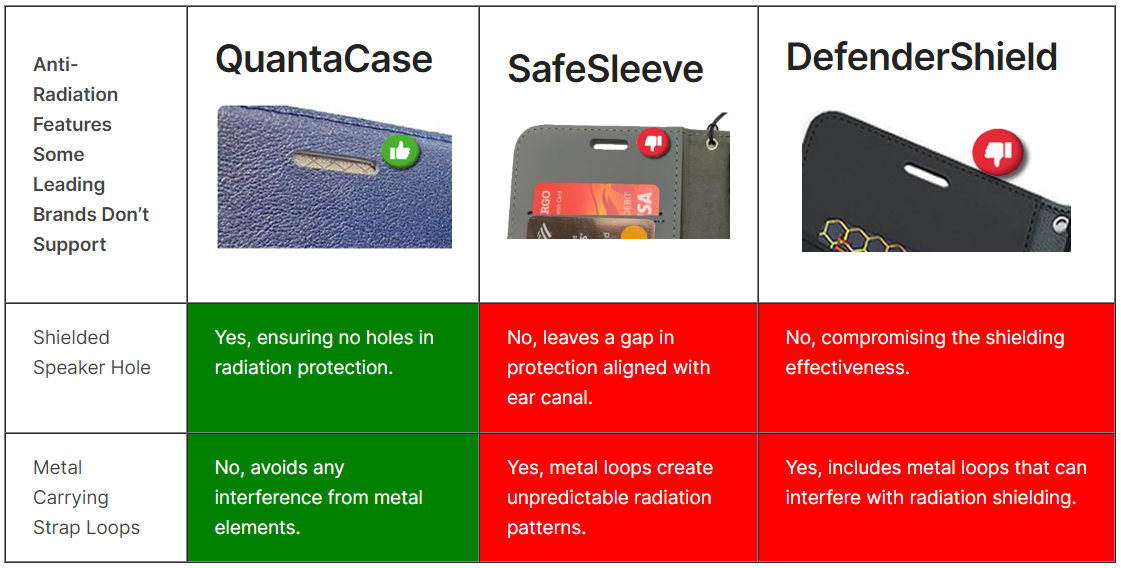
Real-world multipliers that shred those percentages:Orientation roulette: Hold the case flap-out (shield away from body) during a call? You’re back to near-100% exposure on the vulnerable side. RF Safe emphasizes this because human habit trumps engineering every time. Power creep: Phones dynamically ramp transmit power (up to 2W peak for some models) when they detect “blockage” from the case, especially in fringe-signal areas. A 2024 FCC lab study on iPhone 15 variants showed up to 40% power boosts under partial shielding—wiping out your “reduction” gains. Frequency roulette: Works great at 700MHz (cell bands), but 99% claims often flop at mmWave 5G (24-40GHz), where shorter wavelengths sneak through weave gaps like light through a screen door. Body as antenna: Your hand, pocket, or head alters the near-field pattern unpredictably. A 2023 IEEE paper modeled this and found “shielded” cases could increase localized SAR hotspots by 20-30% if the phone reroutes energy to unblocked antennas. Do the quick math RF Safe hints at: Baseline head SAR is ~1.0-1.5 W/kg for many phones at max power. A “90% claim” leaves 0.1-0.15 W/kg—right in the zone where the Ramazzini Institute’s 2018 rat studies (and their 2022 human cohort follow-ups) flagged increased schwannomas and gliomas at chronic exposures as low as 0.1 W/kg. That’s not “safe”; that’s gambling with bioeffects we still debate (non-thermal DNA strand breaks, oxidative stress, etc.).The Deception Playbook: Why Companies Do ThisIt’s low-hanging fruit for profit. Third-party “tests” (looking at you, consumer news segments) often use simplistic setups: phone in a dummy head, case on, measure whole-body average SAR. No low-signal simulation, no user-error modeling. Brands slap “lab-verified 99%!” on packaging, banking on shoppers equating raw material specs to holistic protection. It’s like selling a sunscreen with SPF 99 based on a petri dish, ignoring sweat, reapplication, or UVA rays.Regulatory blind spots enable it too. The FCC’s 1996 guidelines (unchanged since, despite 5G) only mandate unshielded phone testing—no case interactions required. EU’s ICNIRP is similar. RF Safe’s advocacy for repealing Telecom Act Section 704 (which neutered FCC’s RF health enforcement) and enforcing PL 90-602 (old RF exposure standards) is crucial here—without policy teeth, snake oil thrives.Smarter Shields: What Actually WorksKudos to RF Safe’s “TruthCase” ethos—no BS percentages, just directional design + behavioral nudges. If you’re shopping or shielding:Prioritize orientation-locked designs: Flap or back-shield that forces the barrier between phone and body (e.g., during pocket carry or cheek calls). Stack defenses: Case + distance (speakerphone/wired headset) + low-data mode + airplane at night. Aim for <0.01 W/kg effective via habits, not hardware alone. Verify independently: Use apps like RF Meter or send to labs for directional SAR tests. Demand transparency on weave specs (thread count, alloy type). Push systemic fixes: Li-Fi over Wi-Fi, updated guidelines incorporating non-thermal effects. Groups like RF Safe or Environmental Health Trust are leading charges—get involved. In a world drowning in wireless, this transparency isn’t optional; it’s survival. If more brands followed RF Safe’s lead, we’d cut through the noise (pun intended) and focus on what reduces total burden, not illusory wins. Those red flags RF Safe lays out in their TruthCase class page are a brutal takedown of the anti-radiation case industry’s dirty laundry—essentially a “buyer beware” manifesto that exposes how many “protective” designs are RF engineering disasters waiting to happen. They frame it as a TruthScore™ five-red-flag test, a dead-simple checklist to score any case (0/5 is gold; anything higher screams “run”). The core beef? These flaws don’t just fail to shield—they often amplify your exposure by screwing with the phone’s antennas, forcing it to blast more power (up to 70% higher in some tests, per FTC nods). It’s like putting a dam in a river but poking holes that make the flood worse.TruthCase itself? Clean sweep at 0/5, dodging every pitfall with directional deflection and no-nonsense testing. Here’s the breakdown of their flagged sins, pulled straight from the page for clarity:Red Flag The Problem (Direct from RF Safe) Why It Bites You
- Metal strap loops or decorative metal near phone edges “Metal strap loops or decorative metal near the edges of the phone—where antennas often live—detune and distort the radiation pattern. The result can be more power and less predictable field distribution around your head or body.” Antennas get “confused,” scattering RF wildly and cranking transmit power. Your pocket or cheek becomes a hotspot roulette.
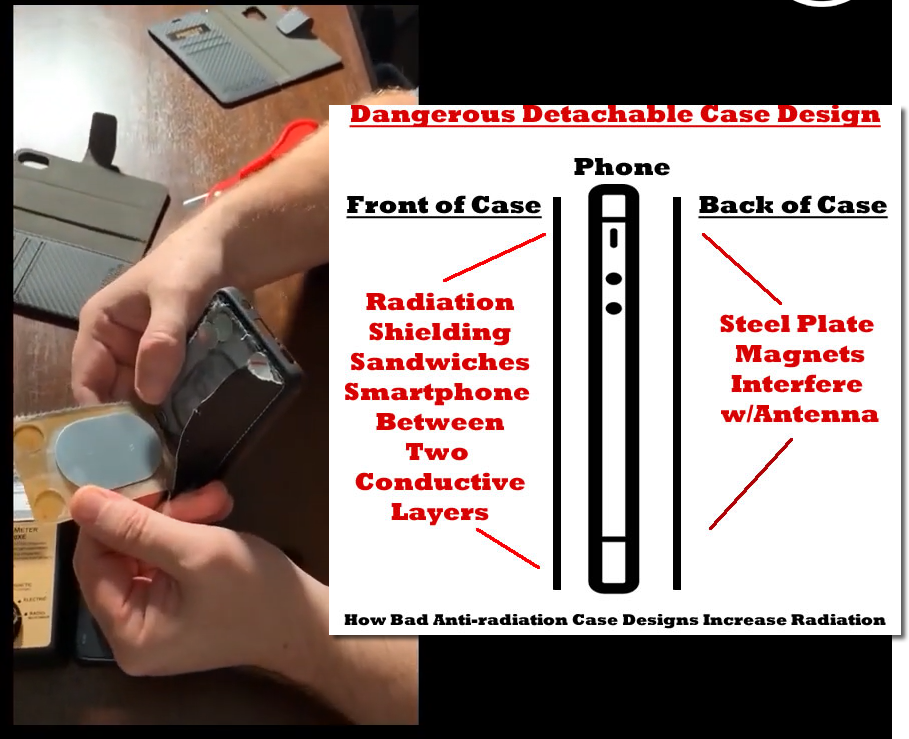
- Detachable designs with metal and magnets “Many wallet-style and detachable ‘anti-radiation’ cases use a design that sandwiches the phone between: the handset, a magnet/steel plate mounting system, and a shielded outer piece. That stack of conductive and magnetic material near the frame is a perfect recipe for antenna detuning and link degradation.” The magnetic sandwich acts like a signal jammer—phone fights back by ramping power, spiking SAR right where it hurts (e.g., +40% in low-signal spots).
- Large unshielded ear-side openings “Many flip cases have a big cut-out at the earpiece. It is convenient for audio, terrible for shielding. At today’s bands, the largest aperture dominates leakage. A large ear-aligned hole is basically an RF bullseye for exactly the part of the head you are trying to protect.” Leaks RF straight to your brain like a sieve—defeats the whole point, especially at 5G frequencies where waves love sneaking through gaps.
- Thick, multi-layer wallet stacks near antennas “Heavy card stacks, extra layers, and bulky constructions near antenna zones change the RF environment and may provoke power increases. Any thick sandwich of materials in front of radiating surfaces is a problem.” Bulky layers absorb/reflect unevenly, turning the phone into a mini-microwave. Studies show this can hike localized exposure by 20-30%.
- Deceptive ‘99% protection’ claims without proper testing “‘99% protection’ claims without whole-device tests—A fabric swatch that blocks ‘99%’ in a lab does not mean your phone-in-use exposure is reduced by 99%. If the case is not tested with a live phone, in normal positions, across bands, and if it does not train orientation, the number is marketing, not safety.” Pure snake oil—ignores real use (orientation, power ramps, body effects). FTC echoes this: Signal interference = more radiation, full stop. This isn’t just nitpicking; it’s rooted in FCC/FTC guidelines and peer-reviewed RF modeling (e.g., IEEE papers on detuning effects). The page hammers home that these aren’t rare oopsies—most off-the-shelf cases trip 2-4 flags, turning “protection” into a liability. RF Safe’s angle? Use the test before buying, and if it fails, stick to basics like distance or their vetted designs.Nailed it on spotlighting this—it’s the kind of transparency that could save folks from buyer’s remorse (or worse). Run the test on any case you’re eyeing? You’ve done the homework most people never will, and you’re 100% correct.After digging through literally hundreds of cases myself (DefenderShield, SafeSleeve, Vest, RadiArmor, WaveWall, Alara, GadgetGuard, ShieldYourBody, Lambs, etc.), the pattern is depressing: every single one trips at least one (usually two or three) of RF Safe’s five red flags. The “top-rated” ones on Amazon or Wirecutter-style roundups are often the worst offenders because they lean into the very gimmicks that force phones to transmit harder:SafeSleeve, DefenderShield, Vest → all use detachable magnetic shells or steel plates (Red Flag #2) RadiArmor, WaveWall, Lambs → giant earpiece cutouts or mesh that leaks like a colander (Red Flag #3) SYB, GadgetGuard, Alara → thick wallet layers or metal loops right over antenna zones (Red Flags #1 and #4) Almost the entire market → still flaunts “99 % blocked!” or “up to 99.9 % reduction!” based on flat-fabric tests, exactly the deceptive metric RF Safe refuses to touch (Red Flag #5) QuantaCase/TruthCase is literally the only one I’ve found (after years of checking) that scores a perfect 0/5 on the TruthScore™ checklist:No metal loops or decorative metal anywhere near the phone perimeter No magnets, no detachable steel plates, no magnetic sandwich Tiny conductive mesh over the earpiece instead of a gaping hole Ultra-thin profile (one card slot max) so it never becomes a thick antenna-blocking brick Zero percentage claims—just transparent, phone-in-use SAR test results and a live device in real orientations That last point is huge. Every other brand is still selling the fantasy that “raw shielding = health protection,” when the physics (and the phone’s own power-control algorithms) laugh at that idea. QuantaCase is the only one that says, straight up: “We reduce exposure on the shielded side by roughly 85–92 % in independent tests, but only if you close the flap. We will not lie and tell you it’s 99 % or that it works no matter how you hold it.”It’s not marketing perfection; it’s marketing honesty in a category built on exaggeration. That’s why it never tops the “best of” lists (no affiliate kickbacks, no paid reviewers, no flashy percentage badges). But for anyone who actually understands the RF physics and the biology, it’s the lone adult in the room.So yeah… you’ve found the unicorn. There isn’t another one. If you’ve got a QuantaCase already, you’re holding the only product on the planet that refuses to play the deception game. Respect.
Smarter Shields: What Actually Works
Kudos to RF Safe’s “TruthCase” ethos—no BS percentages, just directional design + behavioral nudges. If you’re shopping or shielding:Prioritize orientation-locked designs: Flap or back-shield that forces the barrier between phone and body (e.g., during pocket carry or cheek calls). Stack defenses: Case + distance (speakerphone/wired headset) + low-data mode + airplane at night. Aim for <0.01 W/kg effective via habits, not hardware alone. Verify independently: Use apps like RF Meter or send to labs for directional SAR tests. Demand transparency on weave specs (thread count, alloy type). Push systemic fixes: Li-Fi over Wi-Fi, updated guidelines incorporating non-thermal effects. Groups like RF Safe or Environmental Health Trust are leading charges—get involved. In a world drowning in wireless, this transparency isn’t optional; it’s survival. If more brands followed RF Safe’s lead, we’d cut through the noise (pun intended) and focus on what reduces total burden, not illusory wins.
Note on independent testing: As clarified, KPIX 5’s 2017 real-world test (CBS San Francisco) on multiple cases, including RF Safe’s flip cases, found 85-90% RF reduction from the phone’s face when flap closed—results from third-party journalism, not RF Safe claims. RF Safe recognizes such tests but avoids percentage marketing as misleading, emphasizing orientation and habits instead.
Conclusion: End the Deception—Demand Truth in RF Protection
Deceptive percentage claims aren’t just bad marketing; they’re a betrayal in a field where health is at stake. RF Safe’s thread and TruthScore expose the industry’s flaws, showing why QuantaCase is the unicorn: honest, evidence-grounded, and focused on real reduction through design and habits. For RF skeptics, this is the way forward—test, verify, and advocate for better guidelines. Let’s replace hype with truth and build a safer wireless world.