
So why are our RF safety rules still pretending this is only about heating?
Here’s the debate trick we’ve all seen a thousand times:
“There’s no proof it causes cancer, so stop worrying.”
That’s not science. That’s a dodge.
Because the real question isn’t “does this prove cancer today?”
The real question is:
Are our safety guidelines even designed to protect children long into the future?
Right now, U.S. RF exposure rules are built around one thing: thermal effects. In plain English: “don’t heat tissue above a threshold.”
But biology doesn’t only respond to heat. Biology responds to signals, timing, electric gradients, and stress pathways that don’t require temperature rise to matter.
And that brings us to the most inconvenient fact for the thermal-only narrative:
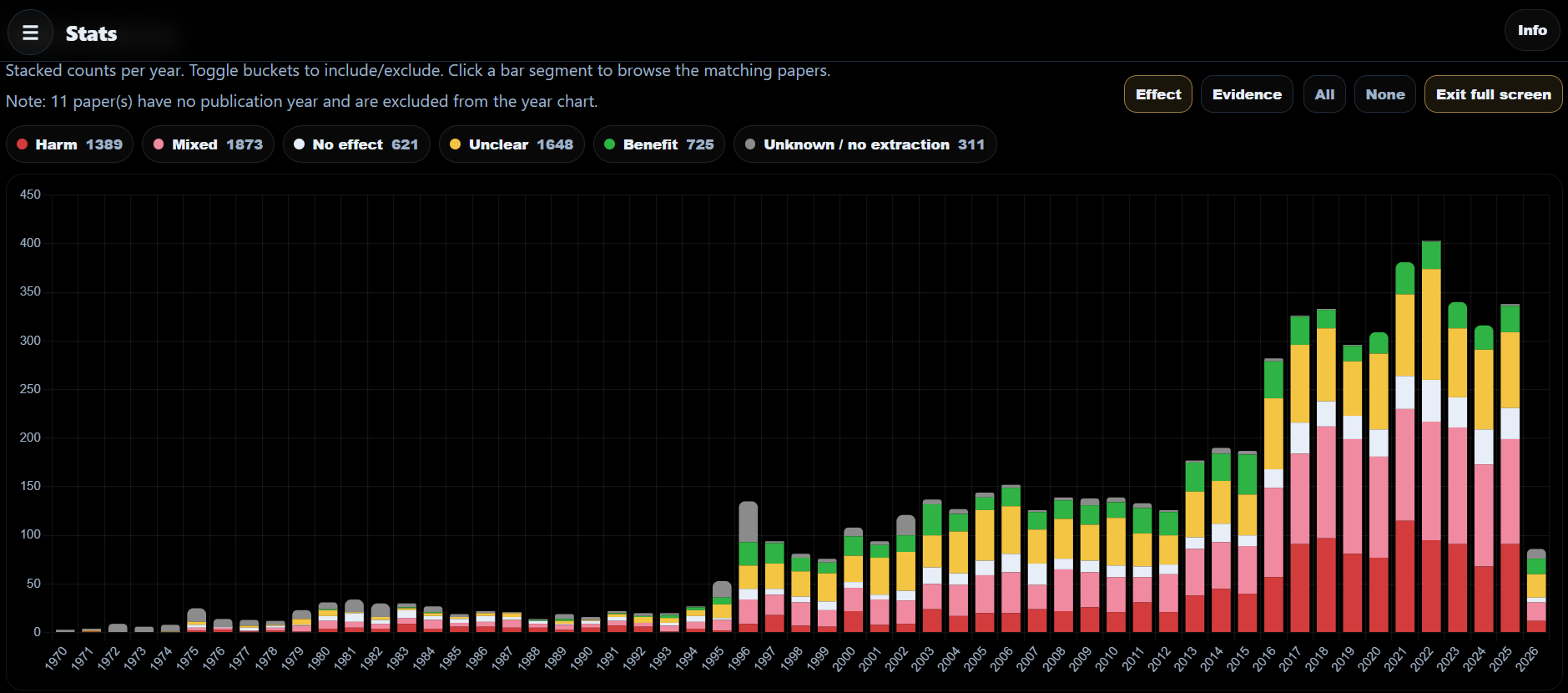
The “No Effect” category is under 10%
RF Safe’s stats page compiles thousands of RF/EMF studies and categorizes outcomes. In that snapshot, only about 9.5% land in “no effect.”
Read that again:
Under 10% of the literature says “nothing happened.”
Now, critics love to argue about whether an effect is harmful, beneficial, replicable, or clinically significant. Fine. Argue that.
But you cannot argue this:
Harmful, mixed, and beneficial outcomes are all still outcomes
“Harm” is an effect.
“Mixed” is an effect.
“Benefit” is an effect.
And if effects occur at non-thermal levels, then a thermal-only safety model is not a safety model. It’s a temperature model.
This is the core point that cannot be debated away:
If non-thermal biological interaction exists, thermal-only guidelines are structurally incomplete.
It doesn’t matter if an effect is “good” in one setting. The existence of a “good” effect proves biological interaction below heating thresholds. And once biology is being influenced, the only honest question becomes:
Are we regulating the right thing?
“But benefit doesn’t mean harm”
Correct. That’s the point.
Benefit doesn’t prove every exposure is harmful. It proves the exposure is biologically active.
If an input can change biology, it can potentially do so in different directions depending on:
-
dose and duration
-
modulation/pulsing
-
tissue type and developmental stage
-
proximity (phone-in-pocket vs distant exposure)
-
cumulative load (multiple radios, chronic indoor exposure)
-
vulnerability (children, pregnancy, fertility endpoints)
So the debate shouldn’t be “are EMFs always harmful?” That’s not how physiology works.
The debate should be:
Should we be saturating children in a biologically active environmental input while regulating only heat?
Why this matters for kids and long-term exposure
Children are not miniature adults.
They face:
-
longer lifetime cumulative exposure
-
developmental windows where systems are forming
-
school environments filled with constant connectivity
-
devices against the body for hours per day
Thermal-only rules were never built for that reality.
And “no proven harm” is not an ethical standard for involuntary exposure. It’s a marketing standard.
In public health, when an exposure is:
-
widespread,
-
involuntary,
-
increasing,
-
and biologically interactive,
you don’t hide behind a single endpoint like “cancer proof.” You modernize the model.
The honest conclusion: the guidelines are inadequate
If most of the literature shows biological interaction and current rules only address heating, then yes:
The guidelines are inadequate and must be updated.
Not because we’re hysterical.
Because the model is missing the mechanism.
A seatbelt law doesn’t wait for every crash type. It exists because we understand injury physics and we engineer around it.
RF safety must be the same: biology-first, reality-based, built for chronic exposure and kids.
And here’s the hopeful part: policy drives technology
This is where the story stops being doom and becomes a blueprint.
When standards change, industry adapts.
That’s how it works.
-
Cleaner fuel standards drove cleaner engines.
-
Catalytic converter mandates changed the car industry.
-
Building codes changed fire safety.
If RF exposure standards were updated to reflect non-thermal biological interaction, the market would respond. Innovation would follow the money and the rules.
And the most obvious next step is already on the table:
Enter the Light Age: Li-Fi and low-burden connectivity
We don’t need to “ban the internet.”
We need to clean the infrastructure.
Li-Fi is a shining example of what modern, biologically respectful connectivity can look like indoors:
-
high bandwidth
-
contained within rooms
-
lower ambient RF burden
-
compatible with fiber backbones
-
ideal for classrooms, libraries, offices, and homes
Li-Fi compatibility can be mandated or incentivized. It can become standard the same way other safety improvements became standard.
Not because companies love spending money.
Because policy creates the lane that innovation runs in.
What people should demand
Stop arguing in circles. Demand modernization.
-
Update RF safety guidelines beyond thermal-only assumptions
-
Prioritize children-first exposure reduction in schools
-
Require transparency, labeling, and real-world exposure metrics
-
Accelerate fiber + Li-Fi deployment where feasible
-
Treat RF exposure as an environmental burden that should be minimized, not normalized
Bottom line
This isn’t about winning a debate over cancer headlines.
It’s about whether the rules are even capable of protecting the public.
If less than 10% of the literature shows “no effect,” and the majority shows some biological interaction, then pretending this is only about heating is not science.
It’s denial.
The right move is obvious:
Update the model.
Update the rules.
Let innovation follow.
Lower the burden.
Protect children.
That takes political will. And political will comes from citizens who refuse to be gaslit into silence.