
Published 19 June 2025 • Starbase/Massey Outpost, Texas
TL;DR
Shortly after 23:02 CDT (04:02 UTC), the Starship upper‑stage prototype Ship 36 suffered a rapid unscheduled disassembly (RUD) on the Massey test stand while engineers were preparing a six‑engine static‑fire. No injuries have been reported, but the vehicle was completely lost and surrounding ground support equipment (GSE) was heavily damaged. Ship 36 had been slated to fly on Starship Flight 10 later this summer. elpais.comnasawatch.com
What Happened?
| Local time | Event | Source |
|---|---|---|
| 22:55 CDT | Ship 36 entered prop load stable; loading of LOX & CH₄ nearly complete | Test‑site audio loops |
| 23:02:00 CDT | First faint venting plume observed near forward dome (upper methane header tank) | NSF / observer footage youtube.com |
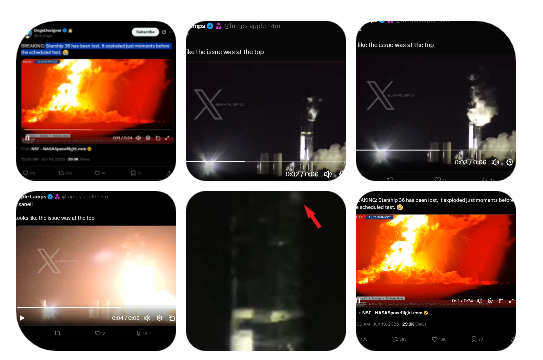
| 23:02:03 CDT | Bright white flash at same location followed by cascading debris | Social‑media clip (@lamps_apple) |
| 23:02:05 CDT | Full‑scale fireball engulfs vehicle; secondary explosions as residual propellant ignites | NSF slow‑mo video elpais.com |
| +30 s | Flames begin to subside; test stand structures still burning | Livestream |
Early frames show a point‑source glow on the forward tank section (see red arrow in still below) before the main conflagration, suggesting a methane‑rich leak or combustion event in the header‑tank plumbing – a region previously modified on Ship 36 to accommodate upgraded autogenous pressurization lines.
Why Is the Massey Site Important?
Most Starship static‑fires occur at Sub‑Orbital Pad B in Boca Chica, but SpaceX recently relocated single‑ship testing to Massey Outpost ~2 km inland to free the launch mount for full‑stack rehearsals. Massey is an open‑air stand with limited flame trenching; any over‑pressure is therefore more likely to damage the vehicle than the mount — one reason SpaceX usually fuels to only 10‑20 % of the ship’s 1,200‑t propellant capacity during ground‑level tests. nextspaceflight.com
How Big Was the Blast?
| Assumption | CH₄ (t) | Energy (MJ) | TNT‑eq. (tons) | Notes |
|---|---|---|---|---|
| 10 % fuel load | 36 | 2 000 MJ | 0.48 kt | Typical for brief engine‑start test |
| 15 % | 50 | 2 800 MJ | 0.67 kt | Upper bound many analysts use |
| Full | 360 | 20 000 MJ | 4.8 kt | Not believed to be the case here |
Rule of thumb: 1 tonne of methane contains ~55 GJ of chemical energy; 1 tonne TNT ≈ 4.184 GJ. Even at 10 % load, the detonation rivalled a half‑kiloton conventional blast – enough to register on infrasound arrays along the Gulf Coast.
Immediate Program Effects
-
Flight 10 Delay – Ship 36 was the flight vehicle; its loss pushes Starship Flight 10 to NET Q4 2025 while Ship 37 or Ship 38 is fast‑tracked.
-
Root‑Cause Investigation – SpaceX will convene a mishap board with FAA oversight. Early focus is on header‑tank isolation valves and methane vent seal integrity.
-
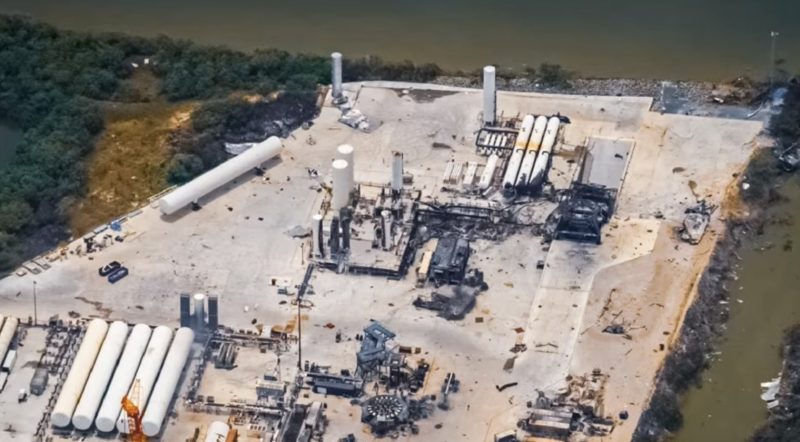
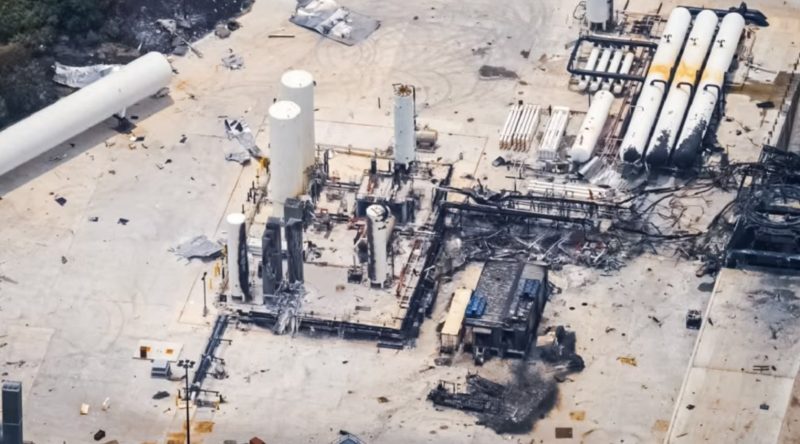
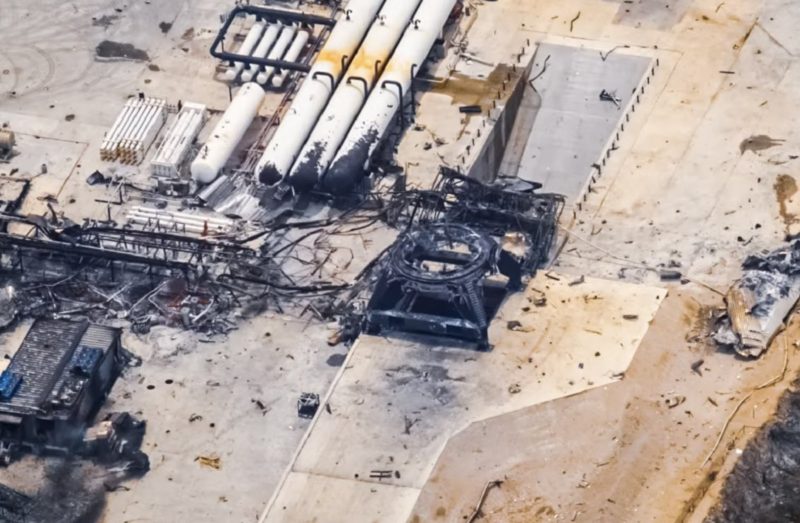
Infrastructure Repair – Massey’s stand suffered visible scorching; crane telemetry indicated boom deflection during the blast. Inspections are under way, but the stand could be offline several weeks.
-
Regulatory Optics – Because the event occurred off the orbital launch pad, major FAA licensing repercussions are unlikely, yet public scrutiny around Starship’s ground operations will intensify.
Context: A String of Upper‑Stage Anomalies
| Ship | Date | Phase | Outcome |
|---|---|---|---|
| Ship 34 | 6 Mar 2025 | Flight | Break‑up in upper atmosphere |
| Ship 35 | 24 May 2025 | Catch rehearsal | Minor engine fire, repaired |
| Ship 36 | 19 Jun 2025 | Pre‑static‑fire | Vehicle lost |
While SpaceX’s iterative approach accepts prototype losses, three significant starship‑class failures in five months will almost certainly trigger design revisions in the common bulkhead and autogenous press loops.
What Happens Next?
-
Data Scrub – High‑speed telemetry (2 k Hz) and 4 k fps test‑site cameras will be replayed frame‑by‑frame; the first detailed statement is expected within 48 h.
-
Hardware Swaps – New CH₄ header‑tank manifolds already in production for Ship 38 may be retrofitted fleet‑wide.
-
Pad Strategy Refresh – Look for more static‑fires to move back to the orbital pad where deeper flame diverters and water deluge systems mitigate blast effects.
-
Schedule Reset – Booster 17 roll‑out was pencilled in for mid‑July; that milestone now hinges on Massey repairs or alternate‑site readiness.
Why This Matters
-
Engineering – Starship is targeting full reusability and >100 t to orbit; every anomaly informs the path to human Mars missions.
-
Commercial Launch Market – Delays cascade to Starlink v3 and NASA HLS timelines.
-
Regulatory Landscape – Each ground incident feeds into environmental impact assessments that determine future cadence at Starbase.
BREAKING: SpaceX Starship 36 Explodes Moments Before Scheduled Test
In a dramatic and fiery event at SpaceX’s Massey Outpost near Starbase, Texas, Starship 36 experienced a catastrophic explosion just moments before a planned static-fire test. This unexpected event occurred late at night, sending flames soaring into the sky and turning the test stand into an inferno visible for miles.
Eyewitnesses and social media footage captured the terrifying sequence, initially spotting what appeared to be an unusual venting plume from the upper region of the spacecraft. Within seconds, a bright white flash emerged at the top of Starship 36, immediately followed by a cascading eruption that engulfed the rocket in a massive fireball.
The explosion created a blaze intense enough to illuminate the surrounding area like daylight. Dramatic images reveal immense clouds of fire and smoke, with secondary blasts triggered by residual propellant, underscoring the immense power and volatility of the liquid methane and oxygen fueling Starship rockets.
Early analysis of footage indicates the incident began near the forward methane header tank, an area where SpaceX had previously implemented design modifications to enhance autogenous pressurization systems. Observers noted a pinpoint source of ignition clearly visible before the large-scale detonation occurred, suggesting a potential leak or rupture within the tank’s plumbing.
Fortunately, the rigorous safety protocols SpaceX has in place meant that no injuries were reported, as personnel were safely distant from the test stand during the fueling process. However, the Massey Outpost testing facility itself sustained significant damage. Observations after the explosion show extensive charring and structural deformation to the support stands and adjacent equipment.
This explosion, despite occurring under partial fueling conditions estimated to be around 10-15% of Starship’s total capacity, still generated a shockingly large blast. Experts indicate the amount of methane involved would equate to roughly half a kiloton of TNT, comparable to a substantial conventional explosion. Such magnitude highlights the extreme care and safety measures necessary in handling these powerful spacecraft.
This incident marks a setback for SpaceX’s aggressive testing schedule. Starship 36 had been earmarked for the highly anticipated Flight 10 mission, part of a series designed to refine technology essential for missions to Mars and commercial satellite launches. With Ship 36 now completely destroyed, SpaceX will likely shift focus swiftly to Ship 37 or 38, potentially causing several months of delay.
Importantly, this setback is expected to impact the deployment speed of SpaceX’s ambitious Starlink satellite internet constellation. Starlink’s rapid expansion hinges significantly on the capabilities and high payload capacity of Starship vehicles, meaning delays in Starship testing and readiness could slow the rate at which SpaceX can launch the vast number of satellites necessary to achieve their global broadband coverage goals.
The explosion at Massey also prompts a necessary period of investigation and infrastructure recovery. Regulatory oversight by the FAA is standard practice following such events, though major repercussions are not anticipated given the remote test location and adherence to safety protocols. Nonetheless, increased scrutiny from public and environmental groups is expected, possibly influencing how SpaceX conducts future ground operations.
In the broader context, this failure follows other recent anomalies involving Starship prototypes, highlighting the challenges and risks inherent in developing the next generation of spacecraft designed for unprecedented payloads and reusability.
As engineers sift through telemetry data and high-speed camera footage to pinpoint the exact failure mechanisms, the lessons learned from Ship 36 will undoubtedly inform crucial design refinements. Such rapid iteration and adaptation have consistently defined SpaceX’s testing philosophy, turning setbacks into valuable insights that eventually enhance spacecraft reliability and safety.
Stay tuned for further updates as more detailed information becomes available from SpaceX and regulatory authorities. Despite the setback, the ambitious goal of enabling humanity’s expansion into space continues to drive forward at SpaceX, each challenge bringing the dream of deep-space exploration closer to reality.
Follow‑Up Resources
-
Replay the NSF slow‑motion footage – provides the clearest view of the initial flash. elpais.com
-
NextSpaceflight incident timeline – running database of Starship test status. nextspaceflight.com
-
NASA Watch live blog – real‑time updates as the investigation unfolds. nasawatch.com
Key Takeaways for Readers
-
Half‑kiloton‑class blast underscores the colossal energy stored even in “partially fueled” Starships.
-
No injuries highlight why SpaceX conducts fueling with remote ops and expansive exclusion zones.
-
Rapid iteration means today’s loss could translate into safer plumbing designs within weeks.