
In a long-overdue move that marks a pivotal victory for public health transparency and scientific integrity, the U.S. Food and Drug Administration (FDA) has drastically revised its webpages on cellphone radiation risks. As of January 15, 2026, the agency has shifted away from blanket assurances of safety—statements that lacked robust, up-to-date evidence—and toward a framework that directly echoes the core mandates of Public Law 90-602, the Radiation Control for Health and Safety Act of 1968. This change not only aligns the Department of Health and Human Services (HHS) with federal law but also opens the door for renewed research into the potential health impacts of electromagnetic radiation from wireless devices.
At RF Safe, we’ve been at the forefront of advocating for this exact transformation for years. Our relentless push for compliance with PL 90-602 has highlighted the government’s failure to fulfill its statutory obligations, including ongoing research and public dissemination of findings on electronic product radiation. Today, we celebrate this breakthrough while acknowledging the 337 days it took under Secretary Robert F. Kennedy Jr.’s leadership to get here. Late is better than never, and this presents an unprecedented opportunity to safeguard the health of the American people.
The Drastic Changes: From Dismissive Claims to Regulatory Responsibility
Let’s start with a side-by-side comparison of the old and new content to illustrate just how profound this overhaul is.
The Old Stance: Unsubstantiated Assurances of Safety
See Online Archive https://web.archive.org/web/20251026083547/https://www.fda.gov/radiation-emitting-products/cell-phones/do-cell-phones-pose-health-hazard
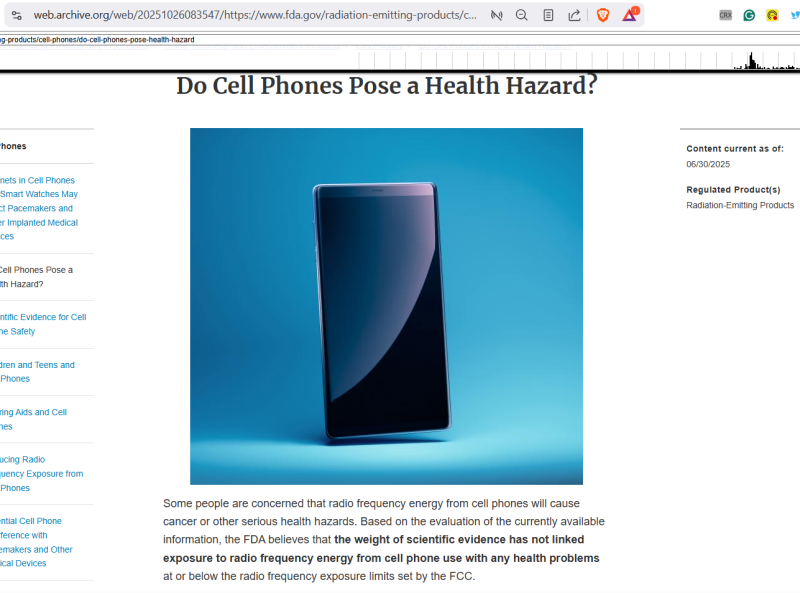
Prior to January 15, 2026, the FDA’s key page—”Do Cell Phones Pose a Health Hazard?”—featured unequivocal statements downplaying any risks from radio frequency (RF) energy emitted by cellphones. Archived versions from as recent as June 30, 2025, show the page asserting:
“Some people are concerned that radio frequency energy from cell phones will cause cancer or other serious health hazards. Based on the evaluation of the currently available information, the FDA believes that the weight of scientific evidence has not linked exposure to radio frequency energy from cell phone use with any health problems at or below the radio frequency exposure limits set by the FCC.”
This was accompanied by additional claims:
“The scientific evidence does not show a danger to any users of cell phones from RF exposure, including children and teenagers.”
“There is no consistent or credible scientific evidence of health problems caused by the exposure to radio frequency energy emitted by cell phones.”
References to no observed increase in brain or central nervous system cancers despite widespread cellphone adoption, citing alignments with organizations like the National Cancer Institute (NCI), World Health Organization (WHO), and others.
These assertions were presented as settled science, yet they ignored or downplayed emerging evidence, such as the 2018 National Toxicology Program (NTP) findings of “clear evidence” of cancer in rats exposed to RF radiation, and the Ramazzini Institute’s corroborating results.
Critics, including RF Safe, argued that this stance violated PL 90-602 by failing to actively pursue and publicize ongoing research into potential hazards.
The New Approach: Quoting the 1968 Mandate
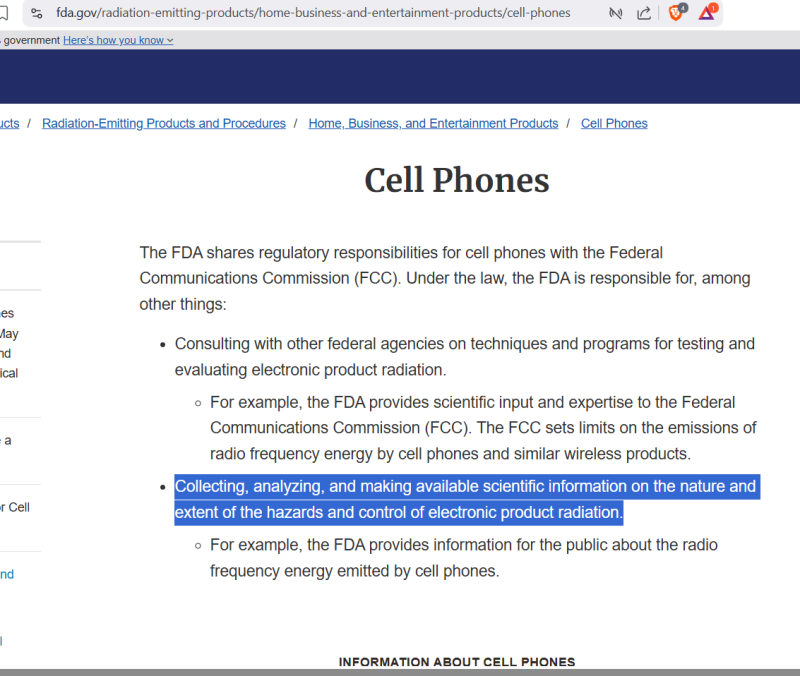
The updated page, now live at https://www.fda.gov/radiation-emitting-products/cell-phones/do-cell-phones-pose-health-hazard, has stripped out these sweeping safety declarations. Instead, it focuses on the FDA’s regulatory role, paraphrasing the language of PL 90-602 almost verbatim. Key excerpts include:
“The FDA shares regulatory responsibilities for cell phones with the Federal Communications Commission (FCC). Under the law, the FDA is responsible for, among other things:
Consulting with other federal agencies on techniques and programs for testing and evaluating electronic product radiation.
Collecting, analyzing, and making available scientific information on the nature and extent of the hazards and control of electronic product radiation.”
While some residual safety language remains in sub-sections—such as “The weight of scientific evidence has not linked cell phone radio frequency radiation with any health problems”—the overall tone has shifted to neutrality, emphasizing ongoing monitoring and practical advice for reducing exposure (e.g., using hands-free devices).
Gone are the detailed rebuttals of risks; in their place is a commitment to research and public information, directly fulfilling the law’s requirements for performance standards and hazard control.
This revision coincides with HHS’s announcement of a new $1.5 million study on electromagnetic radiation, directed by President Trump’s “Make America Healthy Again” (MAHA) Commission. HHS spokesman Andrew Nixon confirmed the removals targeted “old conclusions” to identify knowledge gaps, especially with emerging technologies.
However, not all agencies have followed suit—the CDC’s page still echoes the old safety narrative.
Understanding Public Law 90-602: The Forgotten Mandate
Enacted on October 18, 1968, PL 90-602 amended the Public Health Service Act to protect Americans from radiation emissions from electronic products, including non-ionizing radiation like RF from cellphones.
The law’s core provisions require the HHS Secretary (then under the Department of Health, Education, and Welfare) to:
Establish and carry out an electronic product radiation control program, including research to minimize emissions and exposure (§356(a)(2)).
Collect, analyze, and make public data on radiation hazards and controls (§356(b)(1)(A); §360(d)).
Develop performance standards to control emissions (§358).
The Act was born out of concerns over the “electronics age,” with incidents like faulty color TVs emitting excess radiation highlighting the need for federal oversight.
It mandates proactive research and transparency, using imperative language like “shall” to ensure compliance. Yet, for decades, the FDA’s webpages prioritized industry-aligned conclusions over fulfilling this research imperative—until now.
RF Safe’s Role: Championing Compliance for Over Two Decades
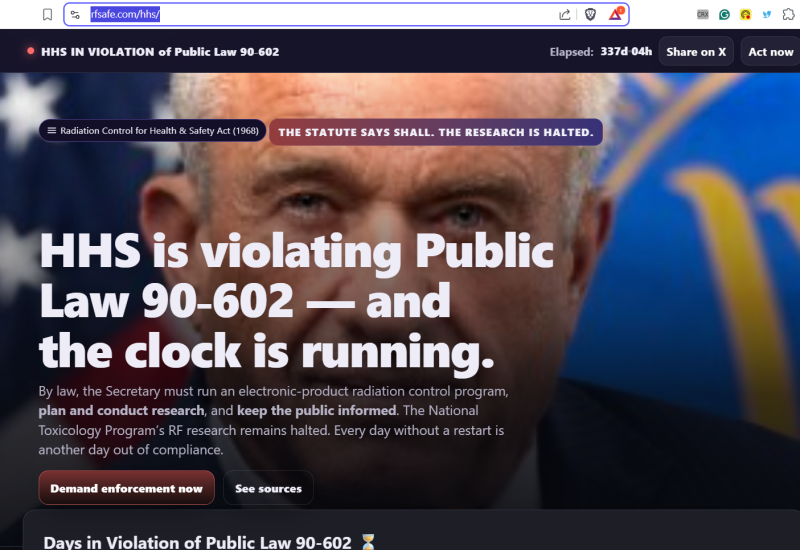
At RF Safe, we’ve been sounding the alarm on RF radiation risks since 1998, providing resources, shielded products, and advocacy to empower consumers. Our recent campaign, documented on https://www.rfsafe.com/hhs/, featured a live counter tracking HHS’s days in violation of PL 90-602, starting from RFK Jr.’s swearing-in on February 13, 2025.
The counter hit 337 days by January 15, 2026, underscoring the delay despite clear evidence of non-compliance, such as the NTP’s halt of RF studies in 2024.
We’ve demanded:
Restarting NTP’s RF research with transparent timelines and safeguards against conflicts of interest.
Correcting MAHA’s report, which omitted key studies like NTP 2018 and Ramazzini 2018.
Establishing a Pediatric RF Health Task Force and promoting Li-Fi alternatives in schools.
Modernizing guidelines beyond outdated Specific Absorption Rate (SAR) metrics.
This FDA update directly addresses our calls by recommitting to research and public information, officially bringing HHS back into compliance.
Applauding RFK Jr. and HHS: A Step Forward, But More Work Ahead
We applaud Secretary RFK Jr. and HHS for this action, even if it took 337 days. RFK Jr., a longtime critic of wireless radiation linking it to cancer and neurological issues, has used his platform to challenge entrenched narratives.
His leadership in launching the new study is a game-changer, potentially addressing gaps in understanding long-term effects, non-thermal biological impacts, and risks to children.
Yet, this is just the beginning. Mainstream bodies like the WHO and CDC still downplay risks, and full compliance requires robust, independent research—not just webpage tweaks.
We urge HHS to accelerate the MAHA-directed study, incorporate post-2022 evidence, and prioritize vulnerable populations.
Implications for American Health: A Golden Opportunity
This shift could revolutionize how we approach wireless technology. By fulfilling PL 90-602’s mandate, HHS can foster innovation in safer alternatives, like wired connections or low-emission designs, while empowering consumers with evidence-based guidance. For families, it means potential policies restricting school cellphone use (already in 22 states) and better protections against cumulative exposure.
At RF Safe, we’re optimistic. This change validates our advocacy and signals a brighter, healthier future. Stay tuned for updates, and explore our resources at rfsafe.com to reduce your RF exposure today.
What do you think about this development? Share your thoughts in the comments below.
References and Further Reading:
- Archived FDA Page (June 2025)
- Current FDA Page
- Full Text of PL 90-602
- HHS Press Releases on MAHA and the New Study