
__us_dia_1976_biological_effects_of_electromagnetic_radiation pdf
Fifty years of research have warned that electromagnetic fields can disturb the timing machinery of biology. The real question is not which single disease they cause, but whether chronic exposure helps drive a low-fidelity meta-disease state.
In 1977, when I was seven years old, I lost my left kidney to cancer.
I had been living with my parents on a military base near a radar installation. No one measured the electromagnetic environment in our home. No one recorded the radar’s pulse structure, peak power, operating schedule, beam orientation, duty cycle, or the fields reaching the places where military families lived, slept, and raised their children.
My childhood is not a one-variable laboratory experiment. I am not claiming that radar selected my kidney and directly produced one particular cancer through one exclusive pathway.
That is not my argument.
My argument is that a developing child depends upon extraordinarily precise biological timing. Ion channels must open and close at the right moments. Calcium signals must have the correct amplitude, frequency, duration, and location. Mitochondria must match energy production to cellular demand. Oxidative signals must occur in the correct compartment and then be terminated. DNA repair, immune surveillance, endocrine rhythms, sleep architecture, cellular differentiation, and developmental patterning all depend upon coordination.
When environmental pressures degrade that coordination, biology can continue operating—but at lower fidelity.
The result is not necessarily one predictable disease. The result is a state in which errors propagate more easily, repair becomes less reliable, adaptation becomes less effective, and rare downstream events become less rare.
I call this low-fidelity biology.
When that loss of fidelity becomes sufficiently broad and persistent, it creates what I call a meta-disease state: not one diagnosis, but an upstream physiological condition that increases vulnerability to numerous developmental, metabolic, neurological, reproductive, immunological, cardiovascular, and carcinogenic outcomes.
My kidney cancer was one downstream event. Other environmental contributors may have been involved. That is not a weakness in this explanation. It is central to it.
Low-fidelity biology is a multi-hit model.
The disease-X question is the wrong question
For decades, the wireless-radiation debate has been forced into a simplistic structure:
- Does RF radiation cause brain cancer?
- Does it cause kidney cancer?
- Does it cause infertility?
- Does it cause neurological disease?
- Does it cause one specific developmental disorder?
That model assumes that an environmental influence is relevant only when it maps cleanly and consistently onto one named disease.
But upstream biological stressors do not necessarily work that way.
Sleep deprivation does not select one disease. Air pollution does not produce one identical outcome in everyone. Processed diets, endocrine-disrupting chemicals, chronic psychological stress, infection, metabolic dysfunction, and toxic exposures can disturb common systems of repair, inflammation, immune regulation, energy metabolism, and hormonal signaling while producing different outcomes in different people.
The downstream diagnosis depends upon the receiver.
It depends upon age, genetics, developmental stage, tissue vulnerability, nutritional status, previous injury, medications, co-exposures, immune history, and chance molecular events.
An upstream fidelity stressor changes the probability distribution, not the name of the diagnosis.
It can move disease earlier in life. It can broaden the range of possible outcomes. It can increase biological variance. It can make a person less able to recover from another stressor. At the population level, it can “fatten the tails,” increasing the occurrence of outcomes that would otherwise remain exceptionally rare.
That is why demanding a one-to-one relationship between RF exposure and disease X can become a scientific blindfold.
The disease name appears at the end of the causal chain.
The loss of fidelity comes first.
The warning was already visible in 1976
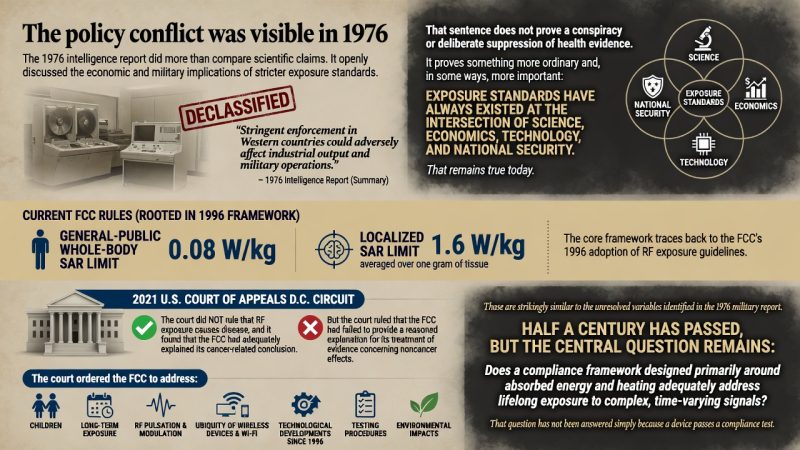
One year before my kidney was removed, the Defense Intelligence Agency published Biological Effects of Electromagnetic Radiation—Radiowaves and Microwaves. It was prepared by the U.S. Army Medical Intelligence and Information Agency and reviewed research collected through October 1975.
It was an intelligence assessment of Soviet and Eastern European research, not a modern clinical trial. Yet the biological pattern documented in its pages was far broader than heating and far broader than any single disease.
The report identified frequency, intensity, exposure duration, body orientation, the portion of the body exposed, environmental conditions, health status, medications, and—critically—whether the field was pulsed, continuous-wave, or modulated as variables that could influence biological response.
It described reported changes involving:
- Sodium and potassium transport across cell membranes
- Blood and blood-forming tissues
- Cardiac conduction and vascular regulation
- Brain electrical activity and neurological function
- Mitochondrial structure
- Oxidative phosphorylation and cellular energy metabolism
- Endocrine and reproductive function
- Immune reactivity
- Cellular nuclei, membranes, and protein-synthesizing machinery
The report discussed experiments in which intermittent and continuous low-intensity microwave exposures produced different changes in brain electrical activity. It described changes in nerve conduction and biopotential amplitude that investigators considered greater than heating alone could explain. It reported altered membrane permeability to sodium and potassium ions and proposed interference with active ion transport or membrane structure.
It also documented mitochondrial swelling and breakdown, disruption of oxidative phosphorylation, reductions in ATP-related energy compounds, and metabolic changes that reportedly appeared before structural changes in heart tissue.
That sequence matters.
First came altered metabolism and regulation.
Structural pathology came later.
The report also described immune changes and reported synergistic interactions between microwave exposure and drugs, ionizing radiation, magnetic fields, and other nonionizing exposures. In other words, researchers were already confronting the possibility that electromagnetic fields might interact with other biological burdens rather than acting as an isolated, single-cause agent.
Most important, the report summarized a comparison of exposed and unexposed workers by saying microwaves might act as a “nonspecific factor” that interfered with adaptation to unfavorable influences and promoted earlier cardiovascular disease in susceptible people.
That is almost a 1976 description of low-fidelity biology.
It is not saying microwaves select one disease. It is saying they may reduce the organism’s ability to maintain adaptation under stress, allowing disease to emerge earlier in vulnerable individuals.
The report’s final information-gap section acknowledged that the health of people living near powerful transmitters was not adequately documented and proposed comparing those populations with people living in more ordinary electromagnetic environments.
That was the study military families needed.
It was never conducted at the scale or with the dosimetry required to answer the question.
Biology is a timing system before it is a collection of organs
A calcium ion is not merely “present” or “absent.”
Cells encode information through calcium waveforms: their frequency, amplitude, duration, repetition rate, subcellular location, and relationship to other signals. A brief calcium pulse may communicate one instruction; a sustained elevation may communicate another. Oscillatory calcium can regulate transcription, metabolism, neurotransmission, contraction, secretion, differentiation, and cell survival.
The same principle applies to sodium, potassium, chloride, protons, membrane voltage, redox signals, mitochondrial potential, hormone pulses, sleep rhythms, and neuronal oscillations.
Healthy biology therefore depends on more than chemical quantity. It depends on:
what happened, where it happened, how strongly it happened, when it began, how long it continued, and whether it stopped at the correct time.
That is biological fidelity.
Low-fidelity biology occurs when those signals become noisier, mistimed, poorly terminated, improperly amplified, or disconnected from the systems that are supposed to interpret them.
A cell may still function. An organ may still appear normal. A person may have no diagnosable disease.
But the margin of resilience has narrowed.
That is why low-fidelity biology can exist before conventional pathology becomes visible. It is a systems-level loss of precision that increases the likelihood of later failures.
The analogy to aging is functional, not cosmetic. It is not about wrinkles. It is about the premature loss of coordination, repair capacity, adaptive range, and physiological precision normally associated with declining biological resilience.
S4: A plausible lever at the cellular membrane
Voltage-gated calcium, sodium, and potassium channels contain voltage-sensing domains. Within those domains, positively charged residues in the S4 segment act as gating charges. Changes in the membrane’s electric field move the voltage sensor and help determine whether the channel opens or closes. This is fundamental electrophysiology, not a speculative feature of ion channels.
The ion-forced-oscillation model proposes that time-varying electromagnetic fields can exert oscillatory forces on mobile ions near cell membranes. Under suitable conditions, that motion could influence the forces acting upon voltage sensors and produce irregular or mistimed gating of voltage-gated ion channels.
That specific coupling model remains a proposed mechanism rather than universally settled science. But it creates clear, testable predictions: biological response should depend upon waveform, frequency, polarization, modulation, exposure duration, ion-channel composition, and the electrical properties of the exposed tissue.
The critical point is that S4 sensors do not need to be destroyed for biological fidelity to fall.
They only need to be mistimed often enough to distort the ionic waveforms that coordinate downstream physiology.
A gate opening slightly too early, closing slightly too late, or responding inconsistently may appear trivial in one event. Repeated across enormous numbers of channels, cells, and exposure cycles, however, small timing deviations can become biological noise.
That noise can then propagate into calcium signaling, mitochondrial demand, redox regulation, gene expression, neuronal oscillations, muscle contraction, hormonal release, and immune activity.
Mito: CYB5B establishes a biological transduction principle
A major development arrived in 2026 with a Cell paper describing an electromagnetic-field-inducible gene switch.
The researchers used a CRISPR screen to identify cytochrome b5 type B—CYB5B—as an essential mediator of their EMF-responsive system. CYB5B is a membrane-bound electron carrier associated with the mitochondrial outer membrane. In the experiment, the applied field produced characteristic calcium oscillations, which then activated gene expression. The researchers emphasized that the switch depended upon rhythmic calcium behavior rather than merely a nonspecific rise in intracellular calcium.
The field used in that experiment was an extremely-low-frequency magnetic field, not a cellular microwave signal. The relevance is therefore not that a 60 Hz laboratory system is identical to Wi-Fi, radar, or 5G.
The relevance is more fundamental:
A native mitochondrial-associated protein can participate in converting an applied electromagnetic field into a specific temporal calcium signal and a downstream gene-expression response.
That is biological electromagnetic transduction.
The study does not establish that every environmental field activates CYB5B in the same way. It establishes that the idea of a molecular field-to-calcium transducer is experimentally real and can be identified through genetic screening.
It also makes the temporal issue impossible to ignore.
The biological output depended upon the pattern of calcium oscillation. The field was translated into timing.
That is precisely the territory of low-fidelity biology.
Spin and redox: Biology has more than one field-sensitive pathway
The “spin” portion of the S4–Mito–Spin framework recognizes another possible route: magnetic-field sensitivity within radical-pair chemistry.
Radical-pair reactions involve electron spins whose chemical outcomes can, under particular conditions, be influenced by magnetic fields. The radical-pair mechanism is extensively studied in magnetoreception, especially in cryptochrome-based navigation systems. Experiments showing that certain weak RF fields can disrupt magnetic orientation in migratory birds provide a concrete example of a nonthermal RF interaction with a biological sensory mechanism.
This does not prove that the same mechanism causes human disease.
It proves something narrower but profoundly important:
“Too weak to heat tissue” is not equivalent to “physically incapable of influencing biology.”
Redox biology is particularly relevant because reactive oxygen species are not simply toxic waste. At controlled concentrations, in the correct location and at the correct time, they are signaling molecules. They participate in immunity, adaptation, metabolism, vascular regulation, cellular proliferation, and repair.
The problem is therefore not simply “more ROS.”
The problem can be ROS generated at the wrong time, in the wrong compartment, for the wrong duration, or without appropriate antioxidant termination.
A 2016 review of 100 peer-reviewed experimental studies reported oxidative effects in 93 of them, including altered ROS-generating pathways, lipid peroxidation, oxidative DNA damage, and changes in antioxidant enzymes. The exposure systems and biological models varied, so this does not provide one universal exposure threshold. It does show that oxidative and redox responses have repeatedly appeared across the RF literature.
In the low-fidelity model, oxidative stress is not an isolated endpoint. It is both a consequence and an amplifier of mistimed calcium and mitochondrial activity.
Calcium influences mitochondria.
Mitochondria influence ROS.
ROS influence ion channels, transcription, immunity, and repair.
Once those feedback loops lose temporal precision, one disturbed signal can reinforce another.
CACNA1C: The receiver is part of the dose
One of the clearest modern demonstrations of individual biological susceptibility comes from a 2025 randomized, double-blind, sham-controlled study of 5G RF exposure and sleep spindles.
Researchers selected 34 participants according to a single-nucleotide variant, rs7304986, associated with the CACNA1C gene, which encodes the α1C subunit of the Cav1.2 L-type voltage-gated calcium channel. The relevant CACNA1C variants occur in an intronic, non-protein-coding region of the gene.
Participants received standardized 30-minute exposures before sleep to 700 MHz, 3.6 GHz, or sham conditions. The investigators found a significant exposure-by-genotype interaction: the 3.6 GHz signal accelerated sleep-spindle center frequency in central, parietal, and occipital regions among T/C carriers, while the same response was not observed in the matched T/T group.
This was a small, acute physiological study. It did not diagnose disease or establish that the spindle change was harmful.
But it demonstrated something that conventional exposure assessment usually ignores:
The same external field did not produce the same physiological response in genetically different receivers.
That means exposure cannot be defined solely by what leaves the antenna.
The biological dose also depends upon what receives the signal.
A single-letter genetic difference associated with calcium-channel biology changed the measurable response of a native human brain rhythm. The study authors also observed that the different results at 700 MHz and 3.6 GHz highlighted the importance of signal characteristics and tissue properties.
This directly supports a central principle of low-fidelity biology:
The receiver is part of the dose.
A population average can therefore hide a responsive subgroup. When genetically and physiologically distinct people are pooled together, genuine effects in susceptible participants may disappear inside the average.
Variation is not necessarily evidence that an effect does not exist.
Variation may reveal the mechanism.
Low-fidelity biology changes probability, not destiny
The model can be expressed as a causal sequence:
Pulsed or modulated electromagnetic exposure plus other environmental stressors
→ perturbation of field-sensitive ionic, membrane, mitochondrial, or redox processes
→ distortion of calcium and other signaling waveforms
→ mismatch between cellular instructions, energy supply, repair, and adaptation
→ reduced biological fidelity and resilience
→ tissue-, genotype-, age-, and context-dependent downstream pathology
This does not mean that every exposure produces every step in every person.
It means the pathway predicts heterogeneity.
That is a strength of the model, not an escape clause.
Low-fidelity biology predicts that:
- One person may compensate while another crosses a pathological threshold.
- The same person may respond differently during childhood, illness, pregnancy, sleep deprivation, medication, or metabolic stress.
- A waveform that produces little response in one tissue may disturb another.
- Effects may be non-linear rather than increasing smoothly with average power.
- Intermittent and continuous exposure may have different consequences.
- Recovery intervals may matter as much as cumulative exposure.
- Rare outcomes may increase without one disease dominating the population.
The model does not say RF radiation is the sole cause of kidney cancer, glioma, infertility, arrhythmia, developmental injury, immune dysfunction, or metabolic disease.
It says RF may contribute to an upstream condition in which the biological systems responsible for preventing those outcomes work with less precision.
That distinction is the heart of the argument.
Density gating: Why some tissues may reveal the problem first
Low-fidelity effects should not be expected to appear uniformly throughout the body.
Some tissues operate with greater electrical activity, denser ion-channel machinery, higher mitochondrial demand, faster calcium cycling, more complex intercellular coordination, or less tolerance for timing error.
I call this density gating.
Under the density-gating hypothesis, tissue vulnerability is determined by the combined density of susceptible biological machinery and the tissue’s dependence upon high-fidelity timing. Relevant variables could include:
- Voltage-gated channel expression
- Mitochondrial density and metabolic demand
- Calcium cycling rate
- Redox sensitivity
- Local field absorption and geometry
- Cell turnover and developmental state
- Repair capacity
- Innervation and vascular supply
- Genetic variation
The National Toxicology Program’s long-duration rat studies found clear evidence of malignant heart schwannomas in exposed male rats under both GSM- and CDMA-modulated 900 MHz exposures. Malignant gliomas and several nonneoplastic lesions in the heart and brain were also related to exposure under the study conditions.
The Ramazzini Institute’s lifetime far-field experiment also reported a statistically significant increase in heart schwannomas in male rats at its highest exposure level, along with other tumor signals.
These findings do not prove density gating.
But the repeated involvement of Schwann cells, heart tissue, and brain glia should not be treated merely as a list of disease labels. These cells exist within highly coordinated electrical and metabolic environments where ion homeostasis, mitochondrial performance, membrane signaling, and intercellular communication are critical.
The proper mechanistic question is not:
Why does RF cause exactly this tumor?
It is:
What properties of these cells and their surrounding tissues make them early sentinels of disturbed biological fidelity?
That can be tested by measuring channel expression, mitochondrial density, calcium dynamics, redox behavior, repair capacity, field distribution, and pathology together.
The tumor is the final event.
The mechanistic trail begins much earlier.
My childhood cancer belongs inside this framework
My kidney cancer was an exceptionally rare event in a seven-year-old.
The low-fidelity model does not require me to claim that radar chose my kidney or acted alone.
It asks a different question:
What environmental and biological conditions allowed an extremely uncommon downstream failure to occur so early in life?
Possible contributors could have included radar exposure, chemicals, contaminated water, fuels, solvents, pesticides, infections, developmental vulnerabilities, nutrition, genetic susceptibility, or combinations that can no longer be reconstructed.
The key word is combination.
A child may tolerate one biological burden. A second may reduce the ability to compensate. A third may interfere with repair. A fourth may occur during a critical developmental window. Eventually, a rare cellular error escapes the systems that would ordinarily correct, contain, or eliminate it.
That is how a meta-disease model approaches causation.
Not as a single falling domino, but as a loss of system integrity.
My cancer is therefore not evidence that one transmitter always produces one tumor.
It is evidence of what can be lost when we do not measure a child’s total environment, do not preserve exposure records, and do not investigate the upstream conditions that make rare pathology possible.
Weston Elementary was a sentinel event—not a one-cause experiment
The California school was Weston Elementary School in Ripon.
In 2019, national reporting documented four student cancer cases. The first publicly identified child, Kyle Prime, had been diagnosed with kidney cancer at age ten. His friend and classmate Mason Ferrulli was diagnosed with brain cancer five months later, and two additional student cases were subsequently reported. Sprint shut down the on-campus tower and planned to relocate it, even while maintaining that it had operated below federal limits.
The parents themselves did not deny the possibility of other environmental influences. Later investigations reported TCE in school drinking water and wider concerns involving contaminated groundwater and possible vapor exposure in Ripon.
That does not make the tower irrelevant.
It does not prove that TCE caused the cancers.
It demonstrates why the disease-X model is inadequate.
The children may have encountered multiple environmental pressures. A proper investigation should have reconstructed RF exposure, water and soil contaminants, air pathways, residential histories, developmental timing, genetic susceptibility, and other relevant variables.
The removal of the tower also created a potential natural experiment. Cancer incidence and other health outcomes should have been followed prospectively before and after removal, with transparent public reporting.
I have not located an official longitudinal registry report that substantiates the claim that no further cancers occurred after removal. That claim should therefore be verified rather than presented as established fact.
But the absence of formal, long-term follow-up is itself part of the problem.
Sentinel events occur.
The community raises an alarm.
One exposure source is removed.
Then the surveillance required to learn from the event is never adequately performed.
RF is one contributor—but it is uniquely difficult to escape
Low-fidelity biology is not an RF-only theory.
Poor air quality can reduce fidelity. Chemical exposure can reduce fidelity. Processed food, metabolic dysfunction, infection, chronic inflammation, inadequate sleep, psychological stress, medication interactions, nutrient deficiencies, and other environmental pressures can all degrade biological coordination and recovery.
RF belongs inside that larger exposome.
But it has one unusual characteristic: it is increasingly difficult to avoid.
People can make at least some choices about food. They can sometimes improve indoor air, reduce certain chemicals, stop smoking, change medications, or protect sleep.
Most people cannot meaningfully choose whether their neighborhood, workplace, school, hospital, transportation system, and public environment contain wireless infrastructure.
“Twenty-four-seven exposure” does not mean every device continuously transmits at maximum power. It means the infrastructure is persistent, the signals recur throughout the day and night, and truly unexposed recovery environments have become uncommon.
This is especially important for children, whose exposures begin during development and can continue across an entire lifetime.
In 2021, the D.C. Circuit Court of Appeals ruled that the FCC had failed to provide a reasoned explanation for its conclusion that existing guidelines adequately addressed noncancer effects. The court specifically identified children, long-term exposure, pulsation and modulation, the ubiquity of wireless devices and Wi-Fi, technological changes since 1996, and environmental effects as issues requiring consideration.
Those are not peripheral details.
They are central variables in a biological-fidelity model.
The research question must be rewritten
The next generation of research should stop asking only whether one RF exposure causes one named disease.
It should ask whether defined exposures alter the fidelity, resilience, and recovery of biological control systems.
That requires five changes.
- Measure the signal as biology receives it. Researchers must record carrier frequency, modulation, pulse duration, repetition rate, peak-to-average ratio, polarization, field geometry, near-field conditions, intermittency, cumulative exposure, and recovery intervals—not merely one time-averaged power number.
- Measure early fidelity endpoints. Studies should track calcium-waveform frequency and amplitude, ion-channel gating, membrane potential, mitochondrial reserve, ATP production, redox timing, oxidative phosphorylation, sleep oscillations, autonomic regulation, immune signaling, DNA repair, apoptosis, senescence, and recovery after exposure.
- Stratify the receiver. Genotype, age, sex, developmental stage, disease state, medication, metabolism, tissue characteristics, previous exposure, and co-exposures should be treated as part of the dose rather than as statistical inconvenience.
- Study mixtures and multi-hit conditions. RF should be examined alongside air pollutants, endocrine disruptors, toxic metals, solvents, sleep loss, infection, heat stress, metabolic dysfunction, and medications. The 1976 report already recognized the possibility of synergistic interactions.
- Create long-term sentinel cohorts. Military families near historical radar sites, children attending schools near transmitters, workers in high-exposure occupations, and communities experiencing unusual disease patterns should be followed with personal dosimetry, environmental sampling, biological markers, transparent protocols, and publicly available data.
The hypothesis is testable.
If low-fidelity biology is correct, investigators should find exposure- and receiver-dependent changes in biological timing before overt disease emerges.
If density gating is correct, vulnerability should correlate with identifiable combinations of channel density, mitochondrial demand, field distribution, and repair capacity.
If recovery windows matter, intermittent exposure schedules should produce different outcomes from continuous or differently patterned exposure even at similar average energy.
If genotype matters, pooled averages should conceal distinct responder groups.
Those are scientific predictions.
They should be tested directly.
The disease name comes last
I have spent approximately 30 years trying to explain that the central warning is not:
Wireless radiation causes one disease in every exposed person.
The warning is:
Chronic electromagnetic exposure may add timing error to biological systems that require extraordinary precision, helping drive susceptible organisms into a lower-fidelity state.
From there, outcomes diverge.
One person develops a neurological problem.
Another experiences reproductive impairment.
Another develops metabolic or cardiovascular disease.
Another develops a rare cancer unusually early.
Many remain apparently healthy because their compensatory capacity, genetics, exposure pattern, and total environmental burden are different.
That variability does not invalidate the upstream model.
It is what the model predicts.
My kidney is not a prosecution exhibit against one radar transmitter.
It represents what is at stake when a child’s environment is not measured, when biological warning signs are divided into unrelated disease categories, and when regulators ask mainly whether a field produces enough average energy to heat tissue.
The 1976 report already described disturbances involving membranes, ions, mitochondria, metabolism, electrical activity, immunity, reproduction, and adaptation. Modern research has added established S4 voltage sensors, proposed ion-forced-oscillation mechanisms, repeated oxidative findings, a CYB5B-mediated electromagnetic transduction system, genotype-dependent 5G effects involving CACNA1C, and long-term animal tumor signals.
These are not identical pieces of evidence.
They are converging pieces of a systems-level question.
The full pathway has not yet been mapped under every real-world exposure condition. But it is no longer reasonable to dismiss the pathway merely because it does not produce one disease in every person.
RF is not the disease.
Low-fidelity biology is the vulnerable state.
The meta-disease state is the opening through which multiple downstream pathologies become more likely.
The rare becomes less rare.
The diseases of later life appear earlier.
The organism loses the precision it needs to resist, repair, and recover.
And by the time the disease receives a name, the upstream loss of fidelity may have been operating for years.
The signal comes first.
The disease name comes last.