Shield the user side, not the fantasy side
A case is only helping in the way it claims to help when the barrier is actually between the user and the handset during real use.
The biggest problem in this category is not a lack of products. It is a lack of honest design logic. Many so-called anti-radiation phone cases ask the buyer to trust a shielding claim without explaining how the phone actually behaves in the real world, how the barrier is supposed to be oriented, or whether the hardware choices in the case work with the phone’s radios or against them.
This page exists to make those design red flags visible. It uses the red-flags guide data already built into RF Safe’s JSON-based slide set, but reshapes it into a long-form, search-friendly page that teaches shoppers what to avoid, why those mistakes matter, and what a better phone protection philosophy should look like.
Most buyers are trying to solve two problems at once: they want to protect the phone from damage, and they want to lower near-body exposure in the direction that matters. A badly designed anti-radiation phone case can fail at both jobs. It can add bulk, create bad habits, obscure what the user is supposed to do, and still leave the buyer thinking they purchased “protection.”
A case is only helping in the way it claims to help when the barrier is actually between the user and the handset during real use.
Plates, magnets, decorative metal, bulky stacks, and poorly thought-through openings are not neutral details. They are design decisions.
A serious product should make correct orientation and lower-exposure use easier, not leave the buyer to guess.
The real divide in this category is not “shielding” versus “no shielding.” It is first-principles design versus gimmick-first design.
The cards below are generated from the same JSON-powered guide data already used in the existing slide-based resource, but reorganized here as a richer page built to teach, rank, and link more effectively.
These links are meant to make the page feel usable at a glance while still giving search engines enough supporting text and structure to understand what each red flag is about.
What to look for to ensure a genuine anti-radiation phone case
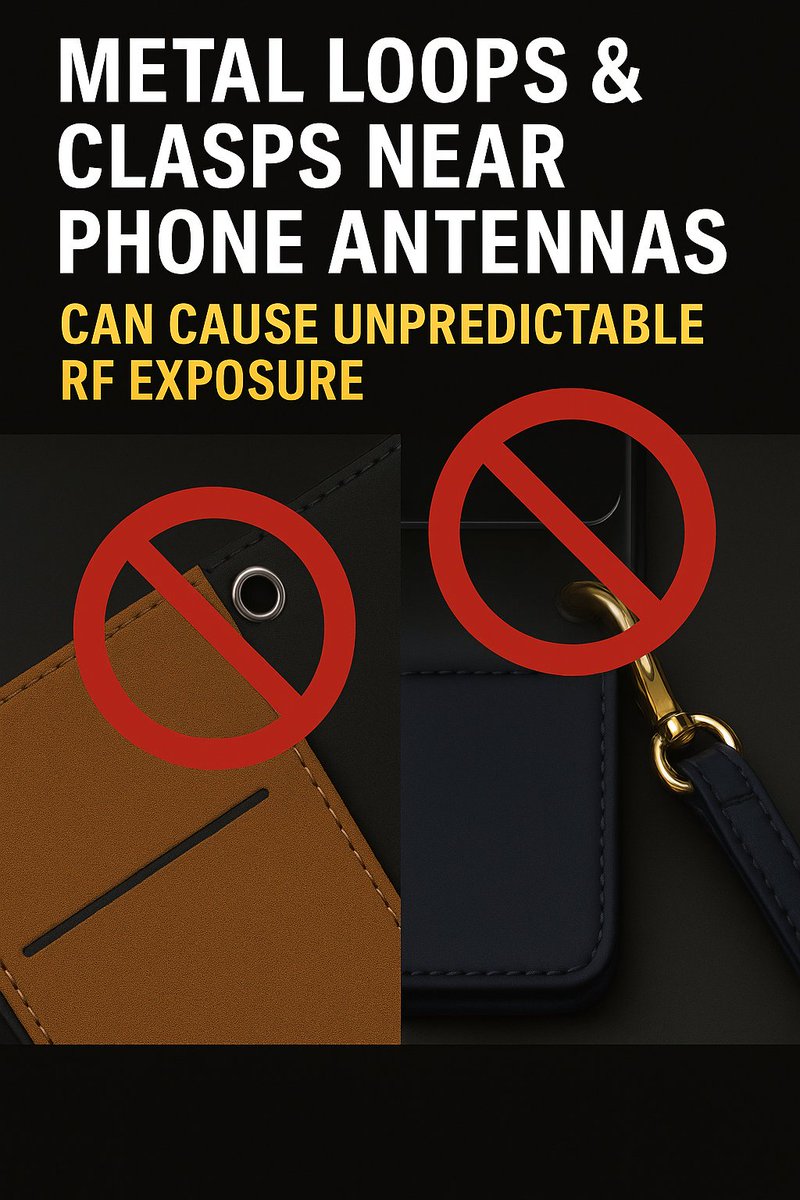
👉 Small metal loops, grommets, and strap clasps placed near a phone’s radiating edge act as parasitic conductors. In the reactive near‑field they add stray capacitance a…
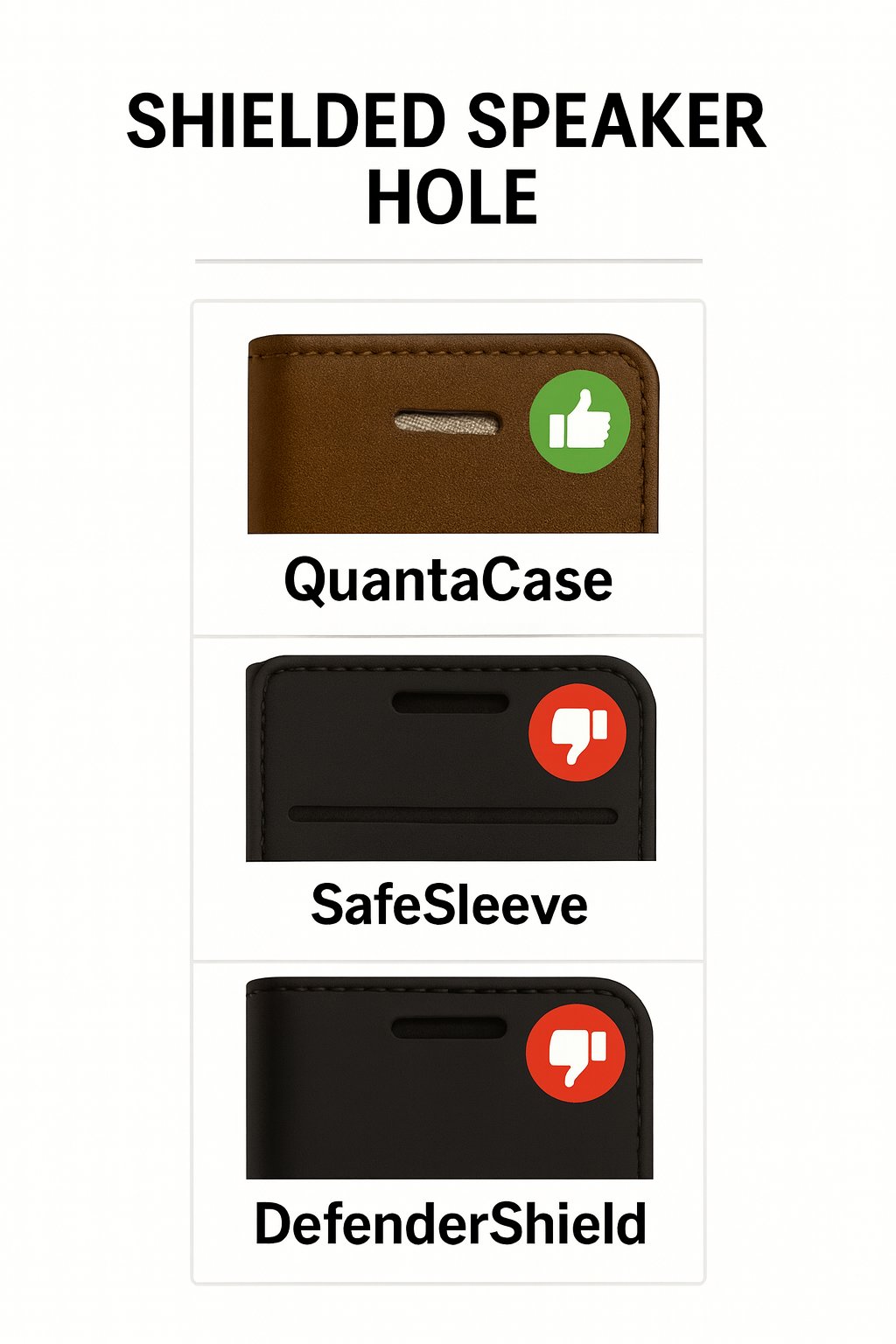
Only QuantaCase shows true ear‑side continuity. The earpiece opening is covered by a visible, conductive mesh that bonds to the front‑cover shield. With the cover closed…
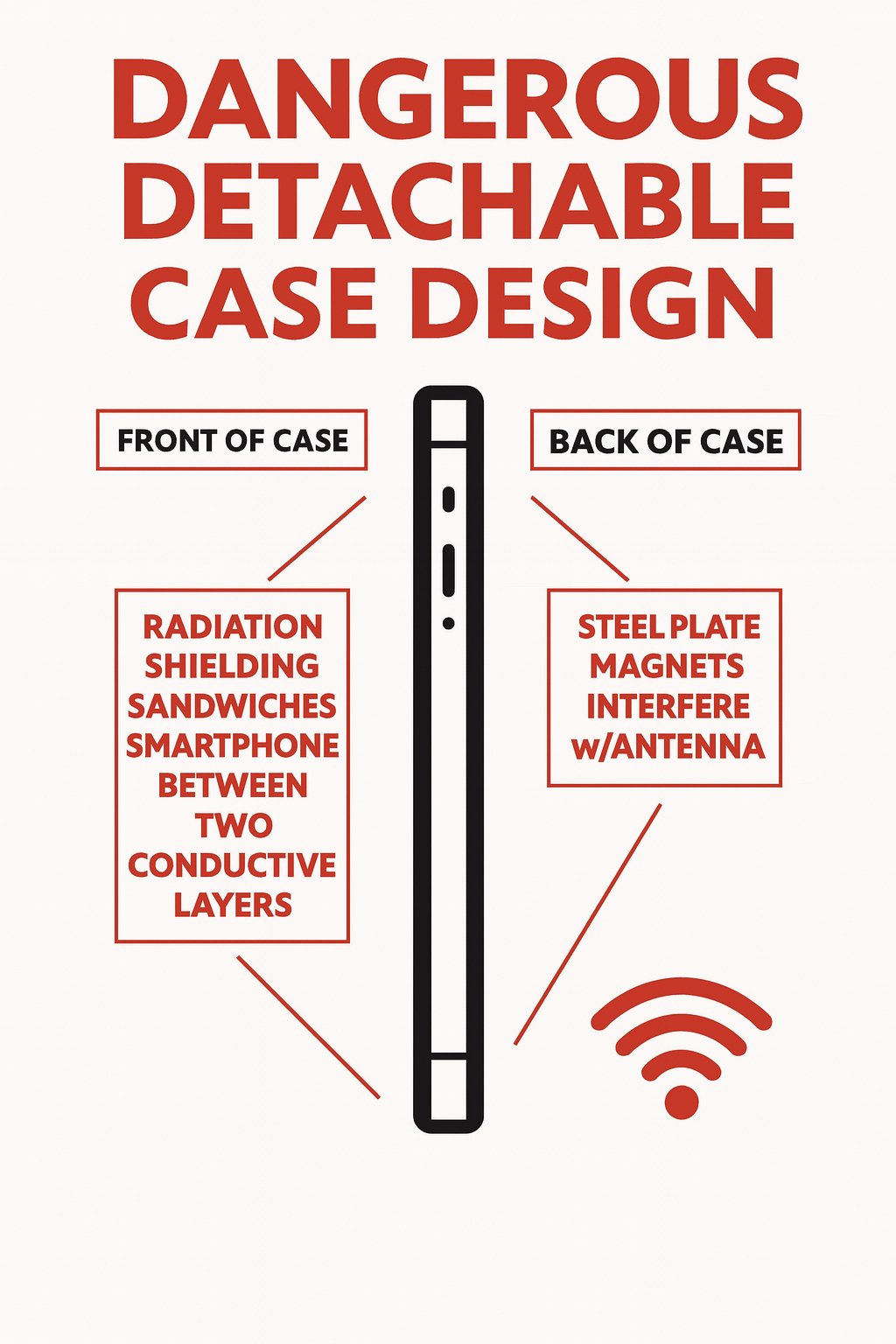
👉 Why detachable “anti‑radiation” cases backfire Many detachable folio designs—often with a front “shield” and a rear steel/magnet plate—sandwich the phone between two c…
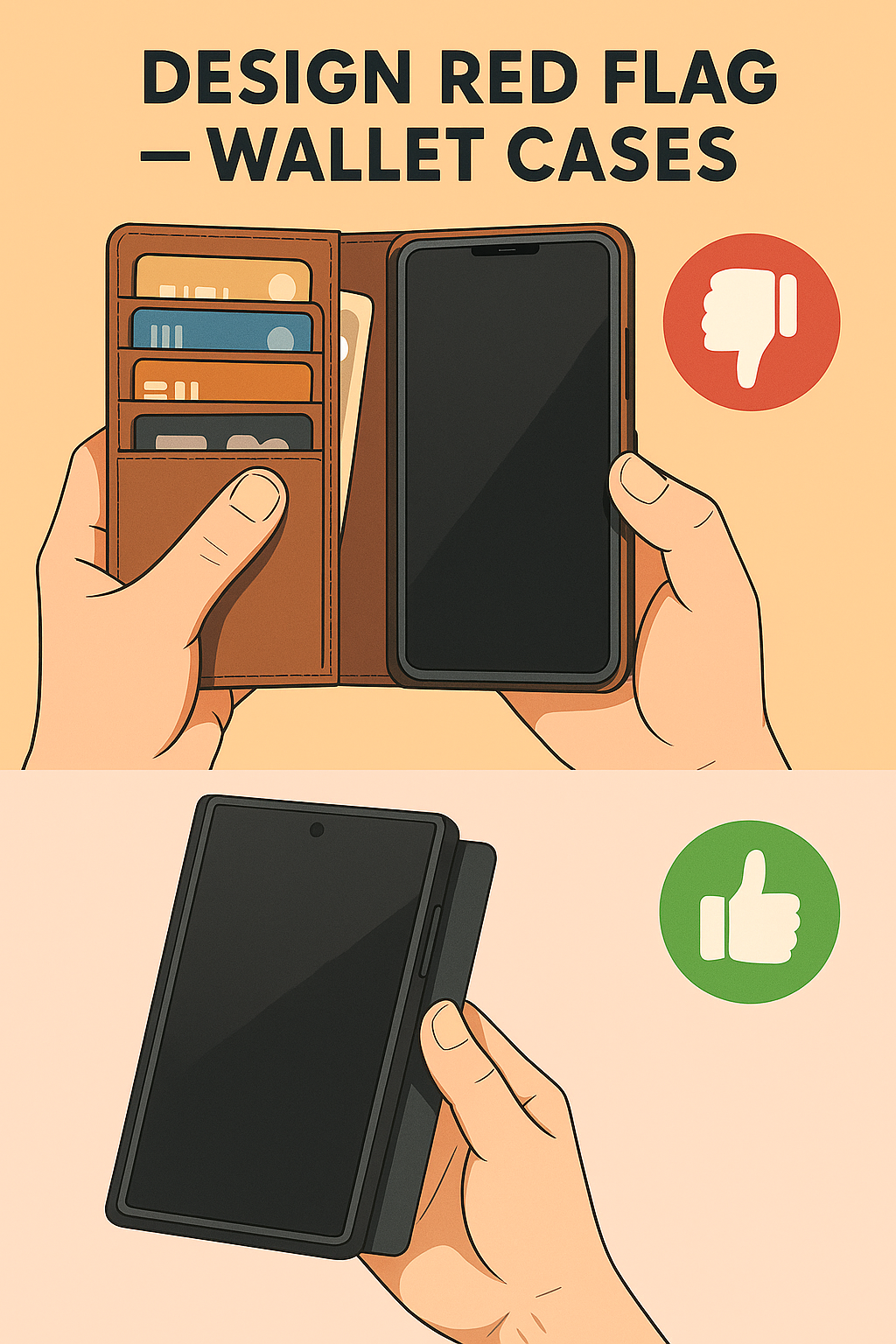
👉 ⚑ Design Red Flag — Wallet-Style Cases For a shielding flip case to work, the cover has to flip all the way around behind the phone so the shield sits between the phon…
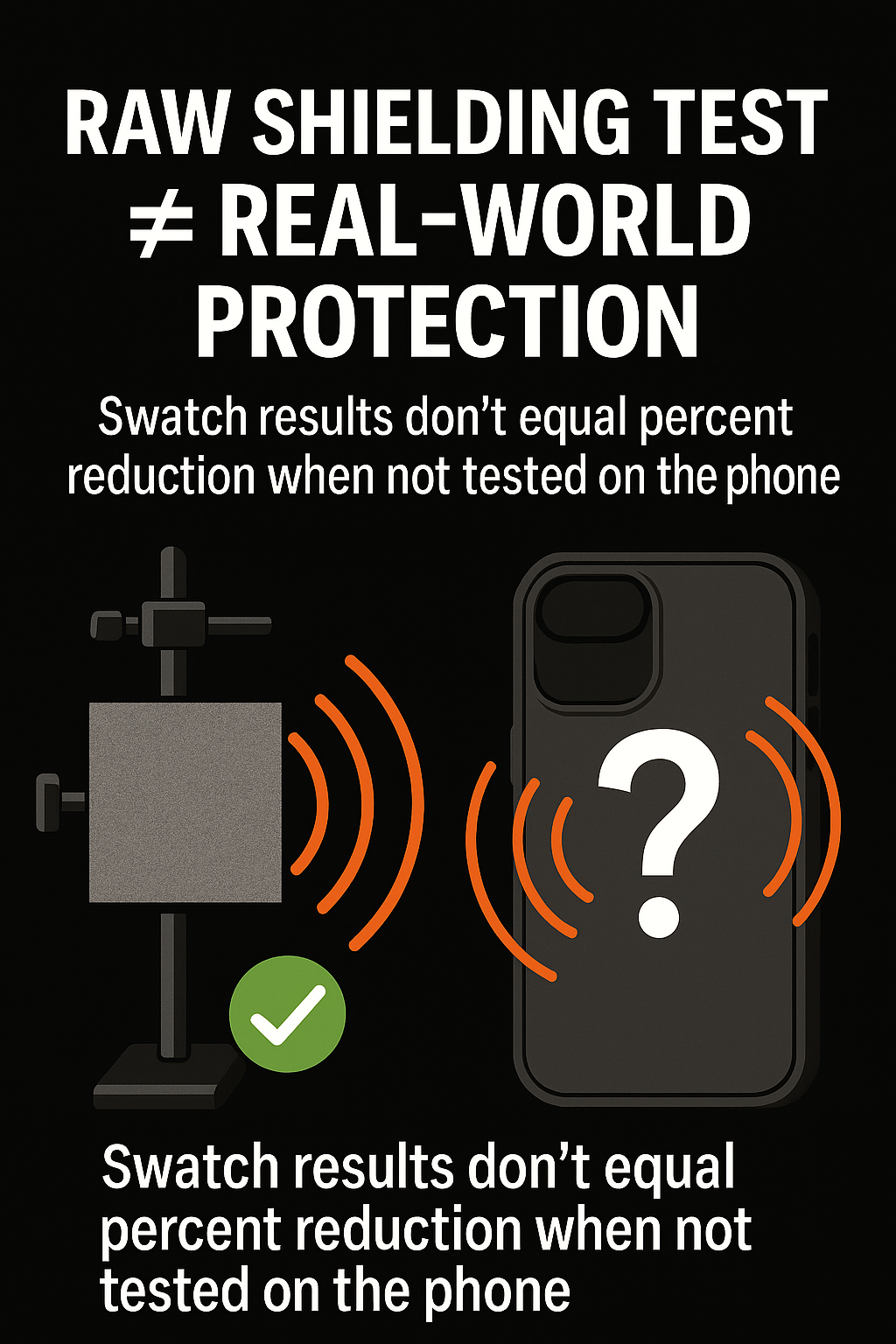
👉 Why “99% blocking” swatch tests don’t equal protection Many ads cite “FCC‑certified testing” of a small fabric or foil coupon. An FCC‑accredited lab can measure how a…
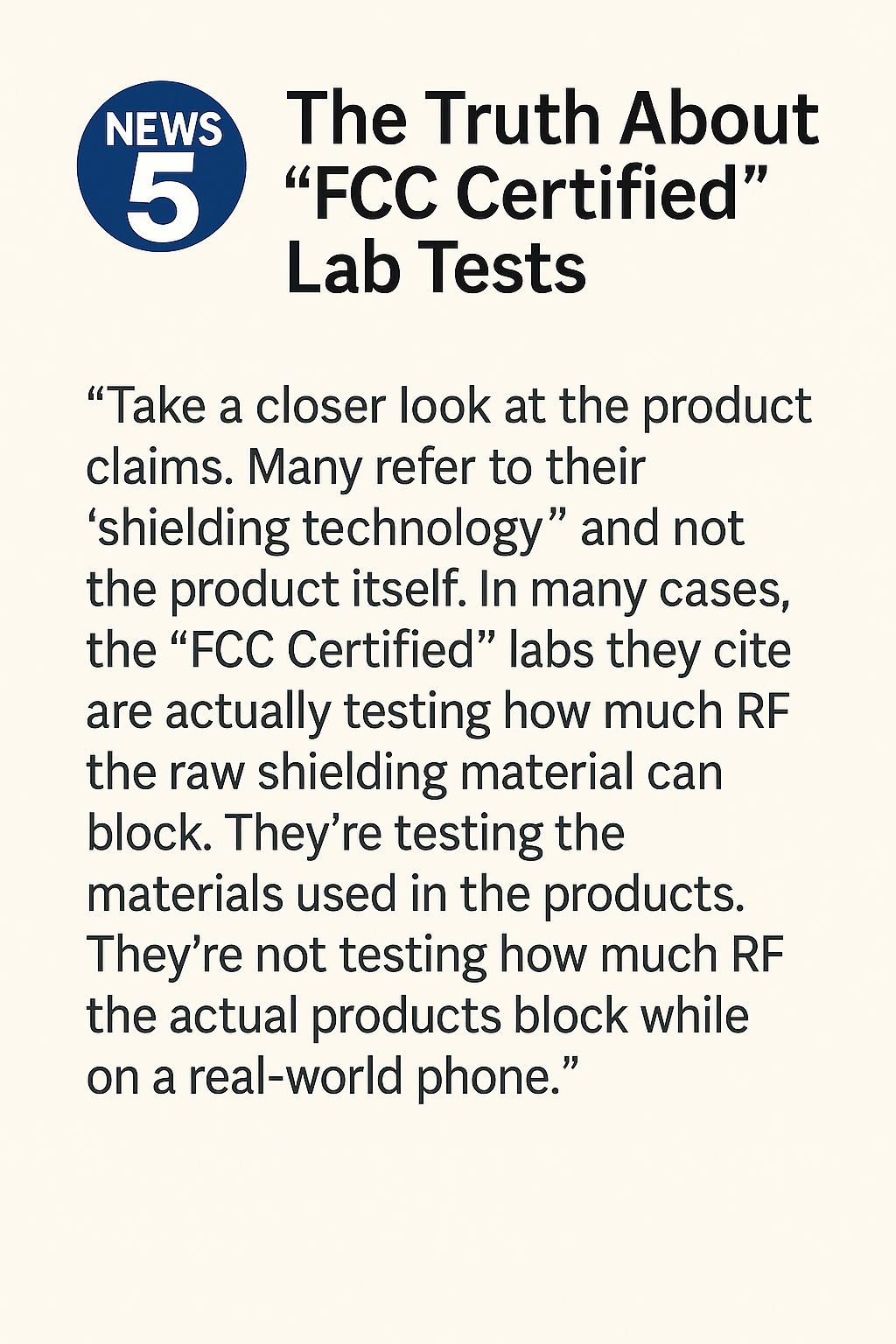
👉 KPIX 5 on “FCC-certified” lab tests: local news investigators found that some case makers cite FCC-accredited labs that only measure how much RF a raw shielding swatch…
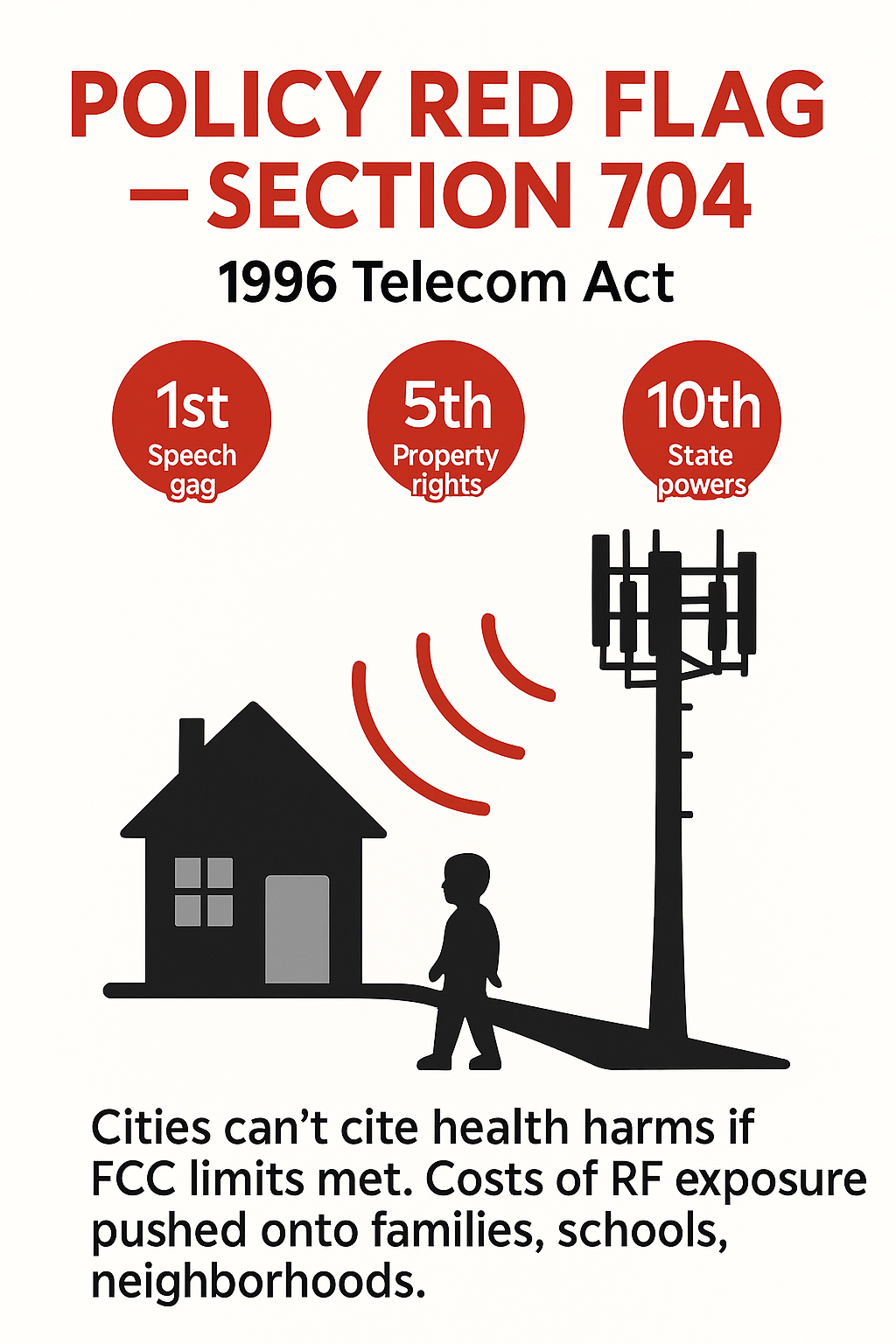
⚑ Policy Red Flag — Section 704 (1996 Telecom Act) Section 704 says that if a wireless facility meets FCC RF limits, local governments “may not regulate … on the basis o…
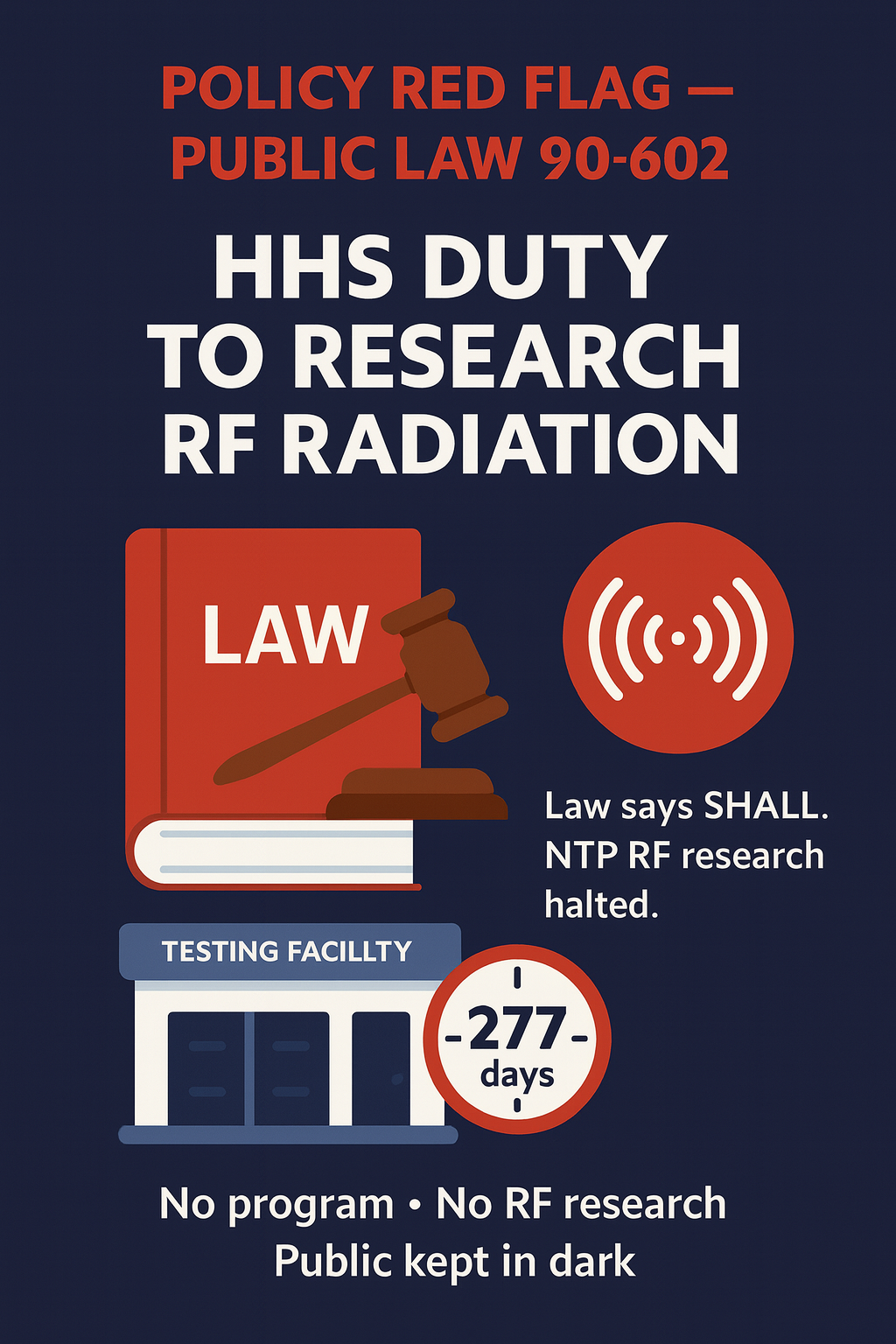
👉 ⚑ Policy Red Flag — Public Law 90-602 (Radiation Control Act) Public Law 90-602 is not a suggestion. It says the HHS Secretary shall establish and carry out an electro…
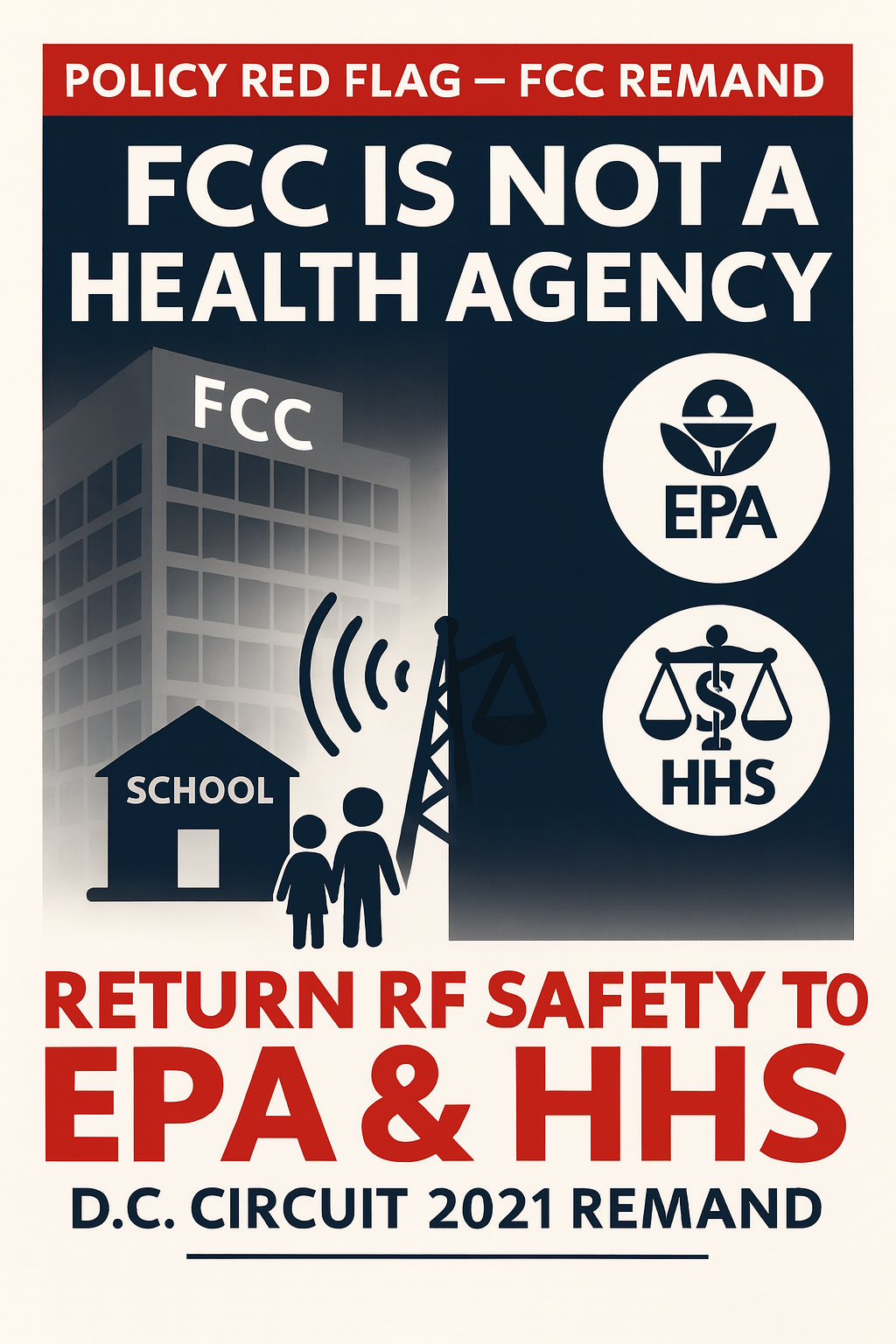
👉 ⚑ Policy Red Flag — FCC Remand (Environmental Health Trust v. FCC) In 2021, the D.C. Circuit held that the FCC’s decision to keep its 1996 heat-only RF limits was “arb…
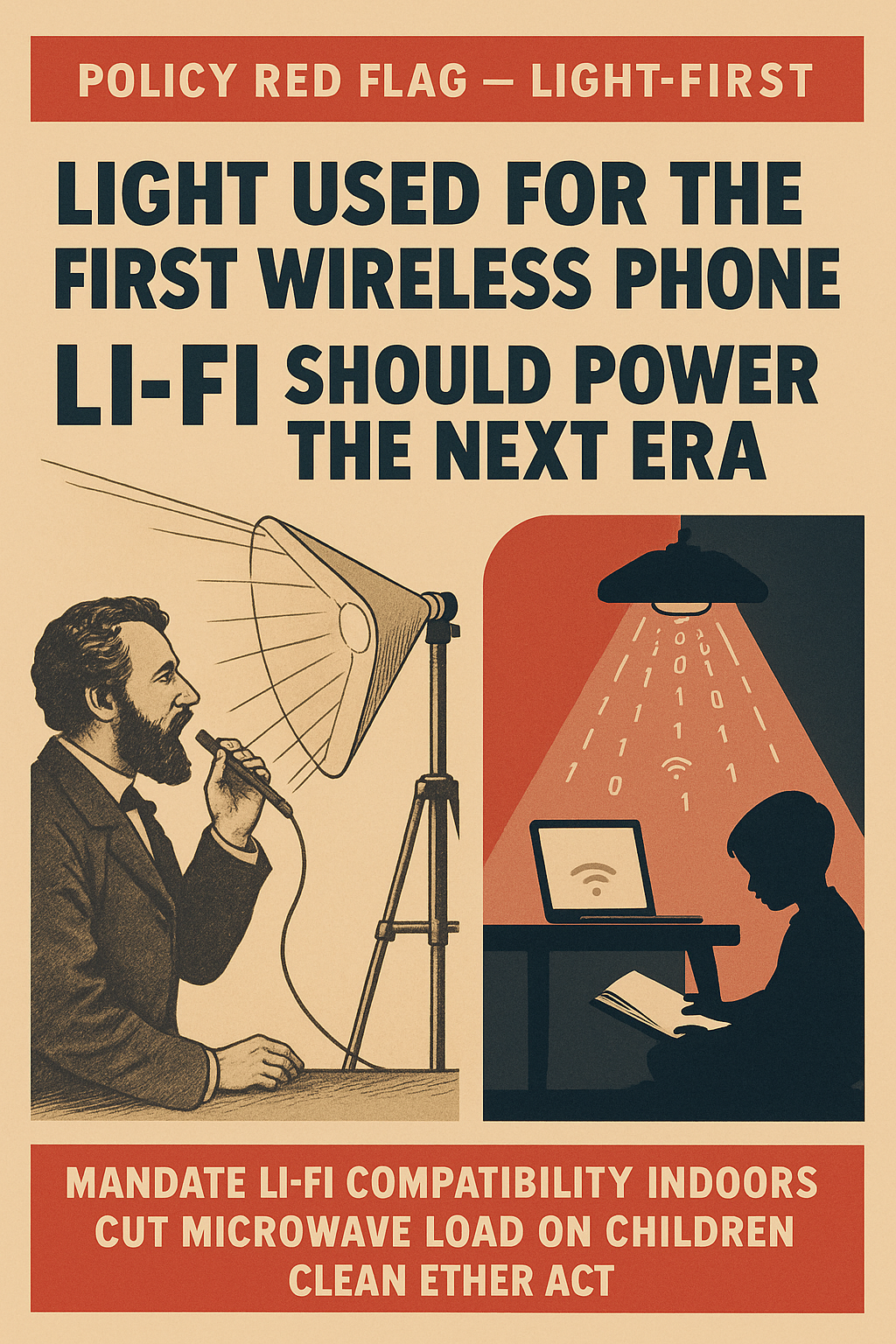
👉 ⚑ Light-First — Li-Fi Compatibility & the Clean Ether Act Long before radio towers, the first wireless phone used light. Bell and Tainter’s Photophone sent voice on a…
These are the full entries from the guide, displayed as readable sections instead of a full-screen slide experience. This keeps the content accessible to readers, easier to share, and easier for search engines to index as a real topic page.
Small metal loops, grommets, and strap clasps placed near a phone’s radiating edge act as parasitic conductors. In the reactive near‑field they add stray capacitance and inductance, which detunes the antenna from its intended 50‑Ω match. Detuning raises VSWR and lowers radiation efficiency: part of the power is reflected and part is stored around the metal instead of being cleanly radiated. The hardware also supports induced currents and can re‑radiate, warping the pattern and creating local E‑field hot spots near the head. Because coupling changes with millimeters of position, angle, and band, the near‑field becomes variable and hard to predict.
When efficiency or match degrade, link quality drops and the phone’s power control raises uplink transmit power to hold the connection. The result is a double hit: higher output plus a distorted near‑field right where the accessory sits. Best practice: avoid metal rings, loops, clasps, magnets, and plates in antenna zones; keep materials thin and non‑conductive around the radios; and place any shielding only between you and the phone, not over or next to the antennas. https://rumble.com/v70msx2-the-silent-signal-health-risks-of-emf-exposure-and-protective-measures.html
Only QuantaCase shows true ear‑side continuity. The earpiece opening is covered by a visible, conductive mesh that bonds to the front‑cover shield. With the cover closed, the entire area between the user and the phone acts as one continuous shield while still passing sound.
Most competing folio cases leave a bare slot. That gap behaves like a small slot antenna/waveguide, especially at today’s mmWave and satellite bands, allowing fields to bypass the cover and diffract toward the head. Because the head is in the near‑field during calls, even a few millimeters of opening can leak disproportionate energy and break the shield’s current path. Effective reduction requires full‑surface shielding continuity at the ear—no unshielded holes—using thin, acoustically transparent conductive mesh.
Many detachable folio designs—often with a front “shield” and a rear steel/magnet plate—sandwich the phone between two conductive layers. This alters the antenna’s boundary conditions, shifting resonance and degrading the impedance match (poorer return loss / higher VSWR). The result is lower radiation efficiency and pattern distortion right next to the user.
When efficiency and link quality drop, the phone’s power‑control system increases uplink transmit power to maintain the connection—exactly the opposite of the goal of an “anti‑radiation” case. The engineering fix is simple: use single‑sided, directional shielding between you and the phone, keep the back of the device free of magnets, steel plates, or other conductive hardware, and stay thin and antenna‑aware. That preserves efficiency so the device can meet network targets at lower power with more predictable fields.
https://www.rfsafe.com/class/detachable/
For a shielding flip case to work, the cover has to flip all the way around behind the phone
so the shield sits between the phone and your head or body. As soon as the cover is turned into a
wallet—stuffed with cards, cash, and receipts—you’ve created a flap that is heavy, stiff, and awkward
to flip on every call or text. In real life people stop doing it. They talk with the cover hanging open,
or they leave it closed like a mirror in front of the screen, which means the shield is almost never
in the right place when the phone is transmitting.
Those extra wallet layers are not just inconvenient; they are also thick, lossy material right in
the antenna zone. Add card chips, metal strips, or magnetic closures and you further detune the
antennas, pushing the phone to use higher transmit power to hold the link. A physics-first
design keeps the front cover ultra-thin and single-purpose: no bulky wallet features, no
magnets or plates—just a light, easy-to-flip shield that makes the correct “flip-to-shield” habit
natural instead of a chore.
Many ads cite “FCC‑certified testing” of a small fabric or foil coupon. An FCC‑accredited lab can measure how a flat sample attenuates a test signal in free space, but that data does not represent a phone in use. Real phones use multiple antennas and bands, operate in the near‑field of the head/body, and continuously adjust transmit power to maintain the link. A material that blocks well on a bench can detune antennas or increase path loss in the case, prompting the phone to transmit harder and creating irregular, posture‑dependent fields. A swatch percentage is therefore not a dose‑reduction number.
What matters is in‑device performance: tests with the finished case on the actual phone, in calling and data modes, with realistic postures (cover closed toward the head/body) and across the phone’s bands. Useful system checks include total radiated power (how much the phone emits), SAR, and near‑field mapping, plus observation of power‑control behavior. TruthCase focuses on shield placement, antenna‑aware thin design, and reduced duty cycle—because real‑world reduction comes from physics‑correct orientation and efficient radios, not from a fabric swatch tested in isolation.
KPIX 5 on “FCC-certified” lab tests: local news investigators found that some case makers cite FCC-accredited labs that only measure how much RF a raw shielding swatch blocks – not how much RF the finished case on a real phone actually reduces.
That kind of coupon test can produce big “99% blocking” numbers in ads, but it tells you nothing about antenna detuning, power-control behavior, or near-field exposure next to your head. Real protection has to be proven in-device, with the phone and case tested together in realistic use.
Section 704 says that if a wireless facility meets FCC RF limits, local governments
“may not regulate … on the basis of the environmental effects of radiofrequency
emissions.” In practice this works like a federal gag rule: city councils and
school boards are blocked from citing health evidence when they review tower sites
or small-cell permits. Critics argue that this undermines the spirit of the
First Amendment (truthful risk information on the public record) and the
Tenth Amendment tradition that protection of health and safety belongs first
to states and communities.
At the same time, allowing antennas almost anywhere on outdated 1996 “thermal-only”
limits raises a Fifth Amendment concern: RF fields are imposed on homes,
schools, and small businesses with no real way to refuse or be compensated. The
revenue from wireless service is privatized, while the long-term costs—exposure,
property-value loss, and any health or ecological impacts—are pushed onto families
and neighborhoods. That is why Section 704 is a major policy red flag for
anyone serious about RF safety.
Public Law 90-602 is not a suggestion. It says the HHS Secretary shall establish and carry out
an electronic-product radiation control program, and shall plan, conduct, coordinate, and
support research to minimize emissions and exposure, then keep the public informed. That duty covers
non-ionizing RF from wireless devices and infrastructure just as clearly as X-ray machines or lasers.
With the National Toxicology Program’s RF studies halted, there is no active federal RF bioeffects program
that meets the statute’s “shall” language. Each day without a restart is another day of
non-compliance and another day families, schools, and workers go without the independent
research and public reporting the law requires. If you care about honest risk assessment and future-proof
safety standards, HHS’s failure to enforce PL 90-602 is a serious policy red flag.
In 2021, the D.C. Circuit held that the FCC’s decision to keep its 1996 heat-only RF limits
was “arbitrary and capricious” and sent the issue back to the agency. The court directed the FCC to give a
reasoned response on long-term exposure, non-thermal biological effects, child-specific risks, and
environmental impacts – not just repeat talking points. Years later, families still have no transparent,
science-based explanation that resolves those questions while antennas continue to proliferate around homes and
schools.
This remand highlights a deeper problem: the FCC is a spectrum and industry regulator, not a
health agency. Its institutional incentives and expertise are aligned with auctions and deployment, not
bioeffects and pediatrics. We therefore argue that RF health leadership should move to EPA and HHS,
which have radiation-protection and public-health mandates, while the FCC remains the spectrum manager. A
court-compliant response means EPA/HHS-led risk assessments, open data, independent scientific review, and
interim protections for children – not another decade of silence from a non-medical agency sitting on a federal
remand.
Long before radio towers, the first wireless phone used light. Bell and Tainter’s
Photophone sent voice on a beam of sunlight, and today’s Li-Fi can carry modern data
payloads the same way, using LEDs and photodiodes instead of microwave transmitters. Any claim that
“light isn’t feasible” ignores both history and current engineering: optical wireless already supports
high-throughput, room-scale links with tight spatial confinement, low latency, and strong security.
A Clean Ether Act simply finishes what Bell started: indoors and around children,
sensitive adults, and pregnant women, make light the default carrier and keep RF as the
low-power backup. That means mandating Li-Fi compatibility in phones, tablets, laptops,
access points, and school networks so indoor traffic rides on photons instead of saturating classrooms and
bedrooms with microwaves. With solid-state lighting, mature Li-Fi standards, and even patented
“bio-defense” Li-Fi concepts that add pathogen control, there is no technical excuse left.
The only thing between our kids and the Light-Age is political will.
The point of this page is not only to criticize bad design. It is to help readers understand what better design looks like when a company starts from first principles instead of marketing theater.
A better design puts the shielded barrier on the side facing the user during calls and carry, instead of pretending the whole phone becomes harmless.
A first-principles design avoids obvious hardware mistakes that can work against the device’s radios or undermine the whole protection story.
A serious product should explain how to use it during calls, in pockets, while texting, and while keeping more distance whenever possible.
A better case page explains what the case can help with, what it cannot do, and why no single accessory replaces better habits and better standards.
The best-case scenario is not just a better case. It is a better case, a better-informed buyer, and a better public conversation about wireless safety and design accountability.
This page works best as part of the broader RF Safe reading path. Use the links below to move from design red flags into the numbers, the science, the buying logic, the product pages, and the proof archive.
The direct commercial landing page for visitors who already know they want an EMF phone case and want the straight TruthCase explanation.
The explanatory page for readers who want the shielding concept first: what it means, what it does not mean, and why directionality matters.
The broader buyer’s guide for normal case shoppers who need to understand why case design can affect more than drops and scratches.
The long-form archive of RF Safe comparison videos, real-world meter tests, and proof-oriented demos.
The science-and-policy page that explains why many people believe heat-only rules are not a complete safety model.
The TruthCase overview page, plus the usage guide and the original red flags slider.
This section is written for the questions people actually ask once they start looking past the marketing language in this category.
The biggest red flags are misleading blanket shielding claims, bad hardware placement, bulky obstruction over radio zones, and designs that never clearly teach correct user-side orientation.
RF Safe’s position is yes: a bad design can undermine the whole protection story by ignoring antenna behavior, using the wrong kind of hardware, or creating false confidence about how the case should be used.
Because a better case should reduce near-body exposure on the shielded side in real use without introducing obvious design mistakes that work against the phone.
Start with the buyer’s guide, the EMF phone case page, the shielding explainer, the anti-radiation video archive, and the TruthCase overview and usage guide.