Low-Fidelity Biology: Why the Wireless Safety Debate Was Never About One Disease
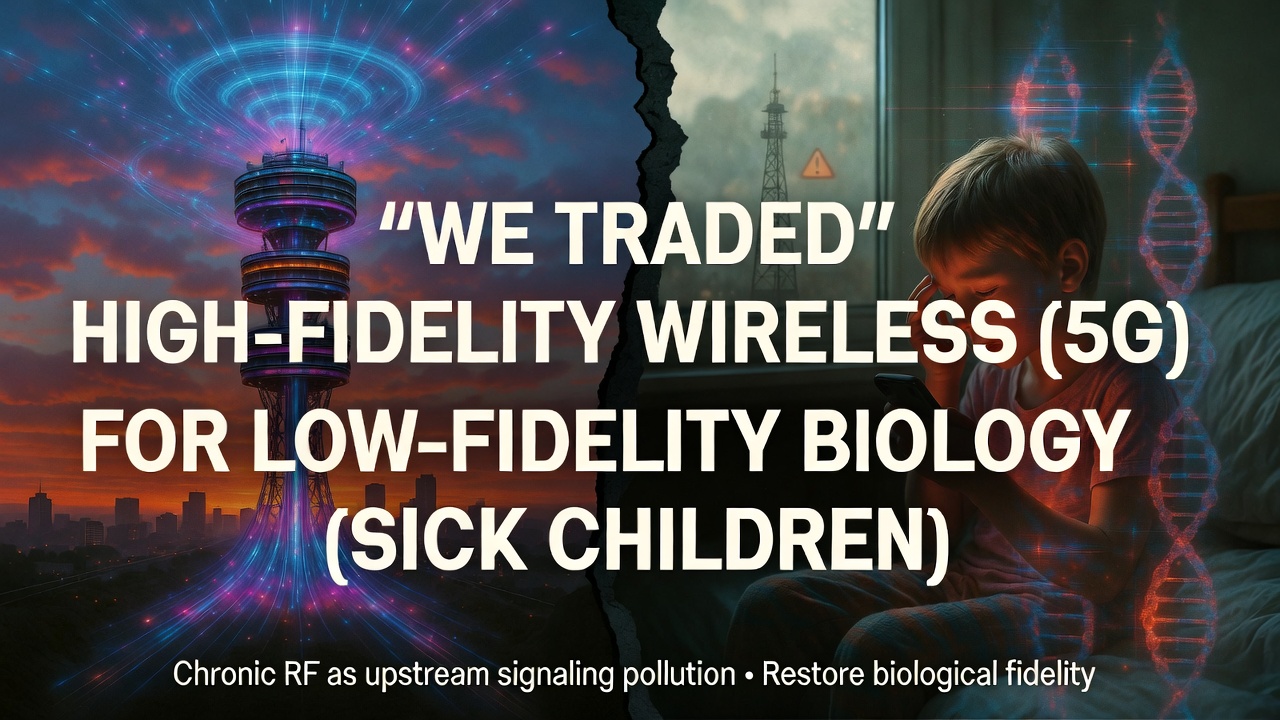
The central error in the wireless safety debate has been the insistence on asking the wrong question. The public has been trained to ask whether radiofrequency exposure causes one disease in one straight line, as though RF should behave like a poison with one target organ and one obvious clinical signature. That is not the frame suggested by the strongest non-thermal literature, and it is not the frame used in RF Safes own recent synthesis work. The more serious question is whether chronic, pulsed, non-native electromagnetic exposure degrades biological fidelity far upstream, at the level of voltage sensing, calcium timing, mitochondrial redox, oxidative stress, and signal coordination across tissues. Once the problem is framed that way, the expected outcome is not one neat disease. It is a rise in vulnerability across many endpoints: cancer, fertility, pregnancy, metabolism, neurodevelopment, immune balance, and repair.
Arthur Firstenbergs Radio Wave Packet chart understood that structural error long before the newest high-certainty reviews. Its power was never that every row carried identical evidentiary weight. Its power was that it put reported biological effects and real-world exposure benchmarks on the same page and showed that biological activity had been reported across many orders of magnitude below the publics thermal reference point. That chart did not prove one endpoint. It exposed a pattern: biology was reacting where regulators said there should be nothing to see. RF Safes own updated analysis is right to treat that chart as an early-warning map rather than a curiosity from the past.
The strongest evidence no longer fits a thermal-only story
The 2026 paper by Ronald Melnick and Joel Moskowitz, Exposure limits to radiofrequency EMF do not account for cancer risk or reproductive toxicity assessed from data in experimental animals, made the regulatory problem quantitative. Its abstract states that the whole-body SAR associated with a 1-in-100,000 cancer risk falls in the range of about 0.8 to 5 mW/kg, and the estimated SAR protective of male fertility falls in the range of about 3.3 to 10 mW/kg. The paper concludes that current public limits are 15- to 900-fold higher than the authors cancer-risk-based estimates, depending on daily exposure duration, and 8- to 24-fold higher than levels protective of male reproductive health. The same abstract states that recent WHO-commissioned systematic reviews concluded with high certainty that RF-EMF increases cancer risk and reduces male fertility in experimental animals. That is not the language of a field with no signal.
The animal cancer line is now difficult to dismiss without ignoring the literature outright. The U.S. National Toxicology Programs TR-595 reported clear evidence of malignant heart schwannomas in male rats exposed to CDMA-modulated cellphone RF and stated that the incidences of malignant glioma of the brain were also related to exposure. The Ramazzini Institutes lifelong base-station-style exposure study reported increased heart schwannomas and increases in glial tumors. Meike Mevissen and colleagues 2025 systematic review then judged the certainty of evidence high for glioma and malignant heart schwannoma in male rats, with moderate certainty for several other tumor types. The 2024 PLOS One paper on Genetic profiling of rat gliomas and cardiac schwannomas matters because it pushed beyond histology and asked whether these rare RF-associated rat tumors have molecular features relevant to human cancer biology. It found that they do.
Human warning signals and childrens vulnerability
The human literature is messier, but that is exactly what would be expected if RF acts upstream rather than through one clean lesion. The pooled INTERPHONE results reported the highest glioma odds in the heaviest cumulative use category, and the study focused on adults aged 30 to 59, not children. That matters because the public was repeatedly told these studies settled safety, while the children most likely to live longest with lifelong wireless exposure were not the population under study. RF Safes evidence file also treats the 2023 Danish Cancer Registry trend report and the 2024 conference abstract on cellphone carrying below the waist and early-onset colorectal cancer as warning signals. Those papers do not all sit at the same evidentiary tier, but together they reinforce the same point: the human question was never closed, and the downstream pattern may be broader than the regulatory narrative allowed.
Children sit at the moral center of the argument because children were never the true compliance model. The 2018 paper Absorption of wireless radiation in the child versus adult brain and eye from cell phone conversation or virtual reality reported that childrens brains are more susceptible and may absorb higher doses in some regions than adults. RF Safes study file summarizes that paper as showing substantially higher localized absorption in parts of the child brain and eye. That concern aligns with the D.C. Circuits 2021 decision, which held that the FCC failed to respond adequately to record evidence on non-cancer harms and that this failure undermined the agencys conclusions as they relate to children, long-term exposure, pulsation or modulation, and technological changes since 1996. A framework that never truly modeled children, then legally blocks communities from objecting to towers near schools so long as FCC limits are met, is not precaution. It is structural negligence.
The mechanism is upstream, not endpoint-specific
The mechanism literature points in the same direction as the animal evidence. Yakymenkos review, Oxidative mechanisms of biological activity of low-intensity radiofrequency radiation, reported oxidative effects in 93 of 100 low-intensity RF studies. The later synthesis Oxidative Stress Induced by Wireless Communication Electromagnetic Fields reported significant oxidative effects in 124 of 131 non-thermal wireless studies. Panagopouloss 2025 paper, A comprehensive mechanism of biological and health effects of anthropogenic extremely low frequency and wireless communication electromagnetic fields, argued that the biologically important feature is not simply microwaves in the abstract but the combination of polarization, coherence, pulsing, modulation, and strong low-frequency variability embedded in wireless signals. Palls calcium-channel work fits the same architecture: it argued that EMFs can act via voltage-gated calcium channels and summarized studies in which calcium-channel blockers blocked or greatly lowered EMF effects. Taken together, these papers do not describe a heating problem. They describe a timing-and-control problem.
That is why RF Safes low-fidelity biology framing is stronger than a single-endpoint frame. If the first hit lands on voltage sensing, calcium gating, redox balance, mitochondrial output, or spin-sensitive chemistry, then the downstream phenotype will depend on tissue, developmental window, genetics, co-exposures, nutrition, sleep, stress, and age. Some bodies will first show reproductive decline. Some will show metabolic instability. Some will show developmental effects. Some will show cancer after enough time. RF Safes own recent essays, It Was Never Just Cancer and Why Non-Thermal RF May Never Map to One Disease, One Cause, are right to insist that non-thermal RF should be understood as a plausible upstream amplifier of vulnerability, not as a courtroom cartoon in which one exposure must explain one disease with perfect simplicity before any policy response is allowed.
Metabolism belongs inside that frame, not outside it. Once calcium timing and mitochondrial redox are pushed off baseline, glucose handling, insulin signaling appetite regulation, and tissue energy balance become obvious candidates for disruption. That is why the 2024 early-onset colorectal-cancer carrying-below-the-waist abstract matters even as an exploratory signal, and why the 2025 Yazd cohort matters even though it is not animal toxicology. The point is not that every endpoint carries the same weight as the NTP or Mevissen papers. The point is that a fidelity problem is expected to surface differently across organs and developmental windows. That is exactly what the literature is beginning to show.
Reproduction is especially important because developmental systems are exquisitely timing-sensitive. The 2025 corrigendum to the male-fertility systematic review upgraded reduced pregnancy rate after male RF exposure to high certainty in experimental animals. The Yazd cohort, The association of widely used electromagnetic waves exposure and pregnancy and birth outcomes in Yazd women: a cohort study, reported that longer cell-phone call duration during pregnancy was associated with higher risks of miscarriage, abnormal birth weight, and abnormal infant height, while cordless-phone exposure was also linked to abnormal birth weight. The article does not need to claim that RF single-handedly causes every miscarriage or birth anomaly to make the point. It only needs to show that the reproductive system is one of the places where low-fidelity biology is most likely to reveal itself first.
Funding patterns, ecology, and the policy failure
The research politics cannot be separated from the science because the outcome pattern has tracked funding patterns for years. The 2006 systematic review Source of Funding and Results of Studies of Health Effects of Mobile Phone Use concluded that industry-only funding was least likely to report statistically significant associations. The 2019 paper Extremely low frequency electromagnetic fields and cancer: How source of funding affects results argued that funding source influenced whether elevated risks were reported in the ELF field literature as well. Those papers do not prove that every industry-funded paper is invalid. They do show that regulatory lag is too polite a phrase when the incentives of the evidence ecosystem have long pointed in one direction.
The ecological line reinforces the same point from outside the human clinic. The 2025 Frontiers paper Flora and fauna: how nonhuman species interact with natural and man-made EMF at ecosystem levels and public policy recommendations argued that current ambient exposures are pervasive and biologically active in nonhuman species and that present standards do not adequately address ecological effects. The companion 2025 Frontiers paper U.S. policy on wireless technologies and public health protection: regulatory gaps and proposed reforms argued that the American framework remains outdated and inadequate for children, vulnerable populations, and wildlife because it is built around short-term, high-intensity assumptions rather than chronic, low-intensity, long-dwell exposures. That is exactly what a low-fidelity-biology critique would predict: once the wrong hazard model is chosen, the blind spot spreads from humans to ecosystems.
What the law got wrong
Congress already assigned the public-health duty. Under 21 U.S.C. 360ii, the Secretary of Health and Human Services shall establish and carry out an electronic product radiation control program designed to protect the public health and safety from electronic product radiation, including research, exposure evaluation, and techniques for minimizing unnecessary exposure. FDAs own current pages still state that FDA is responsible for regulating radiation-emitting electronic products and that its goal is to protect the public from hazardous and unnecessary radiation exposure. The Radiation Control provisions themselves are described by FDA as having been originally enacted as the Radiation Control for Health and Safety Act of 1968. That is the statutory backbone RF Safe is invoking when it argues that HHS, not the FCC, bears the primary health duty here.
The federal message is now internally split. Reuters reported on January 15, 2026 that HHS was launching a new study on cellphone radiation and quoted HHS spokesman Andrew Nixon saying the FDA had removed webpages with old conclusions about cellphone radiation while HHS undertook a new review. Yet the live FDA cellphone page, still marked current as of May 13, 2021, continues to say that the weight of scientific evidence has not linked cellphone RF radiation with health problems and that the evidence does not show danger for children and teenagers. That is not a coherent rebuttal to RF Safes argument. It is contradictory federal messaging layered on top of a framework already under scientific and legal pressure.
Section 704 is where that scientific failure becomes a public-health trap. The statute says that no state or local government may regulate the placement, construction, or modification of personal wireless service facilities on the basis of the environmental effects of RF emissions so long as the facilities comply with FCC rules. That preemption might be defensible if the underlying rules were the product of a modern, health-protective review. But in 2021, the D.C. Circuit held that the FCC acted arbitrarily and capriciously in failing to respond adequately to record evidence on non-cancer harms, children, long-term exposure, pulsation or modulation, technological developments since 1996, and environmental harms. A law that tells communities they must defer to that framework is not a shield for public health. It is a shield for the framework itself. Section 704 should be repealed.
The policy direction follows from the biology. If long-dwell indoor environments are developmental environments, then the burden should be lowered there first. RF Safes Biological Fidelity Act concept is correct to push toward wired-first and light-first connectivity in homes, schools, dormitories, hospitals, and offices, while restoring local authority to consider health evidence near sensitive receptors. The point is not to ban communication. The point is to stop forcing children to live inside the wrong default.
This is a mechanism page, not a courtroom split screen
This page is a mechanism page, not a courtroom split screen. RF Safe is not hiding what agencies have said. RF Safe is declining to give lagging, inconsistent, or court-rebuked institutional talking points equal billing with the upstream biology, the newer review literature, and the agencies own contradictions. This page is built to explain the upstream map: voltage sensing, calcium timing, mitochondrial redox, and spin-sensitive chemistry. It is not built to pretend that a stale boilerplate sentence cancels that map out.
WHO is not the controlling American public-health authority RF Safe is required to platform as a balancing counterweight. HHS announced on January 22, 2026 that the United States had completed its withdrawal from the World Health Organization. More importantly, one of the strongest recent animal-cancer reviews was itself tied to the WHO review process: Mevissen et al. stated that their 2025 review was partially funded by the WHO radioprotection programme, and the review judged the certainty of evidence high for glioma and malignant heart schwannoma in male rats. In other words, WHO is not being omitted because WHO settled the case for safety. WHO is being refused equal rhetorical billing because even a WHO-linked review helped strengthen, not weaken, the case for concern.
FDA is no longer in a position to serve as a clean rebuttal either. Reuters reported that HHS said FDA removed older webpages with old cellphone-radiation conclusions while HHS launched a new federal study, yet the live FDA cellphone hub still carries its 2021 eassurance language on general safety and on children. RF Safe is therefore justified in refusing to quote the most reassuring FDA boilerplate as though it resolves the science when the governments own posture is now split between legacy reassurance and a new federal review.
FCC is the weakest balance quote of all because the D.C. Circuit already found the agency arbitrary and capricious on the very categories RF Safe is highlighting: non-cancer harms, childrens vulnerability, long-term exposure, pulsation or modulation, newer technologies, and environmental harms. A court-rebuked agency still leaning on a framework rooted in 1996 is not the neutral referee this page needs to pause for every few paragraphs. The more honest thing is to say exactly what the court said: the agency failed to explain itself where it mattered most.
The strongest support for the S4MitoSpin framework is not limited to toxicology papers. It also appears inside FDAs own device-approval record. FDAs TheraBionic P1 H220001 page describes an amplitude-modulated radiofrequency electromagnetic-fields device approved for adults with advanced hepatocellular carcinoma. The FDAs Summary of Safety and Probable Benefit identifies it as an amplitude-modulated RF-EMF device, says it should not be used in patients receiving calcium-channel blockers unless treatment is modified, and cites a mechanism paper stating that tumor-specific amplitude-modulated RF fields act through Cav3.2 T-type voltage-gated calcium channels and calcium influx. That does not prove that everyday telecom exposures and a medical device operate identically. It does prove something more basic and more devastating to the old thermal-only story: the premise that RF can interact with biology through voltage sensing and calcium signaling is no longer hypothetical inside FDAs own record. Once that is true, the blanket claim that non-thermal interaction is impossible stops being credible.
This note is not a concession. It is an editorial disclosure. RF Safe is choosing to foreground upstream biology, the stronger recent reviews, the court-identified regulatory failures, and the agencies own documented inconsistencies. The case on this page does not become stronger by stopping every few paragraphs to recite institutional talking points that are no longer controlling, no longer coherent, or already under remand.
What S4MitoSpin means
S4 refers to the S4 voltage-sensor segment found in voltage-gated ion channels. In plain English, it is part of the channel machinery that responds to changes in membrane voltage and helps determine when the channel opens. In RF Safes shorthand, S4 means the first hit is not bulk heating. The first hit is on the bodys voltage-sensing machinery and the calcium timing that follows from it. That framing is reinforced by the TheraBionic FDA record and by the literature arguing that EMF effects can be mediated through voltage-gated calcium channels.
Mito refers to mitochondria. Once calcium handling and membrane signaling are pushed off baseline, mitochondria become amplifiers. They help determine ATP production, redox balance, and reactive oxygen species output. That is why oxidative-stress reviews matter so much in this field. They are not side stories. They are the middle of the story. If voltage and calcium timing are disturbed, mitochondria are one of the first places where that disturbance gets translated into broader biological damage.
Spin refers to spin-sensitive chemistry, especially radical-pair mechanisms. In plain English, some chemical reactions proceed through paired unpaired electrons whose outcomes can be biased by weak magnetic fields because the reaction depends on whether the pair is in a singlet or triplet state. Reviews in spin chemistry describe radical-pair reactions as intrinsically field-sensitive. In RF Safes shorthand, Spin is the reminder that biology may contain electromagnetic sensitivity even where there is no meaningful heating, because weak fields can bias reaction pathways and redox signaling at the quantum-chemical level.
Put together, S4MitoSpin means this: the disturbance may begin at voltage sensing; that disturbance alters calcium timing; altered calcium timing drives mitochondrial and oxidative stress; and spin-sensitive chemistry may further bias how redox and signaling reactions unfold. The downstream disease map then depends on which tissue is under strain, when in development the exposure occurs, what other stressors are present, and how much reserve a body has left. That is why low-fidelity biology does not map neatly to one disease, one cause. It behaves like an upstream degradation of precision, and the downstream failures multiply from there.
Once that frame is understood, the policy response becomes straightforward: repeal Section 704, restore local health authority, force HHS and FDA back into the public-health role Congress already assigned them, and move long-dwell indoor environments toward wired and light-based connectivity wherever practical. The argument is no longer that RF must be blamed for one neat disease before action is allowed. The argument is that a biologically serious society does not keep forcing children to live inside a low-fidelity environment once the upstream case has become this strong.
APPENDIX A – Study-by-study matrix with direct links
This matrix is designed to show what most policy writing on RF still fails to do: each paper in this set does a different job. Some quantify risk. Some expose funding bias. Some show mechanism. Some show child-specific dosimetry. Some deliver animal carcinogenicity. Some show reproductive or pregnancy harm. Some map the policy failure. Read together, they build the case that chronic RF is a biological-fidelity problem, not a one-endpoint toxicology puzzle.
Study 1) Exposure limits to radiofrequency electromagnetic fields do not account for cancer risk or reproductive toxicity assessed from data in experimental animals
Official source open | RF Safe open
Environmental Health 2026
Job in the case: Quantifies how far current limits miss the strongest health endpoints. What it adds: Uses benchmark-dose and risk-assessment methods to estimate cancer-risk and male-fertility-protective SARs far below current public limits. Why it matters to low-fidelity biology: This is the paper that turns the critique from qualitative to quantitative: the thermal-only framework is not merely incomplete; it is numerically out of step with health-protective modeling.
Study 2) The INTERPHONE study: design, epidemiological methods, and description of the study population
Official source open | RF Safe open
Eur J Epidemiol 2007
Job in the case: Shows the structure and limits of flagship human epidemiology. What it adds: Documents the multinational INTERPHONE architecture and reminds us that children were excluded from the study population; the later INTERPHONE results raised a heavy-use glioma signal in the highest cumulative call-time group. Why it matters to low-fidelity biology: It shows why human evidence in this field is inherently difficult: latency, recall error, exposure misclassification, and missing child data all make a one-disease verdict harder to extract.
Study 3) Danish Cancer Registry 2023 Report Reveals Significant Population-Level Increase in Brain and Central Nervous System Tumors: Dispelling the Myth of Stable Incidence Rates
Official source open | RF Safe open
2023
Job in the case: Population-level warning sign against the “stable-incidence” talking point. What it adds: Compiles Danish registry trend data showing rising brain and central nervous system tumor incidence over time. Why it matters to low-fidelity biology: Registry trends do not prove cause, but they challenge the easy reassurance that population-level cancer patterns have remained flat and therefore nothing is wrong.
Study 4) Extremely low frequency electromagnetic fields and cancer: How source of funding affects results
Official source open | RF Safe open
Environ Res 2019
Job in the case: Shows how funding patterns can distort the risk record. What it adds: Reviews the ELF/cancer literature and argues that once funding bias is accounted for, the evidence does not look as inconclusive as regulators often imply. Why it matters to low-fidelity biology: It matters because the RF debate has never been only about biology; it has also been about who funds the science and whose interpretation becomes policy.
Study 5) Is Cellphone Carrying Below the Waist (Exposure to Non-Ionizing Radiation) Contributing to the Rapid Rise in Early-Onset Colorectal Cancer?
Official source open | RF Safe open
ISEE Conference Abstracts 2024
Job in the case: Expands the debate beyond head-only exposure models. What it adds: Presents a hypothesis-generating human study on below-the-waist phone carrying and early-onset colorectal cancer, with side-specific tumor patterns. Why it matters to low-fidelity biology: Even as an early signal rather than a settled endpoint, it underscores a central low-fidelity-biology point: body-carrying patterns matter, and harm need not stay confined to the head.
Study 6) U.S. policy on wireless technologies and public health protection: regulatory gaps and proposed reforms
Official source open | RF Safe open
Front Public Health 2025
Job in the case: Translates the science into regulatory critique. What it adds: Synthesizes the shortcomings of the U.S. wireless-health framework: outdated limits, no child-specific protection, weak oversight, and lack of premarket public-health safeguards. Why it matters to low-fidelity biology: This paper helps move the argument from “there is evidence of harm” to “the policy architecture is structurally unfit for the evidence now in hand.”
Study 7) Flora and fauna: how nonhuman species interact with natural and man-made EMF at ecosystem levels and public policy recommendations
Official source open | RF Safe open
Front Public Health 2025
Job in the case: Shows that the problem is ecological, not merely personal. What it adds: Reviews how anthropogenic EMF can disrupt nonhuman species and argues that current standards are inadequate at ecosystem scale. Why it matters to low-fidelity biology: A system that ignores birds, insects, plants, and other species is not a serious environmental-health framework. Low-fidelity environments do not stop at the human skin boundary.
Study 8) Absorption of wireless radiation in the child versus adult brain and eye from cell phone conversation or virtual reality
Official source open | RF Safe open
Environ Res 2018
Job in the case: Demonstrates child-specific vulnerability in dosimetry. What it adds: Reports that children can absorb materially higher localized doses in some brain and eye tissues than adults and argues for revised compliance methods. Why it matters to low-fidelity biology: This directly undermines adult-male-based testing as a proxy for child safety and makes the protection-of-children issue concrete rather than rhetorical.
Study 9) Source of Funding and Results of Studies of Health Effects of Mobile Phone Use: Systematic Review of Experimental Studies
Official source open | RF Safe open
Environ Health Perspect. 2006
Job in the case: Documents RF funding bias in experimental studies. What it adds: Finds that telecom-industry-funded mobile-phone studies were least likely to report statistically significant associations. Why it matters to low-fidelity biology: This is one of the clearest papers showing why the official record can look calmer than the underlying literature actually is.
Study 10) Oxidative mechanisms of biological activity of low-intensity radiofrequency radiation
Official source open | RF Safe open
Electromagn Biol Med 2016
Job in the case: Builds the oxidative-stress bridge from exposure to mechanism. What it adds: Reviews low-intensity RF studies and reports oxidative effects in the large majority of the literature surveyed. Why it matters to low-fidelity biology: Oxidative stress is not a single disease. It is an upstream process that can feed many downstream failures, which is exactly why this paper fits a low-fidelity-biology framework.
Study 11) Oxidative Stress Induced by Wireless Communication Electromagnetic Fields
Official source open | RF Safe open
2022
Job in the case: Updates the oxidative-stress pattern for modern wireless signals. What it adds: Extends the oxidative-stress review record across 131 RF/wireless studies and emphasizes non-thermal, modulated exposures. Why it matters to low-fidelity biology: It reinforces the argument that the recurring signal is not heat; it is biologic disruption under real-world modulation and pulsation patterns.
Study 12) A comprehensive mechanism of biological and health effects of anthropogenic extremely low frequency and wireless communication electromagnetic fields
Official source open | RF Safe open
2025
Job in the case: Provides the clearest systems-level mechanism in your set. What it adds: Argues that polarized, coherent, pulsed, modulated, low-frequency-rich signals can disrupt ion-channel behavior and drive reactive oxygen species and related injury cascades. Why it matters to low-fidelity biology: This is the conceptual heart of the low-fidelity-biology argument: if the disturbance begins at the signaling layer, the outcomes will diversify across tissues rather than collapse into one neat disease.
Study 13) Report of final results regarding brain and heart tumors in Sprague-Dawley rats exposed from prenatal life until natural death to mobile phone radiofrequency field representative of a 1.8 GHz GSM base station environmental emission
Official source open | RF Safe open
Environ Res 2018
Job in the case: Shows that tower-style, far-field exposure is not exempt from concern. What it adds: The Ramazzini Institute lifetime study reported increased heart Schwannomas and glial findings in rats under base-station-like exposure conditions. Why it matters to low-fidelity biology: This closes the loophole that tries to separate handset risk from infrastructure risk. The biology does not care about the industry’s talking points.
Study 14) NTP Technical Report on the Toxicology and Carcinogenesis Studies: GSM- and CDMA-modulated Cell Phone RFR, NTP TR 595
Official source open | RF Safe open 2018
Job in the case: Delivers the flagship U.S. animal carcinogenicity signal. What it adds: The NTP reported clear evidence of malignant heart schwannomas in male rats and increased malignant glioma findings under long-term cellphone-modulated exposure. Why it matters to low-fidelity biology: Toxicology is how safety limits are built. Once a major U.S. government animal bioassay produces carcinogenicity signals, the burden should shift to regulators to explain why limits remain unchanged.
Study 15) Genetic profiling of rat gliomas and cardiac schwannomas from life-time radiofrequency radiation exposure study using a targeted next-generation sequencing gene panel
Official source open | RF Safe open
PLoS One 2024
Job in the case: Strengthens translational relevance of the animal tumors. What it adds: Molecular profiling found that RF-derived rat gliomas and cardiac schwannomas carried alterations with relevance to human cancer biology. Why it matters to low-fidelity biology: This matters because critics often try to trivialize animal tumors as species-specific curiosities. This paper makes that dismissal harder to sustain.
Study 16) The association of widely used electromagnetic waves exposure and pregnancy and birth outcomes in Yazd women: a cohort study
Official source open | RF Safe open
BMC Pregnancy Childbirth 2025
Job in the case: Adds a real-world human reproductive/pregnancy signal. What it adds: Reports associations between heavier phone use during pregnancy and adverse pregnancy or infant-size outcomes in the Yazd cohort. Why it matters to low-fidelity biology: It does not need to prove the whole case by itself. Its role is to show that the reproductive concern does not live only in animal literature.
Study 17) Effects of radiofrequency electromagnetic field exposure on cancer in laboratory animal studies, a systematic review
Official source open | RF Safe open
Environment International 2025
Job in the case: Aggregates the animal cancer record at systematic-review level. What it adds: Concludes with high certainty of evidence for malignant heart schwannomas and brain gliomas in male rats exposed to RF-EMF. Why it matters to low-fidelity biology: This is one of the strongest pieces in the entire set because it moves the field from isolated study disputes to systematic-review certainty language.
Study 18) Corrigendum to “Effects of radiofrequency electromagnetic field (RF-EMF) exposure on male fertility: A systematic review of experimental studies on non-human mammals and human sperm in vitro” [Environ. Int. 185 (2024) 108509]
Official source open | RF Safe open
Environ Int 2025
Job in the case: Aggregates the male-fertility record at systematic-review level. What it adds: The corrigendum upgraded the key endpoint of reduced pregnancy rate after male RF exposure to high certainty in experimental animal studies. Why it matters to low-fidelity biology: It makes clear that the strongest reproducible non-cancer endpoint is not speculative. It is already strong enough to matter for standards.
APPENDIX B
Key legal and agency record links
These are the anchor legal and agency documents behind the policy case.
47 U.S.C. section 332(c)(7)(B)(iv) – local RF preemption language 21 U.S.C. section 360ii – HHS electronic product radiation control program Environmental Health Trust v. FCC (D.C. Circuit, Aug. 13, 2021) FDA cell phones page (live 2021 language still available) Reuters report on January 2026 HHS cellphone-radiation study and removal of older FDA pages IEEE 802.11bb-2023 light communications standard summary
Note on interpretation
The point is not that every row in Appendix A does the same job or carries identical weight. The point is that a broken safety model has been defended for decades by demanding one kind of proof while ignoring the convergence of many others. Once the science is read through the lens of biological fidelity rather than through the lens of short-term heating alone, the pattern becomes much harder to dismiss.
Why this page does not stage WHO, FDA, or FCC talking points as equal-and-opposite counterweights
This page is a mechanism page, not a courtroom split screen. RF Safe is not hiding what these agencies have said. We are declining to give lagging, inconsistent, or court-rebuked institutional talking points equal billing with the upstream biology, the newer review literature, and the agencies own contradictions. See:
https://www.rfsafe.com/emf/how-cell-phone-radiation-disrupts-biology.html
After decades of watching the same pattern repeat, RF Safe does not believe every page must be diluted by quoting institutions that are still catching up to the evidence. That is not because their positions are invisible. It is because on this topic they are either no longer controlling, internally inconsistent, or already under legal and scientific pressure. This page is built to explain the upstream map: voltage sensing, calcium timing, mitochondrial redox, and spin-sensitive chemistry. It is not built to pretend that a stale boilerplate sentence cancels that map out.
WHO: the United States formally completed its withdrawal from the World Health Organization on January 22, 2026. That means WHO talking points are not the controlling American public-health position this site is required to platform. More importantly, one of the strongest recent animal-cancer reviews was itself part of the WHO RF review effort: the 2025 systematic review partially funded by the WHO radioprotection programme rated the evidence as high certainty for increased glioma and malignant heart schwannoma in male rats, with moderate certainty for several other tumor endpoints. In other words, RF Safe is not omitting WHO because WHO settled the case for safety. We are omitting WHO as a supposed counterweight because even the WHO-linked review pipeline moved toward stronger evidence, not weaker.
HHS WHO withdrawal statement, Mevissen et al. 2025
FDA: the federal message is no longer coherent enough to be treated as a clean rebuttal. Reuters reported in January 2026 that HHS was launching a new cellphone-radiation study and quoted HHS as saying the FDA had removed webpages with old conclusions while the government studies electromagnetic-radiation health gaps. Yet, as of March 2026, the FDAs main cell-phone hub still carried its older 2021 language stating that the weight of scientific evidence had not linked cellphone RF to health problems and that the evidence did not show danger for children and teenagers. RF Safe is therefore not going to quote the most reassuring FDA boilerplate as if it cleanly resolves the science when the governments own posture is now split between legacy reassurance and a new federal review.
Reuters on the 2026 HHS study ,FDA cell-phone page
FCC: the D.C. Circuit already held in 2021 that the FCC acted arbitrary and capricious in failing to give a reasoned explanation regarding non-cancer effects, childrens vulnerability, long-term exposure, pulsation/modulation, newer technologies, and environmental harms. A court-rebuked agency still leaning on a framework rooted in 1996 is not the neutral referee RF Safe is going to use as a balancing quote underneath a mechanism page. The more honest thing is to say exactly what the court said: the agency failed to explain itself on the very categories this site highlights.
And the most important reason of all: the strongest support for the S4MitoSpin framework is not limited to toxicology papers. It also appears inside the FDAs own device-approval record. The FDAs Summary of Safety and Probable Benefit for TheraBionic P1 describes an amplitude-modulated RF electromagnetic-field device for advanced liver cancer. That same FDA document says the device should not be used in patients receiving calcium-channel blockers unless treatment is modified, and its cited mechanism paper identifies Cav3.2 T-type voltage-gated calcium channels and calcium influx as part of the therapeutic pathway. That matters because it proves the core non-thermal premise is no longer hypothetical: RF can modulate biology through voltage-sensing and calcium-signaling pathways under conditions the FDA considered real enough to approve a device around. Once that is true, the question is no longer whether non-thermal interaction is possible. The question becomes how often ordinary wireless systems push the same upstream biology in the wrong direction.
FDA device page, FDA SSPB / labeling record
This note is not here as a concession. It is here as an editorial disclosure. RF Safe is choosing to foreground the upstream biology, the stronger recent reviews, the court-identified regulatory failures, and the agencies own documented inconsistencies. The truth on this page does not become stronger because it pauses every few paragraphs to recite institutional talking points that are either no longer controlling, no longer coherent, or already under remand.