TruthCase — Usage Guide & Policy Red Flags
Two swipeable collections on one page. Tap any card to read more. Links, YouTube videos, and image URLs auto‑embed in the modal.
Usage Guide — core habits
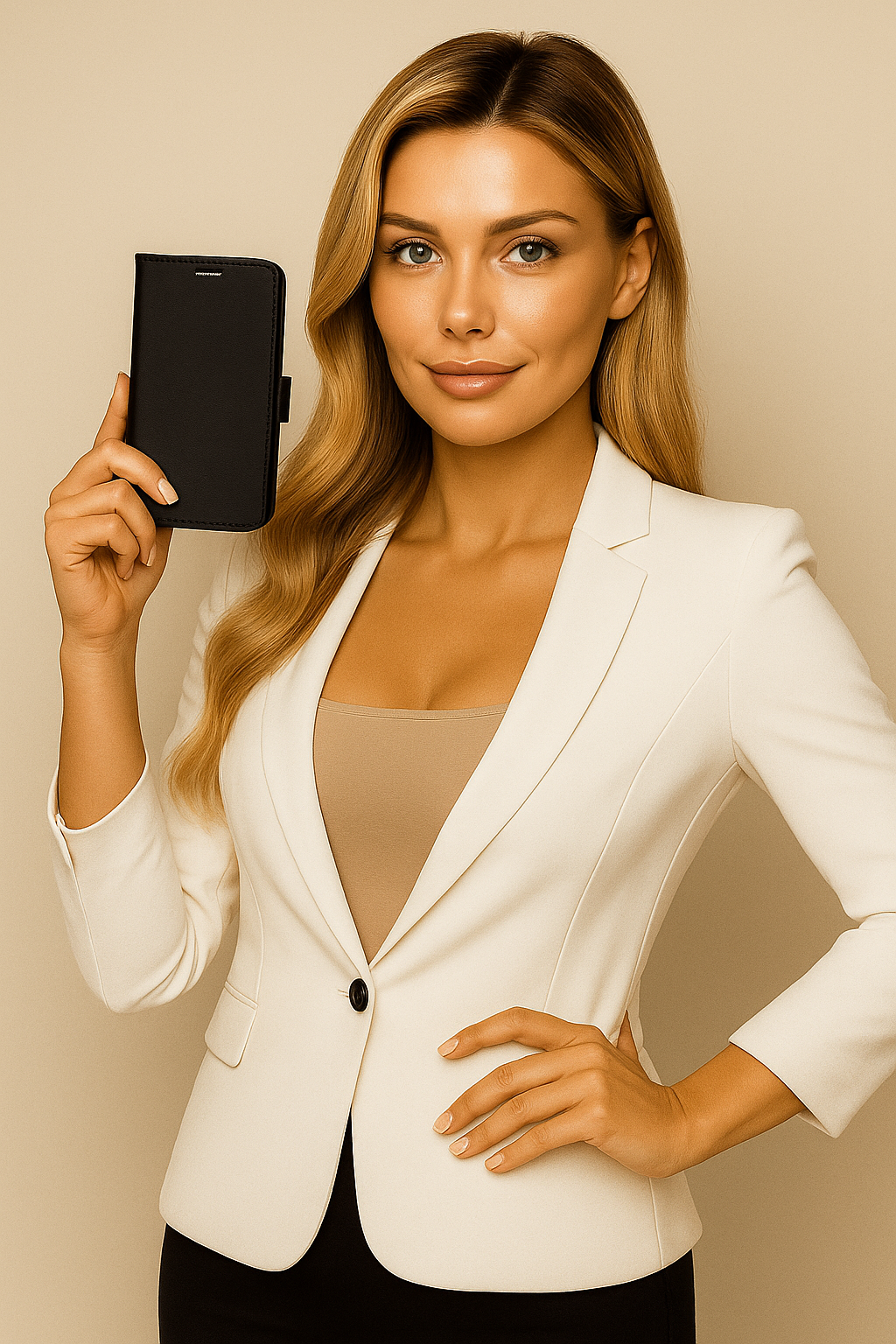
QuantaCase Usage Guide
QuantaCase Usage Guide
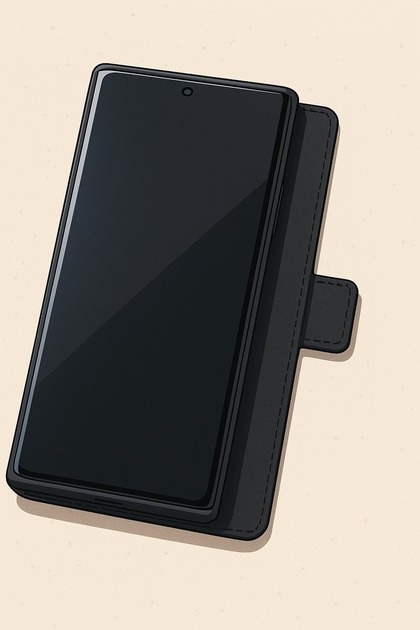
📴 Speakerphone Use
👉In this image, the QuantaCase’s front cover is flipped behind the phone, creating a small lip. This feature allows you to hold the phone without needing to grasp it in your palm, reducing the amount of radiation absorbed by your hand. Keep it away from the body when speaking hands-free.
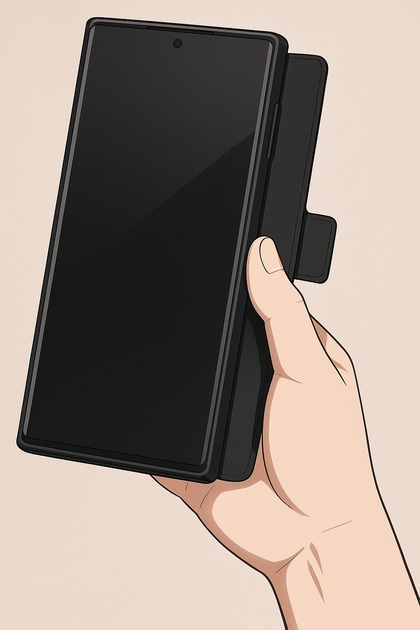
🤌 Speakerphone Hold
👉This image shows how to hold the phone comfortably with the QuantaCase on speakerphone mode. Notice how your thumb rests on the extended lip, providing a stable grip without wrapping your fingers around the phone’s sides. Speakerphone comfort, still clear audio, safe distance.
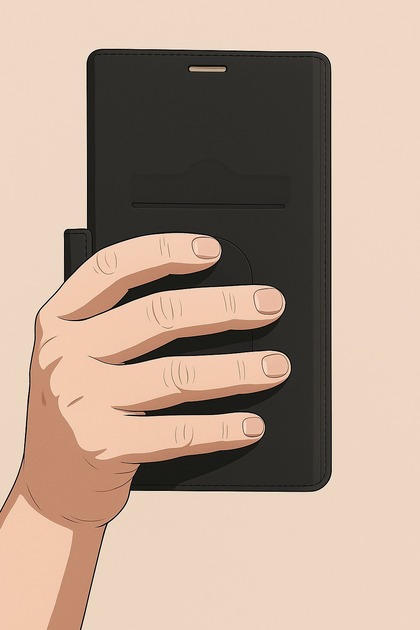
🧾 Speakerphone Hold
👉From behind, you can see how your fingers comfortably support the phone behind the microwave-shielded flap. This technique ensures a secure hold while minimizing direct contact with the phone’s sides, reducing radiation exposure. Maximum safety zone: keep exposure low with distance.

📢 Hold to Ear
👉This image demonstrates holding the QuantaCase to your ear for a private call. If circumstances require placing the phone directly against your head, always ensure the front shielding cover is closed over the front of the phone, positioning it between your head and the device. Additionally, before placing the phone to your ear, turn off all unnecessary transmitters such as Bluetooth and Wi-Fi to further minimize radiation exposure. Using your phone this way should be a last resort—whenever possible, use a headset or speakerphone for optimal safety.
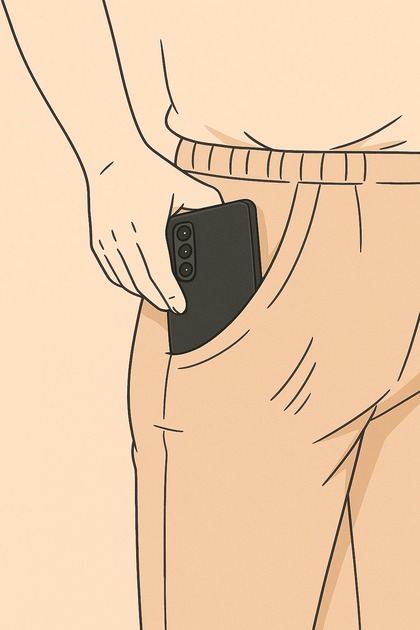
👉 Pocket Carry
👉In this image, the QuantaCase is illustrated as being placed into a pocket, highlighting the correct orientation in an unavoidable situation. QuantaCase does not recommend regularly carrying your phone in your pocket. However, if no other option exists, always ensure the front shielded cover is closed over the screen, positioned between your body and the phone, with the camera lenses facing outward. Before placing the phone in your pocket, disable all unnecessary transmitters, such as Bluetooth and Wi-Fi. As soon as you reach your transportation or destination, immediately return to using the Distance-First Protocol, keeping the phone at a safe distance to reduce radiation exposure. Avoid carrying active devices in your pocket if you are in transit, ensuring that you remain safe and comfortable at all times.
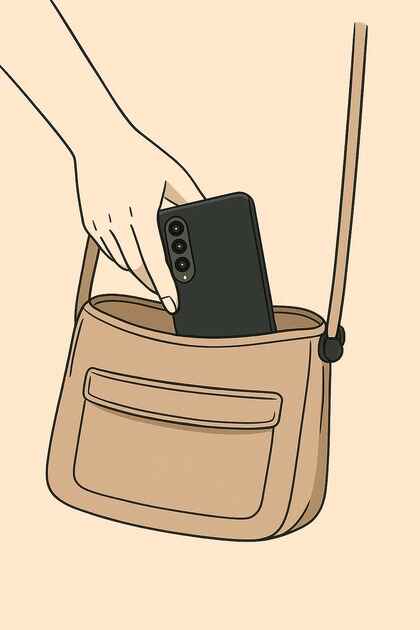
👜 In the Bag
👉For maximum safety, place the QuantaCase inside a bag or purse with the front shielded cover facing toward you. This ensures the shielding layer remains between you and the phone, reducing radiation exposure. For men, using a briefcase or any bag is preferred over carrying the phone in your pocket. Always disable unnecessary transmitters, such as Bluetooth and Wi-Fi, before stowing the phone away.
.png)
In-Car: On Dash Not Seat or Vent
👉Use a dashboard phone holder that props a smartphone with its rear facing the windshield. By directing the phone’s main RF-emitting surface outward, the mount is intended to reduce radio-frequency (RF) reflections back into the cabin—especially useful when phones transmit at higher power (weak signal or heavy data use). The design recognizes that metal-lined, enclosed spaces (cars, buses, RVs) can act like reflective cavities, concentrating RF energy in the passenger area (a Faraday-cage effect). Actual exposure reduction will vary with phone model, transmit power, signal strength, and vehicle materials, but orienting the phone away from occupants can help minimize reflected microwave exposure inside the vehicle. dashboard phone holder
.jpg)
👉QuantaCase™ — Physics‑First EMF Case
👉What it is: QuantaCase™ is an ultra‑thin, antenna‑aware folio that uses directional shielding between you and the phone. It is free of metal loops, magnets, and steel plates and features a shielded speaker opening for the 5G era—engineering choices that avoid antenna detuning and the transmit‑power increases that can come with it.
Why it matters: Gimmicky “anti‑radiation” designs can obstruct radios and push phones to work harder. QuantaCase™ follows the physics: keep radios efficient, place the shield on the user side, and stay thin near antenna zones. Many models also include RFID‑blocking storage for cards.
How to use: For calls, flip the cover toward your head. For carry, place the shielded cover toward your body. Turn off radios you don’t need (Wi‑Fi/Bluetooth/Hotspot) to cut duty cycle in everyday use.
Learn more about QuantaCase™
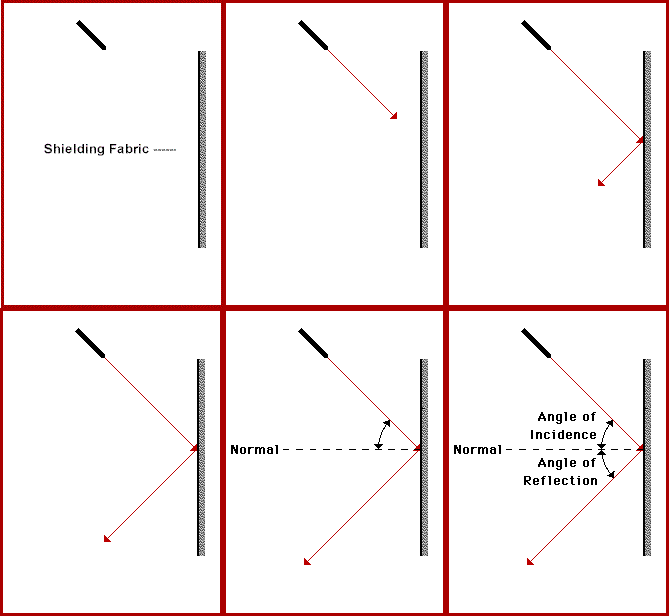
How RF Shielding Fabric Works
The “99%” shielding fabric works because it behaves like a very thin metal surface. When RF hits it, free electrons in the metalized threads are pushed into tiny currents that create an opposing field. That cancels the field on the protected side and reflects most of the energy away, so far less penetrates toward your body. The “fabric” is not magic cloth; it’s a 2D conductive sheet built by weaving polyester with micro-fine metalized filaments (often silver, copper, stainless steel, or alloys). Electrically, that weave behaves very much like a continuous conductor at RF wavelengths, because: The spacing between conductive threads is much smaller than the wavelength of the radiation. To the incident wave, it looks like a quasi-continuous conductive surface with some finite sheet resistance. So from Maxwell’s point of view, you’re looking at a thin conductor, not a porous textile.
Policy Red Flags — what to watch for
Red Flags When Shopping For Phone Cases
What to look for to ensure a genuine anti-radiation phone case
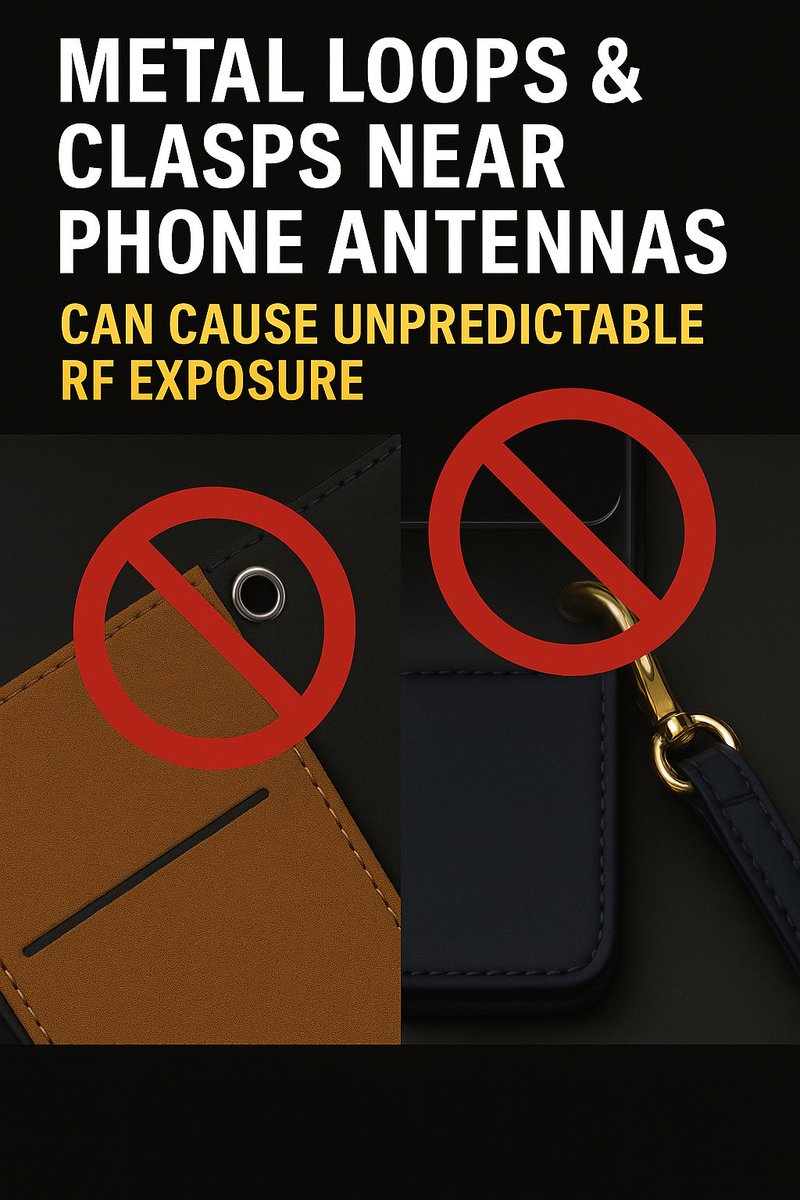
📴 Metal Loops
👉
Small metal loops, grommets, and strap clasps placed near a phone’s radiating edge act as
parasitic conductors. In the reactive near‑field they add stray
capacitance and inductance, which detunes the antenna
from its intended 50‑Ω match. Detuning raises VSWR and lowers
radiation efficiency: part of the power is reflected and part is stored around the metal
instead of being cleanly radiated. The hardware also supports induced currents and can
re‑radiate, warping the pattern and creating local E‑field hot spots
near the head. Because coupling changes with millimeters of position, angle, and band, the near‑field becomes
variable and hard to predict.
When efficiency or match degrade, link quality drops and the phone’s
power control raises uplink transmit power to hold the connection.
The result is a double hit: higher output plus a distorted near‑field right where the accessory sits.
Best practice: avoid metal rings, loops, clasps, magnets, and plates in antenna zones;
keep materials thin and non‑conductive around the radios; and place any shielding only
between you and the phone, not over or next to the antennas. https://rumble.com/v70msx2-the-silent-signal-health-risks-of-emf-exposure-and-protective-measures.html

🤌 Speaker Hole
Only QuantaCase shows true ear‑side continuity. The earpiece opening is covered by a visible, conductive mesh that bonds to the front‑cover shield. With the cover closed, the entire area between the user and the phone acts as one continuous shield while still passing sound.
Most competing folio cases leave a bare slot. That gap behaves like a small slot antenna/waveguide, especially at today’s mmWave and satellite bands, allowing fields to bypass the cover and diffract toward the head. Because the head is in the near‑field during calls, even a few millimeters of opening can leak disproportionate energy and break the shield’s current path. Effective reduction requires full‑surface shielding continuity at the ear—no unshielded holes—using thin, acoustically transparent conductive mesh.
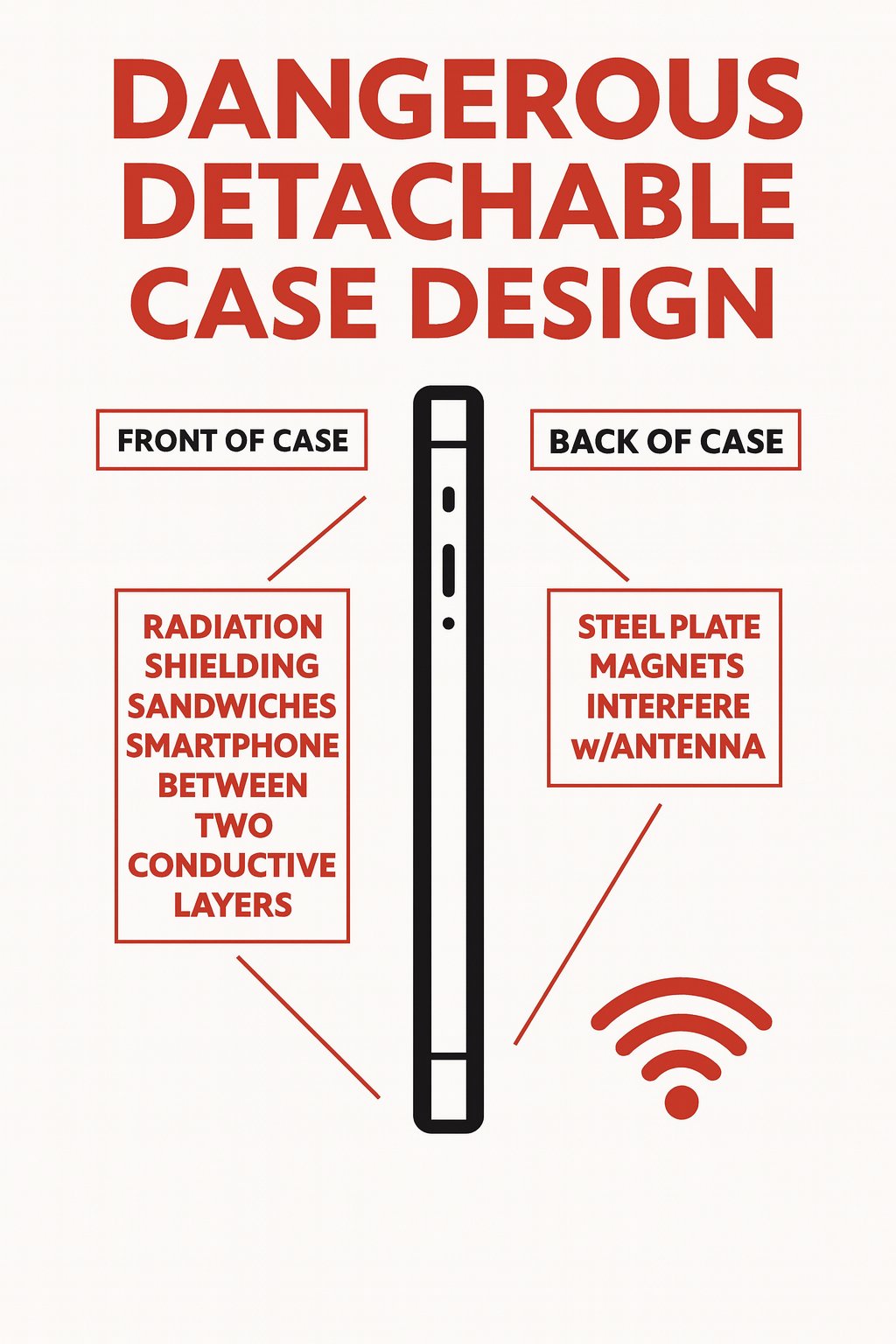
🧾 Detachable Anti-radiation Shields
👉
Why detachable “anti‑radiation” cases backfire
Many detachable folio designs—often with a front “shield” and a rear steel/magnet plate—sandwich the phone between two conductive layers.
This alters the antenna’s boundary conditions, shifting resonance and degrading the impedance match
(poorer return loss / higher VSWR). The result is lower
radiation efficiency and pattern distortion right next to the user.
When efficiency and link quality drop, the phone’s power‑control system increases
uplink transmit power to maintain the connection—exactly the opposite of the goal of an
“anti‑radiation” case. The engineering fix is simple: use single‑sided, directional shielding between you and the phone,
keep the back of the device free of magnets, steel plates, or other conductive hardware, and stay thin and antenna‑aware.
That preserves efficiency so the device can meet network targets at lower power with more predictable fields.
https://www.rfsafe.com/class/detachable/
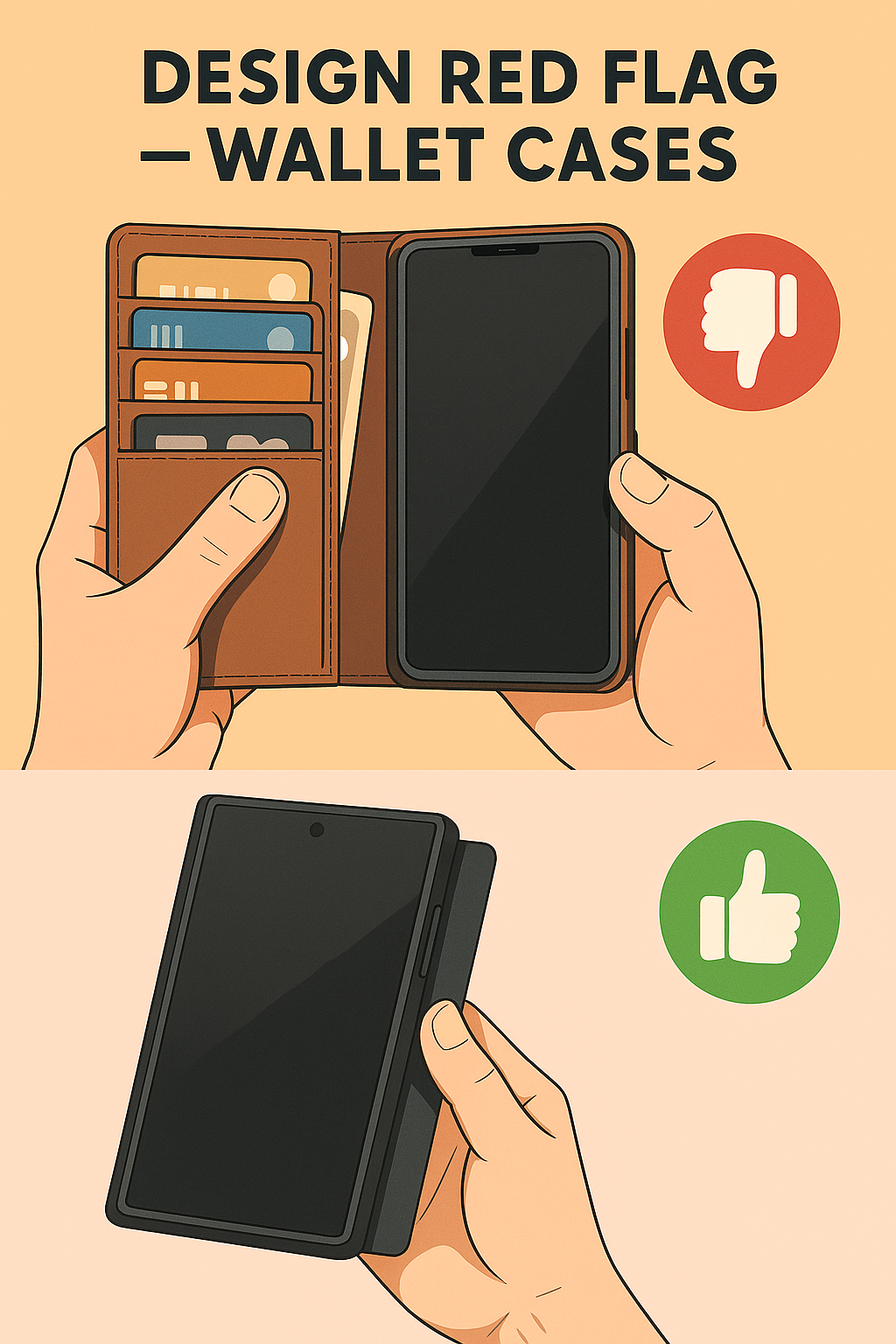
Design Red Flag — Wallet-Style Cases
👉
⚑
Design Red Flag — Wallet-Style Cases
For a shielding flip case to work, the cover has to flip all the way around behind the phone
so the shield sits between the phone and your head or body. As soon as the cover is turned into a
wallet—stuffed with cards, cash, and receipts—you’ve created a flap that is heavy, stiff, and awkward
to flip on every call or text. In real life people stop doing it. They talk with the cover hanging open,
or they leave it closed like a mirror in front of the screen, which means the shield is almost never
in the right place when the phone is transmitting.
Those extra wallet layers are not just inconvenient; they are also thick, lossy material right in
the antenna zone. Add card chips, metal strips, or magnetic closures and you further detune the
antennas, pushing the phone to use higher transmit power to hold the link. A physics-first
design keeps the front cover ultra-thin and single-purpose: no bulky wallet features, no
magnets or plates—just a light, easy-to-flip shield that makes the correct “flip-to-shield” habit
natural instead of a chore.
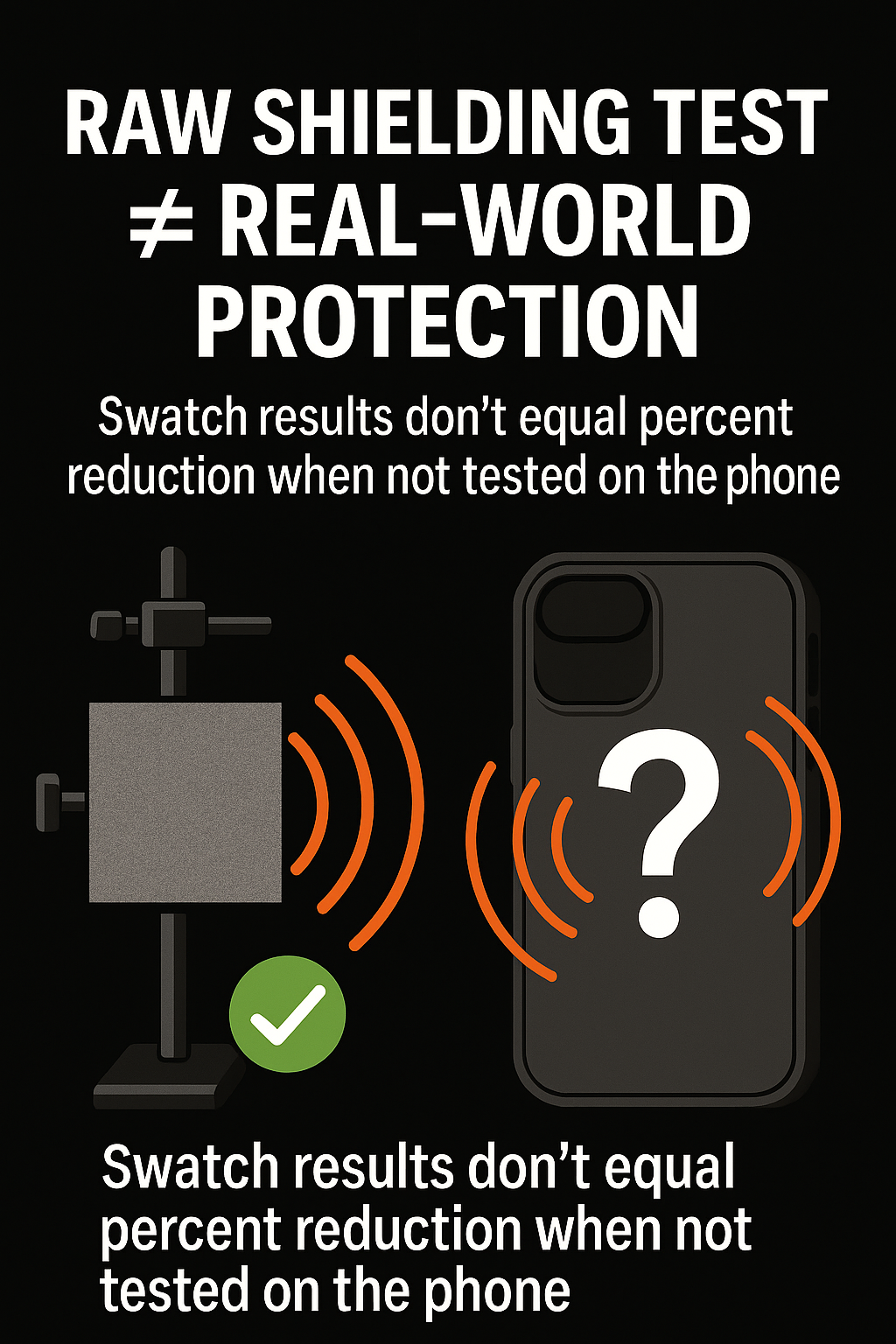
📢 “99% Blocking” Claims are BS
👉
Why “99% blocking” swatch tests don’t equal protection
Many ads cite “FCC‑certified testing” of a small fabric or foil coupon.
An FCC‑accredited lab can measure how a flat sample attenuates a test signal in free space,
but that data does not represent a phone in use. Real phones use multiple antennas and bands,
operate in the near‑field of the head/body, and continuously adjust transmit power to maintain the link.
A material that blocks well on a bench can detune antennas or increase path loss in the case,
prompting the phone to transmit harder and creating irregular, posture‑dependent fields.
A swatch percentage is therefore not a dose‑reduction number.
What matters is in‑device performance: tests with the finished case on the actual phone,
in calling and data modes, with realistic postures (cover closed toward the head/body) and across the phone’s bands.
Useful system checks include total radiated power (how much the phone emits),
SAR, and near‑field mapping, plus observation of power‑control behavior.
TruthCase focuses on shield placement, antenna‑aware thin design,
and reduced duty cycle—because real‑world reduction comes from physics‑correct orientation and efficient radios,
not from a fabric swatch tested in isolation.
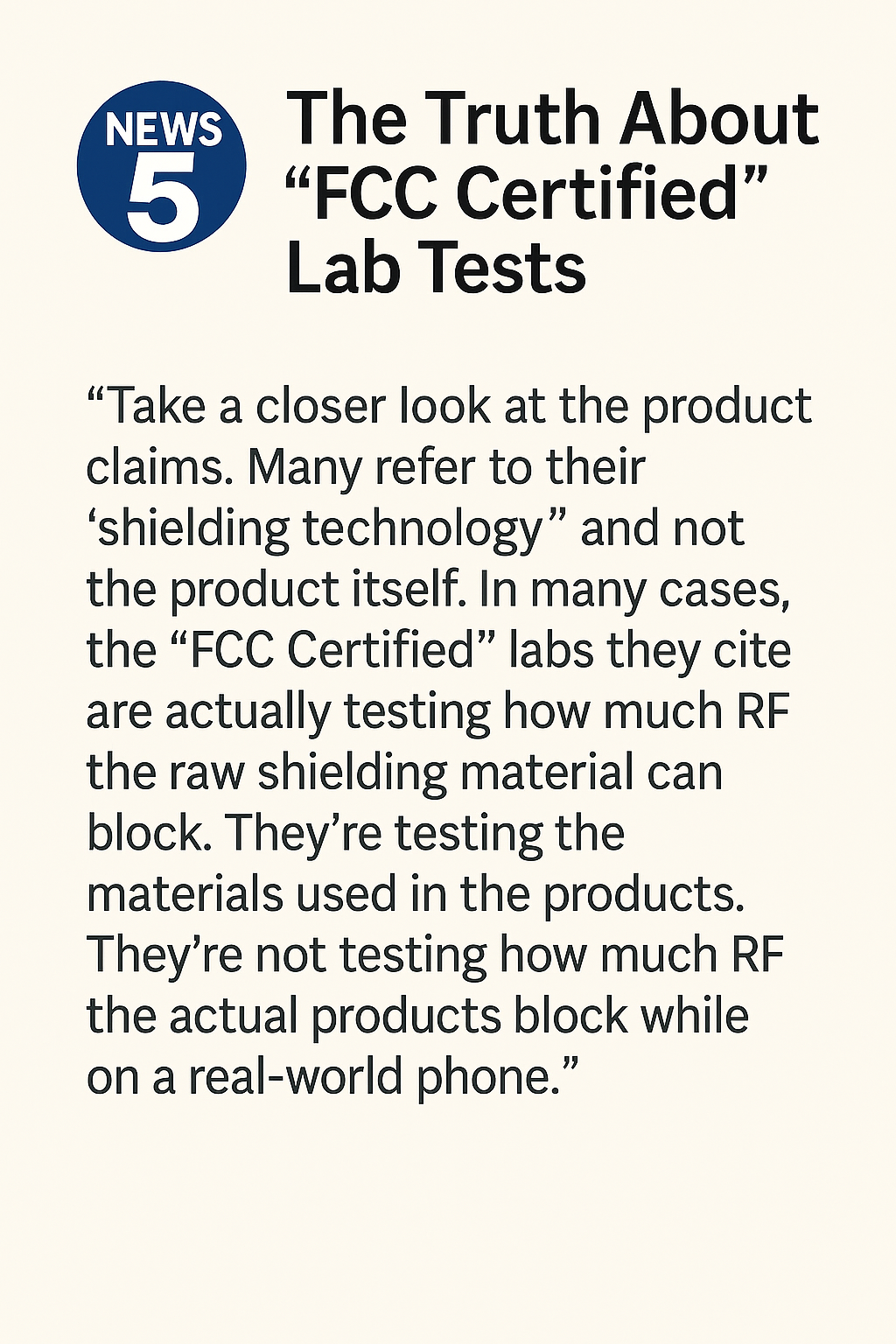
👉 KPIX 5 on “FCC-certified” lab tests
👉
KPIX 5 on “FCC-certified” lab tests:
local news investigators found that some case makers cite
FCC-accredited labs that only measure how much RF a
raw shielding swatch blocks – not how much RF the
finished case on a real phone actually reduces.
https://www.youtube.com/watch?v=iA7yP8V0SCQ
That kind of coupon test can produce big “99% blocking” numbers in ads,
but it tells you nothing about antenna detuning, power-control
behavior, or near-field exposure next to your head. Real protection
has to be proven in-device, with the phone and case tested together in
realistic use.

👉Policy Red Flag — Section 704 (1996 Telecom Act)
⚑
Policy Red Flag — Section 704 (1996 Telecom Act)
Section 704 says that if a wireless facility meets FCC RF limits, local governments
“may not regulate … on the basis of the environmental effects of radiofrequency
emissions.” In practice this works like a federal gag rule: city councils and
school boards are blocked from citing health evidence when they review tower sites
or small-cell permits. Critics argue that this undermines the spirit of the
First Amendment (truthful risk information on the public record) and the
Tenth Amendment tradition that protection of health and safety belongs first
to states and communities.
At the same time, allowing antennas almost anywhere on outdated 1996 “thermal-only”
limits raises a Fifth Amendment concern: RF fields are imposed on homes,
schools, and small businesses with no real way to refuse or be compensated. The
revenue from wireless service is privatized, while the long-term costs—exposure,
property-value loss, and any health or ecological impacts—are pushed onto families
and neighborhoods. That is why Section 704 is a major policy red flag for
anyone serious about RF safety.
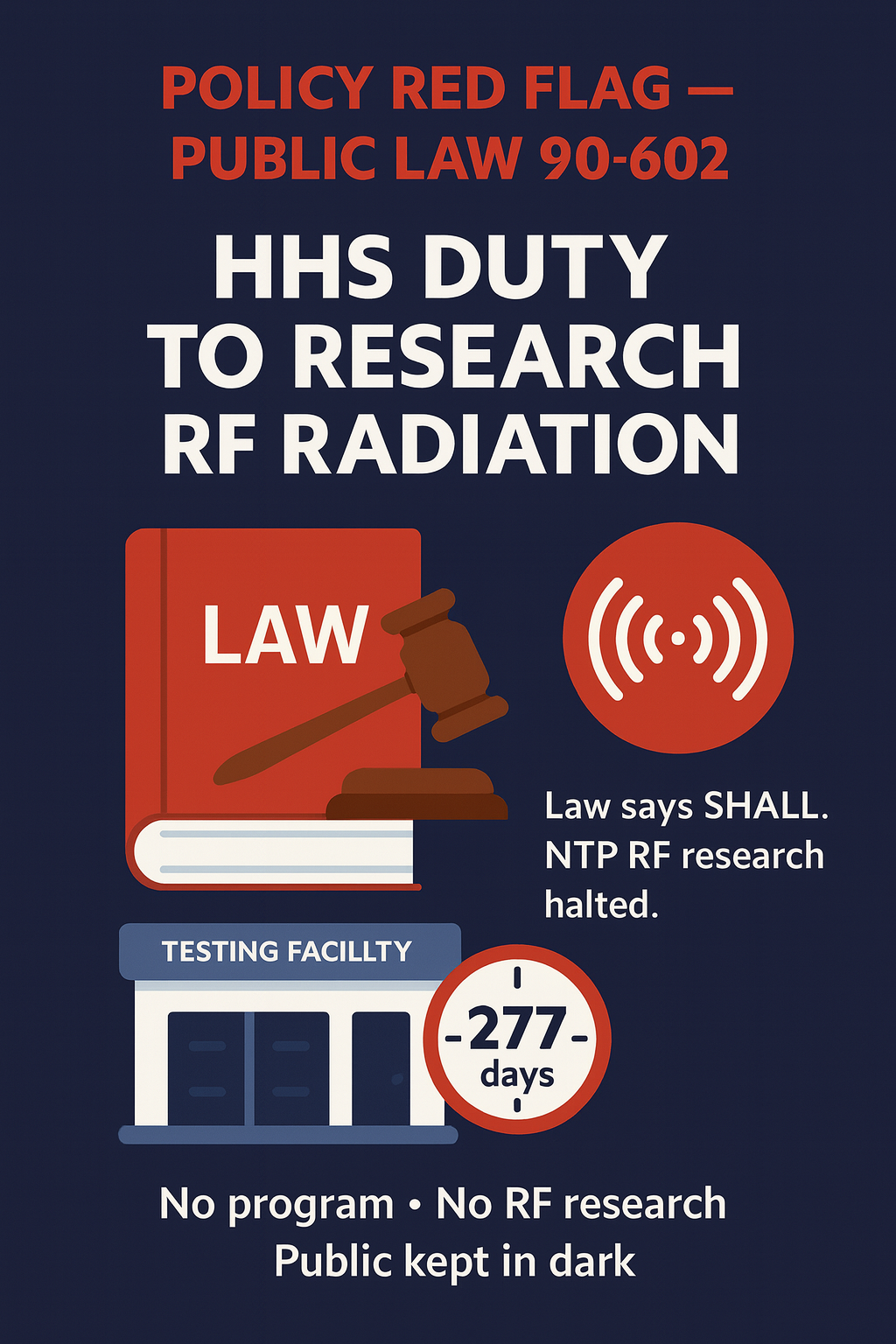
👉Policy Red Flag — Public Law 90-602 (Radiation Control Act)
👉
⚑
Policy Red Flag — Public Law 90-602 (Radiation Control Act)
Public Law 90-602 is not a suggestion. It says the HHS Secretary shall establish and carry out
an electronic-product radiation control program, and shall plan, conduct, coordinate, and
support research to minimize emissions and exposure, then keep the public informed. That duty covers
non-ionizing RF from wireless devices and infrastructure just as clearly as X-ray machines or lasers.
With the National Toxicology Program’s RF studies halted, there is no active federal RF bioeffects program
that meets the statute’s “shall” language. Each day without a restart is another day of
non-compliance and another day families, schools, and workers go without the independent
research and public reporting the law requires. If you care about honest risk assessment and future-proof
safety standards, HHS’s failure to enforce PL 90-602 is a serious policy red flag.
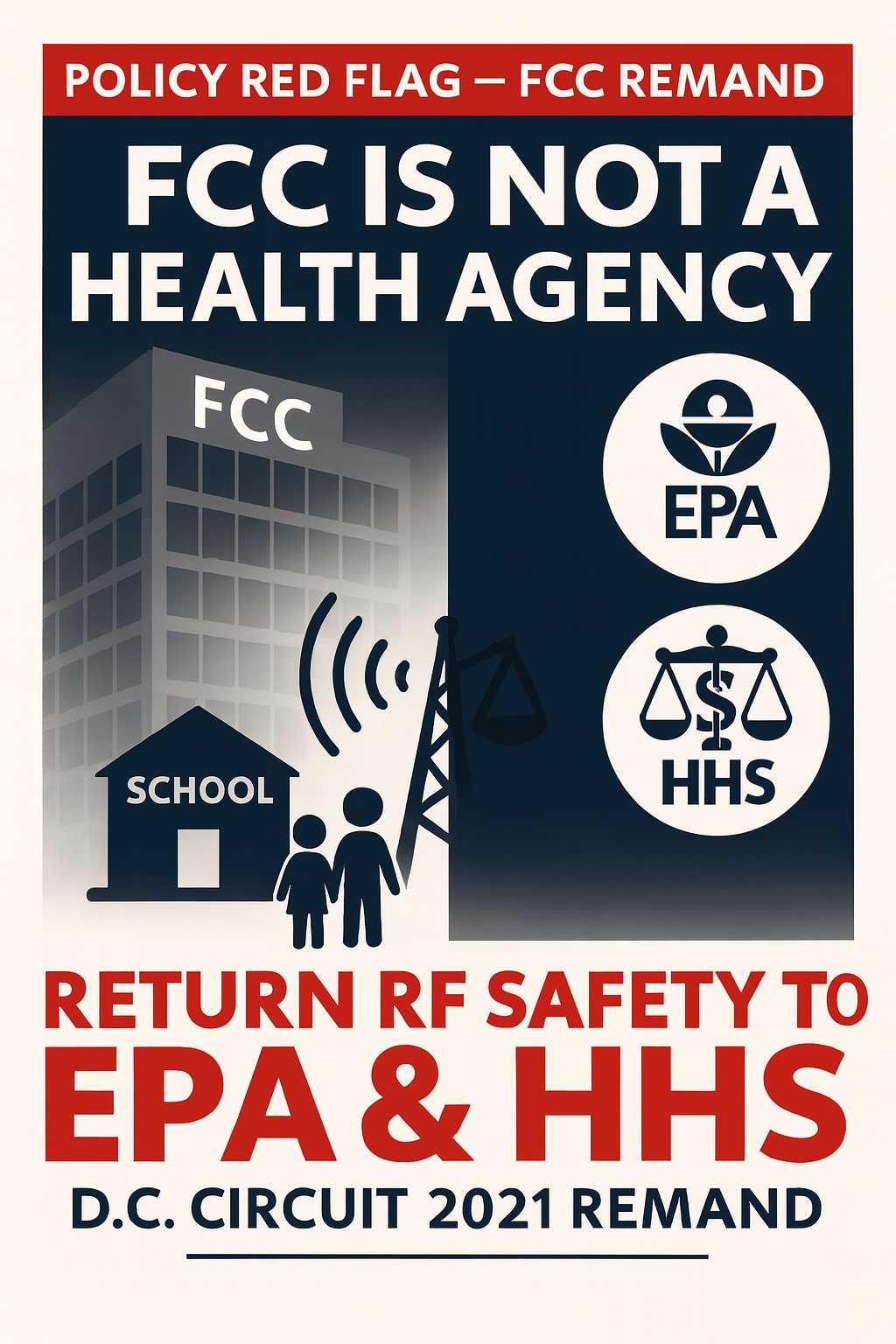
👉Policy Red Flag — FCC Remand (Environmental Health Trust v. FCC)
👉
⚑
Policy Red Flag — FCC Remand (Environmental Health Trust v. FCC)
In 2021, the D.C. Circuit held that the FCC’s decision to keep its 1996 heat-only RF limits
was “arbitrary and capricious” and sent the issue back to the agency. The court directed the FCC to give a
reasoned response on long-term exposure, non-thermal biological effects, child-specific risks, and
environmental impacts – not just repeat talking points. Years later, families still have no transparent,
science-based explanation that resolves those questions while antennas continue to proliferate around homes and
schools.
This remand highlights a deeper problem: the FCC is a spectrum and industry regulator, not a
health agency. Its institutional incentives and expertise are aligned with auctions and deployment, not
bioeffects and pediatrics. We therefore argue that RF health leadership should move to EPA and HHS,
which have radiation-protection and public-health mandates, while the FCC remains the spectrum manager. A
court-compliant response means EPA/HHS-led risk assessments, open data, independent scientific review, and
interim protections for children – not another decade of silence from a non-medical agency sitting on a federal
remand.
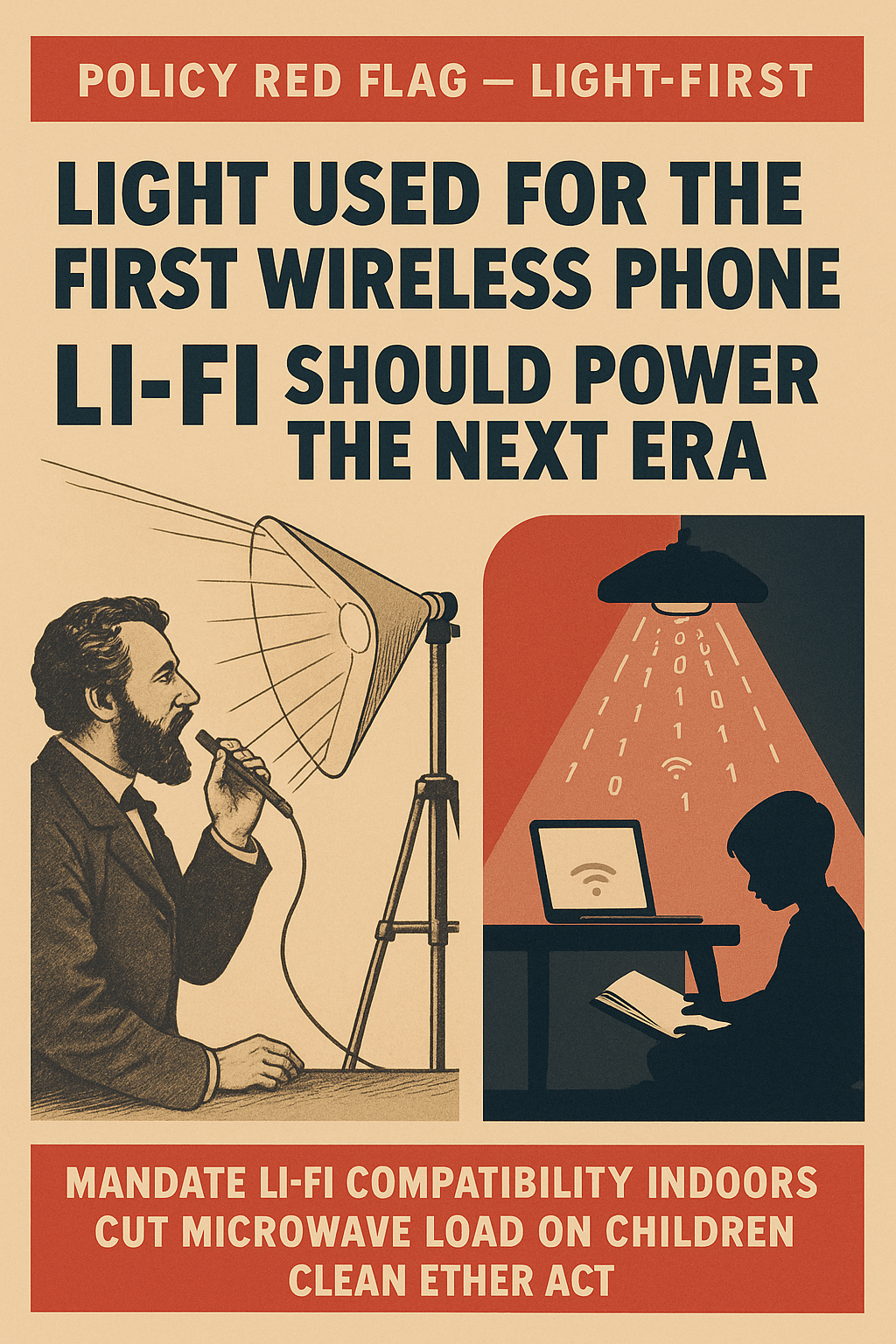
👉Light-First — Li-Fi Compatibility & the Clean Ether Act
👉
⚑
Light-First — Li-Fi Compatibility & the Clean Ether Act
Long before radio towers, the first wireless phone used light. Bell and Tainter’s
Photophone sent voice on a beam of sunlight, and today’s Li-Fi can carry modern data
payloads the same way, using LEDs and photodiodes instead of microwave transmitters. Any claim that
“light isn’t feasible” ignores both history and current engineering: optical wireless already supports
high-throughput, room-scale links with tight spatial confinement, low latency, and strong security.
A Clean Ether Act simply finishes what Bell started: indoors and around children,
sensitive adults, and pregnant women, make light the default carrier and keep RF as the
low-power backup. That means mandating Li-Fi compatibility in phones, tablets, laptops,
access points, and school networks so indoor traffic rides on photons instead of saturating classrooms and
bedrooms with microwaves. With solid-state lighting, mature Li-Fi standards, and even patented
“bio-defense” Li-Fi concepts that add pathogen control, there is no technical excuse left.
The only thing between our kids and the Light-Age is political will.